首頁Morgan

搜尋歷史
熱門搜尋
經銷商登入 / 註冊

When the domestic car market is deeply stuck in stock competition, the incremental logic of Chinese car companies is being rewritten. Chery Group's "double breakthrough" report card for September, not only refreshes the single-month export record of China's automotive industry, but also unusually received capital endorsement from international investment banks.
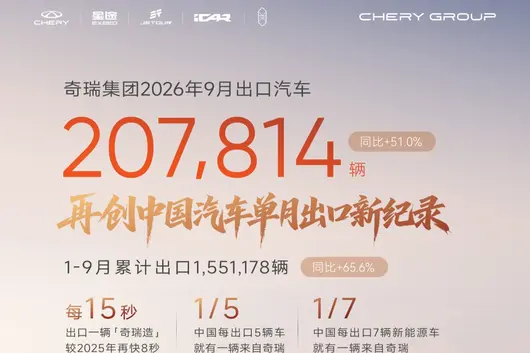
 Data shows, Chery Group's single-month export volume reached 207,814 vehicles in September, a year-on-year increase of 51%. This means, in the just passed month, on average every 15 seconds, a car bearing a Chery badge drives overseas. What is more worth noting is, cumulative exports from January to September reached 1,551,178 vehicles, this figure has surpassed its total export volume for the whole year of 2025, a cumulative growth rate of 65.6% appears particularly noticeable in the current macro environment.
At the end of September, JPMorgan released a research report, covered Chery Automobile for the first time and issued an overweight rating, listing it as the preferred target for Chinese passenger cars. In the capital market, ratings backed by real money are often more persuasive than companies talking to themselves. The core reason given by JPMorgan is, Chery's overseas business has evolved from pure trade exports to the local operation stage, and formed a scale-based profitability platform.
 A qualitative leap from going out to rooting down
For a long period in the past, the outside world's impression of Chinese car going overseas often stayed at cost-effectiveness and Asia-Africa-Latin America markets. But Chery's September report card is breaking this stereotype.
A representative one is the UK market. In September, Chery's single-month sales volume in the UK reached 32,823 vehicles, taking the UK monthly brand sales champion for the second consecutive month. In such a strict regulation, traditional automotive industry extremely mature European core market, JAECOO 7 topped the sales list of all models, JAECOO 5, OMODA 5 also made it into the top 10. In other words, for every 10 new cars sold in the UK, 1 comes from Chery.
This breakthrough is not an isolated case. Jan-Aug, Chery cumulative sales in 24 European countries reached 234,000 vehicles, year-on-year growth of 193%, among which new energy models account for nearly half and growth rate exceeded 3 times. Being able to achieve scale breakthrough in a high regulatory threshold market like Europe, indicates China car's competitiveness is no longer limited to price dimension, but truly touches the comprehensive competition of product power, brand power, and compliance capability.
 New Energy: From Overflow to Engine
Another change worth deep thought for the industry is the role conversion of new energy going overseas. Data shows, Jan-Sept Chery exports new energy vehicles 529,337 vehicles, year-on-year increase 136%. Currently, for every 7 new energy vehicles exported by China, 1 comes from Chery. Behind this proportion, is the collaborative overseas expansion of multiple new energy brand matrices such as OMODA & JAECOO, iCAR, Zhongheng. From Thailand, Malaysia to Saudi Arabia, UAE, Chery's new energy products are establishing segment advantages in markets at different levels.
JPMorgan specifically mentioned in the report, it is expected that Chery's new energy penetration rate and gross margin will increase significantly. This actually points out a breakthrough trend in the industry, new energy going overseas is turning from a channel for domestic capacity overflow, into the core engine for Chinese car brands to achieve high-end and intelligent image output.
 Industry Implications Behind Capital Favoritism
Looking at Chery's recent global actions, whether it is brand topping in the UK market, or 3 car models winning the Turin Design Award, or the investment in global top 10 styling centers and thousands of design teams, all point to the same direction: Chinese car overseas logic is upgrading from selling products to outputting brands and systems.
The positive ratings given by JPMorgan and other institutions, are essentially pricing this systematic overseas capability. When overseas business can contribute continuously growing revenue and profit, the valuation model of Chinese car enterprises needs to be re-examined.
From cumulative export volume first breaking 7 million vehicles, to single-month exports reaching a new high again, to obtaining preferred target certification from international capital, Chery's globalization path provides a new sample. In the big exam of globalization, the real moat is not a certain hit model, but the depth of local operations, the breadth of product matrices, and the adaptability to cross different market cycles.

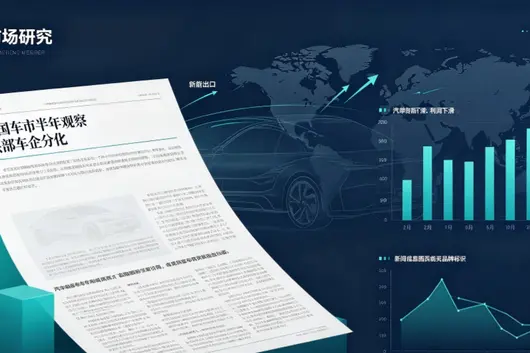
In September 2026, overseas investment bank JPMorgan released the latest industry research report regarding the Chinese passenger car market, giving an overall prudent assessment on the domestic vehicle sector, only prioritizing BYD and Geely, two car companies with scale, diversified products, and globalization capabilities. The underlying motive is the H1 2026 financial reports of domestic car companies just released.
The prudent tone of this report is not groundless speculation, but based on the actual operating results of the domestic auto market in H1 2026. Official data from CAAM is right in front: Total domestic car sales in H1 were 15.017 million, down only 4.1% year-on-year. Market volume remains huge, consumer demand has not collapsed. But opening mainstream car company financial reports, the industry's profit system almost collectively collapsed: net profit basically fell across the board, over half of car companies fell into loss, many old top players shifted from profit to loss.
Many people think the difficulty in the car market is "can't sell". The real status is: cars are still sold, just thinner margins, deeper losses the more it sells.
The biggest abnormal reversal in the H1 car market this year: growth was all in revenue and sales, collapse was all in profit.
Among 16 mainstream listed car companies, only Leapmotor, NIO, JAC, BAIC BluePark had net profit indicators achieve year-on-year positive growth. But this group of bright data is completely a "verbal trap": the latter three didn't profit at all, just loss width narrowed, book still losing money. Only Leapmotor truly profited and profit surged in the whole industry.
More terrifying than losses is profit regression. Seres, Li Auto, Voyah, BAIC Motor four last year still steadily made money. This year H1 collectively shifted from profit to loss, directly fell from profit tier into loss quagmire. Market iteration speed far exceeded everyone's imagination.
More subversive to cognition is: even the industry absolute leader, cannot withstand this profit winter.
Take BYD as example. As the industry profit ceiling, it is still the only one in the whole industry with net profit over 10 billion. Basic market share no one can shake. But vertically compared to same period last year, decline data glaring to the naked eye: H1 revenue 344.815 billion yuan, year-on-year 7.13%; net profit attributable to parents 12.325 billion yuan, year-on-year significantly down 20.54%, gross margin fell back to 18.85%.
Simple calculation reveals the truth: BYD sales still leads globally, but vehicle profitability is continuously shrinking. Domestic price war has precisely pierced the leader's profit floor.
If BYD is "earned less", then Great Wall Motor is "earned it all away", perfectly confirms the dilemma of traditional car companies.
Great Wall this year seems comprehensive improvement: H1 sales 575,800 vehicles, year-on-year slight increase 1.22%; revenue first exceeded 100 billion in H1, reached 102.101 billion yuan, year-on-year realized positive growth. Sales, revenue double increase, should be a favorable report card. Result profit directly halved then halved again: net profit attributable to parents only 2.465 billion yuan, year-on-year plummeted 61.11%.
Car companies have entered the distorted stage of "volume without profit, revenue increase without profit increase". Surface sales red fire, inside profit already riddled with holes.
In the industry full loss tide, uniquely killed out a counter-trend steady outlier, again subvert industry cognition.
Geely Automobile became the head only steady basic market share car company: H1 sales 1.423 million vehicles, year-on-year slight increase 1%; revenue 173.6 billion yuan, year-on-year surged 14.67%; net profit attributable to parents 9.09 billion yuan, only slightly down 1.79%, gross margin stable at 17.90%.
In the large environment of full industry profit plummet, nearly zero decline profit performance appears especially scarce. Its counter-cyclical logic is very clear: Zeekr high-end models volume boost lift product average price, overlay overseas exports continuously increase revenue. Using product upgrade + globalization, hedged against domestic fierce price war. This is also the core direction for subsequent car companies to break the situation.
Many people doubt: Sales didn't drop big, where did the car companies money go lost? Two full industry common reasons, reveal the answer.
First, manufacturing costs fully up, squeeze full industry gross margin. Lithium carbonate, chips, copper, aluminum etc raw material prices rose, directly lift per-vehicle manufacturing cost. NIO's Li Bin openly admitted: compared to end of last year, this year Q2 per-vehicle cost up 14,000 yuan. H2 will also up 2,000 yuan again.
Cost up treat all car companies equally, but leader can rely on scale, supply chain advantage hedge. SMEs, new forces can only hard carry. Loss naturally continuously expand.
Second, currency fluctuation violently, swallow overseas car companies profit. Now head car company overseas ratio extremely high. Chery export ratio about 70%, Great Wall over 50%, BYD, Changan over 40%, Geely, SAIC over 30%.
Great Wall's Wang Xingjun directly points out profit down key: Overseas tax subsidy payment delay, currency fluctuation drag performance. But most key reversal is here: excluding exchange rate, one-time gains/losses, most head car companies real profit actually in big surge.
Data won't lie: SAIC adjusted core net profit 7.87 billion yuan, year-on-year surge 72%; Changan adjusted profit year-on-year growth 12%; Geely adjusted core net profit 9.68 billion yuan, year-on-year big increase 46%.
This means, car companies main business earning ability didn't collapse. Just short-term external factors covered real strength. Globalization long ago not bonus, but car company survival core trump card.
More key incremental fact is: Overseas market not only risk avoid, but also earn higher profit.
BYD H1 overseas revenue 181.268 billion yuan, year-on-year surge 33.9%, account for total revenue half more. JPMorgan precise calculation: BYD domestic vehicle profit about 10,000 yuan, overseas vehicle profit over 20,000 yuan. Profitability is domestic market two times. With Hungary, Indonesia, Brazil overseas factories continuously ramp up, overseas high profit bonus will continue release.
Also precisely saw through this industry underlying logic, JPMorgan gave extremely sober differentiated judgment: Keep prudent on Chinese passenger car industry overall. Not blindly bullish. Only long term firmly first choice BYD, Geely two leaders. At the same time strategy bullish counter-cyclical heavy truck track.
Current car market, long ago said goodbye to "Sales is King" era.
2026 H1 Report given ultimate answer very cruel: Domestic involution kill profit, overseas increment save company. Car companies only can in domestic price cut involution, being market eliminated. Holding scale, diversified product, globalization layout leader, crossing industry winter.
This thunderous car market reshuffle just started: Sales decide hype, profit decide life and death, overseas decide future.
Source: Car Observer