


首頁Model Y (Overseas)

搜尋歷史
熱門搜尋
經銷商登入 / 註冊

Once the China Passenger Car Association released the pure electric retail ranking for the first half of 2026, the industry finally saw the true temperature of the market. The top ten seats underwent a complete shake-up, with long-standing top models collectively diving. Seagull, Qin PLUS, and other former top hits fell out of the head lineup, replaced by all-new products concentrated on the market in the past year. Many people say the pure electric market is not doing well, but looking closely at the data reveals that what is not doing well are old products, low price points, and stock models without technology. Truly new products that hit users' core needs are still surging against the trend.

No.1 Geely Star Wish
Geely Star Wish, which took the pure electric sales crown for the first half of the year, has mixed feelings. The result of 194,000 units looks impressive, but actually decreased slightly by 5.3% year-on-year. Against the background of the overall contraction of the entry-level pure electric market, holding onto this volume is already considered a win. This 60,000-level A0-class small car has ranked at the top for 16 consecutive months, the core being that it solves the pain points of commuter cars to the extreme. Rear-drive architecture, independent suspension, CATL cells, and fast-charge configurations are fully loaded on all models. Using superior specifications, it beats competitors at the same price point. Cumulative sales exceeded 800,000 units in less than two years.
Conversely, the 50,000 to 100,000 market is continuing to shrink. Leapmotor and other competitors have entered with lower prices and higher configurations. Plus, car profits are thin as razor blades. Star Wish's domestic market share has basically hit the ceiling. The next incremental growth can only be supported by overseas markets.

No.2 Tesla Model Y
Tesla Model Y, ranked second, sold 172,500 units in the first half of the year, with a slight increase of 0.6% year-on-year. It barely held onto its basic market position amid the blockade of domestic models. As the industry benchmark for the 250,000 to 300,000 pure electric SUV market, Model Y's core competitiveness has never been interior configurations, but mature powertrain systems, a supercharging network spread across the country, and Tesla's brand premium. Many family users choose it for peace of mind and value retention.
However, with new products from Li Auto, Xiaomi, and AITO taking turns siphoning users, Model Y's growth has long entered stagnation. The latest news is that the high-performance version of this car has completed MIIT declaration. It will likely maintain sales with facelifts and price adjustments in the second half of the year, but it is highly probable that its overall market share will continue to be eroded.

No.3 Li Auto i6
Li Auto i6 reached third place with 120,400 units, the brightest dark horse in the first half of the year, and marked that Li Auto's pure electric transformation is fully completed.
This 250,000-level family pure electric SUV completely continues Li Auto's product logic oriented towards family users. It does not compete on paper data like 0-100 km/h acceleration, but makes 800V high-voltage platforms, dual-chamber air suspension, and advanced intelligent driving standard configurations. It maximizes space, comfort, and energy replenishment efficiency, precisely hitting the pain points of urban family users.
Since its launch, this car has had monthly sales exceeding 20,000 for four consecutive months, directly accounting for 62% of Li Auto's total sales, siphoning its own extended-range L series. However, the 200,000 to 300,000 pure electric SUV market is the most competitive track this year. New products are flocking to the market in the second half of the year. It is not easy for the i6 to maintain current sales levels. Later, it will depend on new products like the i8 to take over.

No.4 Xiaomi YU7
Xiaomi YU7, as a popular model, sold 104,600 units in the first half of the year, ranked fourth. As a brand-new car launched only half a year ago, this result has exceeded industry expectations. This mid-size SUV focusing on sports and family, relying on Xiaomi's ecosystem traffic, reached a peak of nearly 38,000 units in the first month after launch, directly breaking the market pattern at the same price level.
However, the subsequent trend can be described as opening high and closing low. After the heat subsided, sales declined month by month until June, relying on the launch of the standard version and employee internal purchase discounts to return to the ten-thousand club. Ultimately, the 200,000-level pure electric SUV track is too competitive. Tesla Model Y is above, and cost-effective brands like Leapmotor are below. YU7's product strength has not pulled an absolute gap. Next, Xiaomi's focus will shift to its extended-range series. YU7 will likely maintain steady sales, making it difficult to replicate the explosion in the early stages after launch.

No.5 BYD Yuan UP
BYD Yuan UP sold 82,700 units in pure retail sales in the first half of the year, increasing by 14.7% year-on-year, making it BYD's new backbone in the entry-level pure electric market. It gained volume because it took over from Yuan PLUS. The old Yuan PLUS saw a cliff-like drop in sales. Yuan UP used lower pricing, newer designs, and BYD's mature powertrain system to quickly fill the market gap for pure electric SUVs under 100,000.
Plus, BYD's service network spread across the country and the reputation of Blade Batteries have extremely strong attraction for mass market users. However, there is bad news: Leapmotor A10 has overtaken Yuan UP in retail volume for two consecutive months. It is advancing step by step with a cost-effective strategy of larger space and higher configurations. In the second half of the year, it will be quite difficult for Yuan UP to continue climbing. It will likely hold its current market share and maintain stable output through capacity ramp-up.

No.6 Xiaomi SU7
Xiaomi SU7 sold 80,500 units in the first half of the year, dropping 48.3% year-on-year, with the ranking falling to sixth. The main reason is that the replacement gap dragged it down. At the beginning of the year, the old SU7 was discontinued to pave the way for the new model. Two months of delivery vacuum directly lowered the total for the first half of the year. After the new generation model was launched in March, it quickly returned to a monthly sales level of 20,000+, remaining the benchmark for 200,000-level pure electric sedans.
As Xiaomi's founding work, SU7 thoroughly opened up the capacity of the niche sports car market, even siphoning users from BMW 3 Series and Tesla Model 3. However, the sports car market itself has a low ceiling. Plus, with more and more competitors, SU7's sales have basically hit the upper limit. Next, it will be more about stabilizing output as the brand's basic market. The stage of explosive growth has passed.

No.7 NIO ES8
NIO ES8 accumulated 78,600 units in retail sales for the first half of the year, ranking seventh, being the absolute sales king in the high-end market above 400,000. The fully new ES8 can fight, the core is hitting the pure electric replacement demand of high-end family users. The swapping system solves energy replenishment anxiety. Luxury and service experience crush same-price BBA fuel cars. Users accounting for more than 97% are exchange/purchase users, of which 60% come from BBA owners.
Less than a year after launch, the new ES8 cumulative delivery broke 120,000 units, ranking the large SUV sales champion for six consecutive months, hard撑着 (proping up) the market capacity of the high-end pure electric market. Next, its own lower-positioned ES9 has already siphoned many users after launch. The 6-seater version has just started reservations. Plus, the high-end market itself has limited capacity. ES8's main goal for the second half of the year is to hold onto the basic market of the high-end market.

No.8 Wuling Hongguang MINI
Once the national god car Hongguang MINI EV sold only 72,800 units in the first half of the year, dropping 57.4% year-on-year, falling directly from the top spot to eighth. It is known as the most tragic fall among old models.
The loss of speed of Hongguang MINI is not caused by a single reason. On one hand, the A00-class microcar market is contracting overall. Adjustment of purchase tax policy has significantly shrunk the cost-performance advantage of low-price cars. On the other hand, user consumption upgrades are obvious. Adding 20,000 can buy a small car with larger space, higher configuration, and longer range. Many users who watched MINI EV finally bought Bingo, Star Wish. Wuling itself is clear about the problem. The fifth-generation model changed to a four-door structure, added fast charging and safety configurations, but it still could not stop the downward trend.

No.9 Changan Qiyuan Q05
Changan Qiyuan Q05 sold 71,600 units in the first half of the year, breaking into ninth, a true comeback dark horse.
This car had little presence last year. After price reduction and configuration increase in April this year, it took off directly. It pulled the entry-level range to 506km, even downgraded laser radar to the 80,000 level. Using a "technology equity" strategy, it precisely hit the pain points of home users. It sat firmly as the pure electric compact SUV sales champion for three consecutive months. Changan's capacity also kept up with the rhythm. After the Nanchang factory was put into production, bottlenecks were gradually relieved. The overseas market also bloomed synchronously. Thailand launched in half a month, and orders broke 3,000. After capacity is fully released in the second half of the year, Qiyuan Q05 sales still have rising space. It is expected to冲击 (attack/strive for) the first echelon of entry-level pure electric.

No.10 MG4
Ranked tenth, MG4 sold 70,800 units in pure retail sales in the first half of the year, purely relying on overseas market endorsement. This 100,000-level pure electric hatchback has been selling well in Europe for several years. It has ranked as the China-brand European sales champion for 11 consecutive years. Overseas sales share far exceeds domestic.
In the domestic market, MG4 began to gain volume gradually after its refresh last year. Rear-drive architecture and five-link independent suspension chassis quality are unique at the same price level. The MG4X version launched this year even downgraded semi-solid-state batteries. The technology普惠 (universal benefit) strategy was very effective. Domestic monthly sales have exceeded 10,000 for 9 consecutive months. However, hatchbacks themselves are a niche market in China. MG's brand voice is far less than mainstream autonomous brands. There will be no big breakthroughs domestically. Next, its incremental growth will still come from overseas. Maintaining steady state domestically is sufficient. It is a model that relies on the global market to amortize costs.

Summary
After reading the top ten ranking, you can see that the pure electric market has long passed the barbaric growth period where any car can be sold by just building it. The logic now is very clear. The low-end market is continuously shrinking. Consumption upgrading is the big trend. Old products that do not iterate quickly will be eliminated quickly. New products that truly hit user needs, have proper configurations, and reasonable prices can still break through against the trend even in an environment where the overall market is declining. Competition in the second half of the year will only be more intense. More new products will be concentrated on the market. The price war will continue. Looking at the ranking by the end of the year, the rankings may have to change one more time.
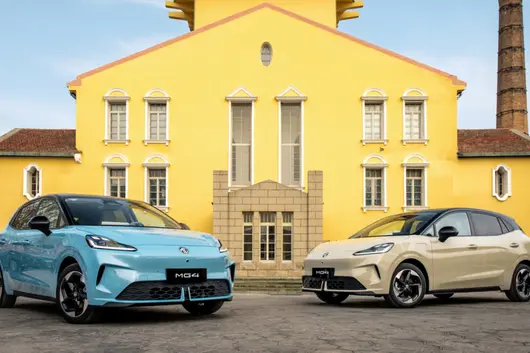

In the first half of 2026, cumulative retail of passenger cars in China's automotive market reached approximately 8.75 million units, a year-on-year decline of about 20%; meanwhile, new energy penetration rate broke 63% in May to set a historical high, and climbed further to about 63.6% in June.
The overall market downturn and structural upgrade running in parallel can be said to be the theme of this half-year; against this backdrop, true new energy top players are beginning to surface.
BYD, with 1.7774 million units in sales, continues to top the sales list; Geely Auto follows closely, with cumulative sales of 1.423 million units in the first half of the year, setting a new historical high for the same period, with the two companies combined taking about 38.7% of the new energy market share in China. More than one-third of new energy vehicles are either made by BYD or Geely.

At this point, the "Two Supers and Many Strong Powers" new energy market structure has been formed, and the top two automakers are widening the gap with the followers. Many automakers have fought in the new energy market for so many years; the elimination round is approaching its end, the market share of domestic brands has exceeded 73%, and the "Hegemony War" of China's new energy market has basically been locked between these two companies.
BYD and Geely are seizing territory with different paths respectively; one is a strong hand at integrating the industry chain, and the other is a skilled hand at organizing the system. In this "Hegemony Battle", will it ultimately end with two strong heroes standing together, or will someone seize power at once?
# BYD and Geely, Leaving Followers Far Behind? #
Stretching the timeline to 2025, the basic outline of China's new energy vehicle market structure was already apparent.
BYD, with 4,602,436 units of new energy vehicle sales for the full year of 2025, a year-on-year growth of 7.73%, among which pure electric vehicle sales were 2.2567 million units, surpassing Tesla for the first time to become the annual sales champion of pure electric vehicles globally. The domestic new energy vehicle market share exceeded 35%, and the full-year sales of 2025 entered the global automotive group sales top five for the first time.

Geely, with 3.0246 million units in sales for the full year of 2025, breaking 3 million units for the first time, up 39% year-on-year. New energy sales exceeded 1.68 million units, up 90% year-on-year. Full-year revenue was 345.2 billion yuan, up 25% year-on-year. Core net attributable profit was 14.41 billion yuan, up 36% year-on-year.

Entering the first half of 2026, BYD reached 1.7774 million units (down 15.9% year-on-year), Geely 1.423 million units (up about 1% year-on-year). Still the top two in domestic sales. From the market share perspective, the China new energy passenger car market in the first half of 2026 was about 5.5 million units. BYD's share was about 32.3%, Geely's share was about 14.5%.
One could say that in China's new energy market, these two brands took nearly half of the market. You should know that six years ago, Geely's new energy proportion was in single digits, and BYD was far from forming the scale it has today. At this point, the pattern of China's new energy market has basically been set, with multi-brand chaos evolving into "Two Giants and Multiple Strong Contenders".
# Scale and System: Which is the Key to Seizing Market Hegemony? #
Why is it BYD and Geely that can form dominance in China's many new energy brand markets with so many cars, plus policy support?
Let's look at BYD first. Currently, its biggest moat is its massive scale. This scale not only protects itself but also blocks the invasion of competitors. So where does this scale come from?
At the beginning of the development of China's new energy market, it could be said to be a complete blue ocean. At that time, even large global automotive groups dared not easily get involved. After all, this is a fundamental energy transition. Entering this market means that the profit model, production and manufacturing system, and product definition model of the previous fuel car era must be completely started from scratch. Not only must time costs be paid, but an economic account must also be calculated.
But in China, there is an undeniable point, which is the support of policy direction. BYD is able to become the current hegemon of the new energy industry because it also bet on the direction of policy. Under the decision to go ALL IN on new energy, it successfully became the first Chinese automaker to conquer the new energy market, thereby helping itself quickly take a large share of the market.
On top of this, through the path of vertical integration, from lithium mining to battery manufacturing, from chip design to vehicle production, BYD itself has built a complete industry chain closed loop.

Its advantage lies in that even if the industry's overall profit margin is only 3.2% now, BYD can still press down costs by self-producing batteries, self-producing chips, and self-producing electronic controls. In 2025, why BYD was able to reach a 35% market share in the domestic market, it relied on "others cutting prices, and I can still make money".
So at this time, this first-mover advantage combined with cost control can give it the initiative in market competition, not being led by the nose by other opponents, but making itself the person who moves first. When grasping the initiative, it will be more at ease in the market, thereby quickly forming scale expansion.
But historical experience shows that when scale expansion reaches a certain extent, it will naturally slow down or even decline. Even as strong as BYD has not escaped this law. In the first half of this year, its sales saw a decline, and the market sales of main models such as Song PLUS, Qin PLUS, and Seagull saw a year-on-year decline.
When the price war dividend has fully receded, simple price strategies are difficult to form differentiation barriers. Wang Chuanfu admitted at the shareholders' meeting: Current technology leadership is not as good as in previous years, the market wow factor of technological results has decreased, and industry homogenization characteristics are becoming increasingly obvious.
For this, in June 2026, BYD launched the largest scale organizational reform of its vehicle business since its inception, reorganizing the four brands Dynasty, Ocean, Denza, and Fang Cheng Bao into independent operating units, implementing independent accounting and bearing their own profit and loss. The R&D system was reconstructed into "Group Technology Middle Platform + Brand Research Institute". The purpose is very clear: after achieving expansion, gradually shifting from "scale driven" to "profit and efficiency driven".
Let's look at Geely. Its play is completely different from BYD. It does not build a wall with one industry chain, but uses a set of system structure to deploy.
The foundation of such a system is built under Li Shufu's "One Geely" strategy. Closing redundant entities, integrating R&D, procurement, and intelligent resources, the Qianli Haohan Intelligent Driving System is reused across brands. This unified technology base, relying on brands to form product differentiation, is forming the late-mover advantage of traditional large factories against rapid iteration and price wars.
Specifically, Geely Galaxy undertakes the task of high-volume market mainstream new energy vehicles, with cumulative sales of 519,793 units in the first half of the year; the China Star Series stabilizes the fuel car base, with cumulative sales of 580,580 units in the first half of the year; Zeekr raises brand premium with an average price of 350,000 yuan, delivering 178,300 units in the first half of the year, up 97% year-on-year; Lynk & Co covers both high-end new energy and overseas expansion.
This division of labor where each fulfills its duty allows Geely to maintain the healthiness of its own brand development in the background of the increasingly fierce price war in China. Reflected in the data is that the core net profit per vehicle in the first quarter reached 6,429 yuan, up 30% year-on-year, with the gross margin rising to 17.5%. In the context of the industry generally declining by over 20%, this performance has a certain persuasiveness.
And Geely's product layout is quite targeted. It seized the most high-volume market from 100,000 to 200,000 yuan, relying on the dense coverage of products and the full coverage of power types. This point has a strong effect on improving consumer awareness. Among them, Geely Star Wish one car contributed 34.6% of group sales.

At the same time, the overseas market is becoming Geely's second growth curve. Exports in the first half of the year were 474,200 units, up 158% year-on-year, already exceeding the total export volume of the whole year of 2025; new energy product exports were 277,200 units, up 585% year-on-year. Exports in June broke 100,000 units for the first time. Currently, Geely has raised export targets to 1 million units twice consecutively.
Combining the above content, we can see that BYD's scale gives it enough exposure in the market, and this scale effect can also bring a certain positive impact to the brand. Meanwhile, facing the current bottleneck of scale development to a certain extent, BYD is also starting to delegate authority to consider efficiency issues, seeking to allow each sub-brand to respond to the market more flexibly.
Under the background of Geely's "One Geely" strategy, scattered resources have been concentrated again. It carries out targeted layout of different markets according to the different positioning of its sub-brands. While reducing internal friction, it is also easier and more accurate for consumer groups to see Geely products in the corresponding market, thereby driving sales growth.
Although these two paths are different, the purpose is one, which is to improve its own competitiveness in the existing market. The Chinese automotive market has long entered a saturation status. So at this time, being able to live better here relies on scale and system capabilities. This point, through the examples of BYD and Geely, can verify the correctness of this development model. Although they are in a competitive relationship in the market, their development models start from different paths and end at the same destination.
Except for the domestic market, the overseas market is becoming a factor that determines the pattern of the two strong ones. Interestingly, BYD and Geely, the sales champions who took different routes in the domestic market, still have two different paths in their overseas layout.

BYD took the heavy asset wholly-owned route, building its own factories in Brazil, Thailand, Hungary, etc., intending to maintain technical and management autonomy. The Thailand factory is the only overseas full-process factory currently in production. The Hungary factory will be put into production in Q2 2026. "Local production + domestic exports" jointly improve delivery flexibility.
Geely took the light asset synergy route, cutting into local manufacturing and channels by leveraging existing cooperation networks such as Volvo, Proton, Renault, etc. Acquiring Ford's Valencia plant production line in Spain, signing Swiss distributor Emil Frey. This model avoids the heavy asset burden of large-scale self-built factories.
The two routes have pros and cons. BYD's wholly-owned model can守住 technical sovereignty, but the capital pressure is huge and implementation is slow; Geely's synergy model can quickly pave the way, but it has a high dependence on cooperation partners and weak brand control. From the data in the first half of 2026, Geely's export growth (157%) was higher than BYD's (70%), but BYD's overseas sales absolute value (789,400 units) still leads Geely (474,200 units).
Subsequently, the performance of these two giants in the overseas market may become a key factor affecting their overall brand development. Under the background of the EU IAA Act locking foreign shareholding at 49%, Geely's joint venture synergy model may face lower policy compliance costs, while BYD's wholly-owned route may face greater institutional barriers.
# Top Structure Established: Can Followers Replicate the Success Path? #
When the market has a successful template, naturally others are like copying. So can BYD and Geely's development model be replicated?
BYD's vertical integration is built on more than twenty years of deep cultivation in the industry. Starting from batteries to vehicle manufacturing, this is a road that cannot be done quickly. CATL is a battery giant, but it doesn't make cars; Nio and Li Auto are new car-making forces, but they don't produce batteries. To keep the whole industry chain in hand, it requires time, capital, and strategic resolve. All three are indispensable.
Geely's systematic capability is built on the long-term accumulation of multi-brand acquisition and integration. Volvo, Proton, Lotus, Polestar, etc., these brands were not bought overnight; it is the result of a ten-plus-year continuous layout. Without this "brand pool", the "One Geely" strategy loses the foundation of synergy. New entrants only have one or two brands, and traditional automakers mostly have only one main brand. None have the conditions for Geely's "multi-brand matrix synergy".

So, saying it is that these two roads, BYD and Geely can walk, does not mean others can too. So is there another way to squeeze into the camp of China's new energy "Strong Ones"? Let's see how subsequent followers respond.
Currently, relying on brand premium and single-model efficiency are the general tactics of most market followers. Among them, Tesla and Xiaomi are considered two representatives.
From the brand statistical scope, the new energy brands ranked behind BYD and Geely are Tesla. In the first half of 2026, Tesla's China domestic market retail sales were approximately 325,000 units. If referring to the total delivery volume of the Shanghai Gigafactory (including exports) in the first half of the year, it was 468,000 units.
But it is worth noting that Tesla's product portfolio has not been updated for a long time. Two flagship models, Model S and Model X, were discontinued in the first half of this year. The main models currently on sale are Model 3 and Model Y. So what is the reason boosting its sales? The answer is very simple, it is its brand influence.

If switching to other brands, or saying the majority of domestic brands, having only two models in the market is obviously not enough competitiveness. Otherwise, they would not deploy numerous models in the domestic market. You should know that in the first half of this year alone, there were over 500 new and upgraded models entering the Chinese automotive market. The main purpose is to exchange consumer attention and sales through short time and high frequency exposure.
But Tesla's advantage lies in its brand influence. One is entry early, counting as the absolute pioneer of the electric market, and having its own energy replenishment system. Plus, the personal charm of the brand founder adds to it. Many consumers, if not considering price and other factors, will take it as one of the primary or main choices.
Speaking of Xiaomi, this can actually be counted as a sample of high efficiency for a single model. In the first half of 2026, Xiaomi Auto cumulative deliveries exceeded 180,000 units, basically reaching a monthly average of 30,000. It relied on one car in its first year, and now it only has two models on sale.
If you put it together with BYD, you can see what level its per-vehicle efficiency reaches. Two cars with 180,000 sales, compared to 1.196 million for 66 models, its per-vehicle average sales are far higher than most other brands on the market, basically reaching more than 3 times the industry average.
Why are these two paths worth being discussed separately? The cases of Tesla and Xiaomi answer the question "Can BYD and Geely's paths be replicated".
BYD's scale requires twenty years of industry chain deep cultivation; Geely's system requires ten-plus years of brand acquisition integration. These two things, other brands can almost not replicate. So if other brands want to gain presence in the market, they must have other differentiation advantages, relying on brands, or relying on their own ecosystems, or starting from other ways.

And there is one more point, relative to scale and system which are barriers that won't be easily broken, other methods may all have a certain uncertainty.
For example, Tesla's brand influence. Tesla's domestic retail sales in the first quarter of 2026 declined by 16.2% year-on-year. In January, Model Y even fell to 20th place in the retail ranking. Its pure electric retail market share in April of this year was only 3.06%. All of this explains one issue, that is, brand influence can be diluted by competitors.
Then there is Xiaomi's per-vehicle efficiency. If market acceptance of products is acceptable, then per-vehicle extreme efficiency is an advantage. If per-vehicle appeal in the market declines, then it is a serious blow to the brand, and it may even appear that one car decides life or death.
So, the "Hegemony" established by BYD and Geely is the effect of the superposition of factors such as time. In the short term, it is like ascending to heaven to replicate this brand development path. So the endgame of China's new energy market later will not be a "BYD + Geely" duopoly, but the top structure they are in has solidified. This barrier will not be easily broken by latecomers. On the contrary, these giants may "absorb" small and medium brands that are hard to sustain in the market.
# One Dominant Leader or Two Tigers Coexisting? #
As the saying goes, one mountain cannot hold two tigers. So will this point be reflected in the "Hegemony" contest between BYD and Geely?
In the short term, BYD appeared with teething pains after scale expansion. Domestic sales declined, and organizational reform just started, but its trump cards are relatively still thick enough. After all, it is the world's largest new energy capacity, has a complete industry chain layout, and has the largest user base in the current new energy field. If organizational reform can activate the combat power of respective brands, BYD's scale advantage still has hope for expansion.
In the medium to long term, Geely's growth momentum may have a longer sustainable period. Per-vehicle net profit hit a new high in the first half of the year, overseas exports surged, and new energy penetration rate steadily improved. The complementary structure of major brands gives it a buffer at any single market fluctuation.
At the same time, whoever can turn the overseas market from increment to profit, can get the hope of leading opponents. BYD's wholly-owned model has verified feasibility in Brazil and Thailand; Geely's synergy model is accelerating landing in Europe. Both roads can be passed, but which road can be walked better depends on who can find a better balance between localization operations, brand construction, and cost control.
Objectively speaking, the endgame of China's new energy market, one dominating is difficult, the probability of two strong heroes standing together is obviously higher. This point has already been confirmed in many markets globally. Regardless of BYD's scale or Geely's system, these two weapons can eliminate, but a more important point in the market is who can be more flexible. At this time, whether it is BYD's organizational adjustment or Geely's integration concept, they are all the adaptive answers produced to cope with current problems.
As for the final hegemony contest, whoever can take the lead in finding that key balance point between scale expansion and efficiency, product coverage and technology focus, development speed and product quality, is the one who may find the opportunity to lead opponents in the tense hegemony battle.

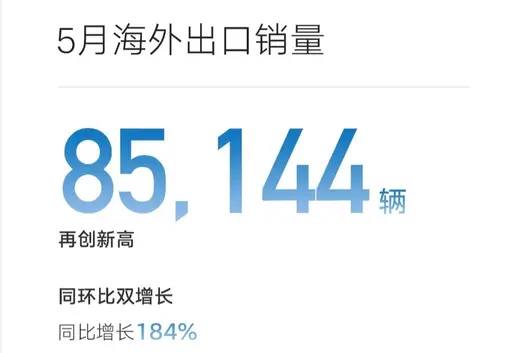
85,000 units. This is Geely's May overseas export report, a 184% year-on-year increase. Australia, Geely has only been there for 14 months, deliveries exceeded 10,000 units. EX5 was the first-quarter sales champion of pure electric SUV-C there, Zeekr 7X was even tougher, directly pulling down the long-dominant Tesla Model Y. Mexico cumulative 16,000+ from January to April, breaking records. Brazil single month hit 4,000+ units, also the highest record in that country's market.

After the order surge, logistics come first
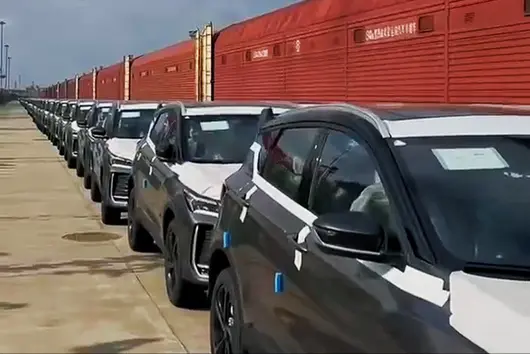
Facing the sudden influx of orders, Geely didn't push all the pressure onto dealers and users to wait, but instead directly utilized the Ningbo overseas hub. Ro-ro ships, container ships, and international rail freight trains operated on three parallel lines, 4 major rail ports and 6 sea ports all got moving; Two self-owned ro-ro ships stood guard, China-Europe freight train special trains ran regularly, rail could cut dozens of days off the delivery time to Europe compared to sea transport.
Nearly 10,000 units are stably shipped to core ports monthly, it's not as light as a phrase "we will supply with all efforts", behind it is a net woven by routes, slots, customs affairs, loading/unloading yards, and long-term contracts. You can imagine, if there were no this sea-land-air intermodal chassis, even the best sales performance would vanish amidst the long sea shipping cycle and user complaints.

Rejecting the "cheap" logic, digging deep into local soil
Many people still look at domestic brand overseas expansion with old eyes, thinking it's just "cars are cheap, foreigners seek value". This logic might have held five years ago, but now it cannot explain why Zeekr 7X can pull down the long-dominant Tesla Model Y in Australia, let alone explain the pursuit of Dubai dealers.
What place is Dubai? It's an arena where luxury cars gather globally. What scenes haven't dealers there seen? They chase Geely for cars, what they seek is definitely not "cheap". The strategy of "One Geely" seems abstract, but when implemented, it is exceptionally specific: Geely, Lynk & Co, and Zeekr each keep their positions, maintaining brand tonality independence while sharing system capabilities behind the scenes. Right-hand drive adaptation, the introduction of 6AT versions, these trivial engineering details are the true roots taking deep into the local market.
The feedback from the Mexican market is particularly typical. The local team has a very simple sentence: "We will not change strategy due to short-term tariffs." Translated, it is: I am not here to make quick money, I am here to stay long-term. This mindset projected onto products, saw EX2 win the sales champion of B-segment hatchback new energy vehicles in Mexico, Indonesia, Costa Rica; projected onto channels, is the symbiotic ecosystem with dealers.

Systematic overseas expansion, winning in the unseen places
Explosive sales growth is most likely to expose shortcomings. Geely upgraded after-sales from "car repair" to user operations, super long warranties, three-level parts systems, a VOC user voice system covering the globe... These actions cannot be directly printed on posters, but they are the key deciding whether the reputation rises or collapses two years later.
One could say, Geely's 85,000 units overseas were not shouted out by loud voices, but operated by a precision machine from product definition, logistics delivery to user operations. When logistics fleets race day and night on the Eurasian land bridge, when Dubai dealers recommend Geely to customers in showrooms, the narrative logic of Chinese cars going overseas has turned the page.
#Geely Sells Explosively Overseas #Geely In Foreigners' Eyes

In Dubai where luxury cars are everywhere, what good cars has the dealer not seen?
But recently, an overseas dealer selling Chinese cars in Dubai came to domestic exhibitions, and was firmly won over by Zeekr. He stated directly, the technical iteration of Chinese cars has entered a new stage, traditional German luxury brands will hardly compete with Chinese brands like Zeekr anymore.

This sounds like politeness, but their actions are fiercer — he already has one Zeekr 9X, after Zeekr 8X launched, he turned around and blind-ordered two more.
This is the subtlest change happening in Chinese car exports: In the past, we actively "went out", now overseas quality dealers are starting to "reach out in reverse".
Hot sales overseas, not just a market feverGeely's latest disclosed overseas data is indeed confident.
This May, Geely Auto sales reached 238,000 units, achieving growth both year-on-year and month-on-month. Of which overseas exports exceeded 85,000 units, setting a historical high, year-on-year growth reached 184%.
Looking at the total amount alone is bright enough, but the deeper value lies in: This is not propped up by speculation in a single market, but blooms across the board.
In April, Geely overseas new energy sales year-on-year growth was 624.5%, consecutive first in Chinese new energy car export growth rate. North America, Asia, Europe, South America four continents are all picking up volume, multiple countries growth rate exceeded 300%.
Geely entered the Australian market only 14 months ago, vehicle delivery has broken through 10,000 units, becoming one of the fastest-growing Chinese car enterprises locally; Brazil market monthly sales rushed above 4,000 units, refreshing the local highest monthly sales record; Mexico market January to April cumulative sales exceeded 16,000 units, also set a historical high.

These markets are geographically dispersed, consumption habits, road environments, and policies/regulations vary greatly. Geely managing to run through simultaneously shows this wave of growth is by no means a chance hitting of a single trend.
Car models are also blooming in multiple points.
Geely EX2 in Mexico, Indonesia, Costa Rica and other markets, took first place in B-class hatchback new energy sales TOP1 of the first quarter; Geely EX5 in Australia, UAE, Uruguay and other countries, became the sales champion of the first quarter pure electric SUV-C market.
In the past, Chinese cars going overseas were often labeled with the value-for-money tag of "cheap, high configuration". And Geely now takes first place simultaneously in different markets and different niche categories, means products have truly invaded the car selection list of the local mainstream consumer group.
Zeekr Overthrows Model Y in AustraliaGeely's export wave this time is not just relying on ordinary models to move volume.
If Geely EX2 and EX5 are responsible for building a solid sales base, then Zeekr is responsible for another hard card: breaking the price ceiling of Chinese brands overseas.
In May, Zeekr brand delivery reached 34,377 units, reaching a new high. Of which, Zeekr 9 Series, 8 Series models share nearly 50%, brand unit transaction price year-on-year growth 52.4%, even exceeding traditional BBA.
High-end market is never shouted out, eventually needs real transaction prices to speak. Taking Australian market as an example, Zeekr 7X sales topped the list again, even surpassing the long-term dominant Tesla Model Y. Australia is not a virgin land for new energy, Tesla has cultivated deeply here for a long time, Zeekr can face off head-on and overtake, extremely valuable.
So, the Dubai dealer being moved by Zeekr is not an isolated little anecdote.

For many overseas users, Chinese cars have changed too fast in these years. In the past they might think Chinese cars just had high configuration, low price, but now truly sitting in the car, experiencing smart cockpit, tri-electric efficiency, chassis texture, luxury configuration and vehicle completion, feelings will be completely different.
Especially brands like Zeekr, no longer answering the question of "Can Chinese cars build new energy cars", but answering the question of "Can Chinese brands make high-end cars". This opened up more imagination for Geely's premium space overseas.
After cars sell explosively, logistics are the first to buckleAfter sales volume picks up, what is tested first is often not marketing, but delivery.
Overseas markets are not like domestic ones, new cars from factory to terminal, need to cross ports, sea freight, rail, customs clearance, distribution, dealer delivery and many other hurdles. Any blockage of capillaries will directly destroy user experience.
After "sellable", Geely's core task now is "supply-able".
To cope with the explosive overseas orders, Geely relies on Ningbo export hub, simultaneously activating Ro-Ro ships, container ships and international rail freight trains to carry out sea-land intermodal transport. Currently, Geely has added multiple transport routes, forming a capacity resource layout of 4 major rail ports, 6 major sea ports, and equipped with two self-owned Ro-Ro ships.

Meanwhile, Geely has also opened multiple cross-border transport special lines, continuously supplementing capacity resources, monthly can stably ship nearly 10,000 new cars to core European ports. China-Europe Railway Express Geely special train has also been operating normally, transport time compared to sea transport can be shortened by 40 days.
This turning point is very interesting: In the past, Chinese cars exports anxious about "how to sell out", while Geely now faces a sweet trouble "how to deliver cars faster".
This is exactly a microcosm of export logic iteration.
Early car exports were more like "trade business" one-off deals, on ship, sell to middlemen, task completed. But now different, overseas users buying Chinese cars, not only look at the product itself, but value delivery cycle, after-sales service, parts supply and warranty policy, they value whether the brand plans to cultivate deeply locally.
So, don't just stare at that 85,000 units export data of May. The real test is after cars sell explosively, can logistics deliver on time, after-sales can respond quickly. Geely this time is impressive, is it putting these logistics support ahead.
This is the mark of Chinese car companies entering the deep water zone of global competition.

85,000 units. This is Geely's May overseas export report, a 184% year-on-year increase. Australia, Geely has only been there for 14 months, deliveries exceeded 10,000 units. EX5 was the first-quarter sales champion of pure electric SUV-C there, Zeekr 7X was even tougher, directly pulling down the long-dominant Tesla Model Y. Mexico cumulative 16,000+ from January to April, breaking records. Brazil single month hit 4,000+ units, also the highest record in that country's market.
After the order surge, logistics come first
Facing the sudden influx of orders, Geely didn't push all the pressure onto dealers and users to wait, but instead directly utilized the Ningbo overseas hub. Ro-ro ships, container ships, and international rail freight trains operated on three parallel lines, 4 major rail ports and 6 sea ports all got moving; Two self-owned ro-ro ships stood guard, China-Europe freight train special trains ran regularly, rail could cut dozens of days off the delivery time to Europe compared to sea transport.
Nearly 10,000 units are stably shipped to core ports monthly, it's not as light as a phrase "we will supply with all efforts", behind it is a net woven by routes, slots, customs affairs, loading/unloading yards, and long-term contracts. You can imagine, if there were no this sea-land-air intermodal chassis, even the best sales performance would vanish amidst the long sea shipping cycle and user complaints.
Rejecting the "cheap" logic, digging deep into local soil
Many people still look at domestic brand overseas expansion with old eyes, thinking it's just "cars are cheap, foreigners seek value". This logic might have held five years ago, but now it cannot explain why Zeekr 7X can pull down the long-dominant Tesla Model Y in Australia, let alone explain the pursuit of Dubai dealers.
What place is Dubai? It's an arena where luxury cars gather globally. What scenes haven't dealers there seen? They chase Geely for cars, what they seek is definitely not "cheap". The strategy of "One Geely" seems abstract, but when implemented, it is exceptionally specific: Geely, Lynk & Co, and Zeekr each keep their positions, maintaining brand tonality independence while sharing system capabilities behind the scenes. Right-hand drive adaptation, the introduction of 6AT versions, these trivial engineering details are the true roots taking deep into the local market.
The feedback from the Mexican market is particularly typical. The local team has a very simple sentence: "We will not change strategy due to short-term tariffs." Translated, it is: I am not here to make quick money, I am here to stay long-term. This mindset projected onto products, saw EX2 win the sales champion of B-segment hatchback new energy vehicles in Mexico, Indonesia, Costa Rica; projected onto channels, is the symbiotic ecosystem with dealers.
Systematic overseas expansion, winning in the unseen places
Explosive sales growth is most likely to expose shortcomings. Geely upgraded after-sales from "car repair" to user operations, super long warranties, three-level parts systems, a VOC user voice system covering the globe... These actions cannot be directly printed on posters, but they are the key deciding whether the reputation rises or collapses two years later.
One could say, Geely's 85,000 units overseas were not shouted out by loud voices, but operated by a precision machine from product definition, logistics delivery to user operations. When logistics fleets race day and night on the Eurasian land bridge, when Dubai dealers recommend Geely to customers in showrooms, the narrative logic of Chinese cars going overseas has turned the page.
#Geely Sells Explosively Overseas #Geely In Foreigners' Eyes


