首頁Mileage

搜尋歷史
熱門搜尋
經銷商登入 / 註冊

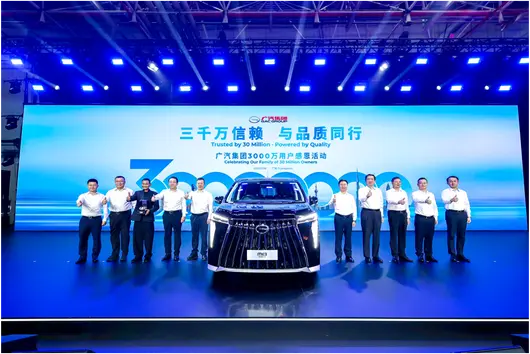
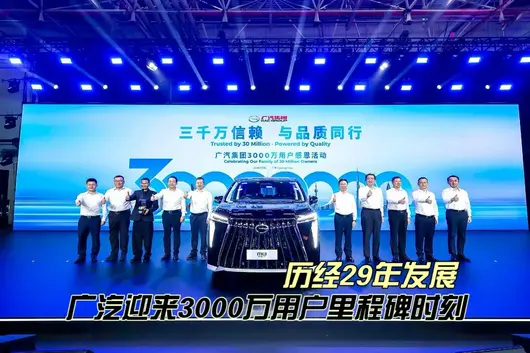
From thousands of selections to millions of trusts, every choice is the best testimony to brand growth. On July 16, the GAC Group 30 Million User Gratitude Ceremony was grandly held at the GAC Trumpchi factory. Government and enterprise leaders, industry giants, industry chain partners, domestic and overseas owners, media, and employee representatives gathered on site to jointly witness the highly significant 30 million whole vehicle delivery milestone in GAC's development history, unlocking a brand new chapter of high-quality development of Chinese car brands.

[Meeting Guests Witness GAC Welcoming 30 Million User Milestone Moment]
After 29 years of hard work, GAC has progressed from the first whole vehicle rolled off the line to a cumulative 30 million whole vehicles delivered. The digital leap is not only a breakthrough in scale but also an accumulation of reputation from millions of users. This milestone is not only proof of GAC's adherence to the original quality intention and accelerated smart new energy transformation, but also a vivid vignette of the Chinese automotive industry moving from scale expansion to value leap.
This ceremony showed GAC's strong transformation vitality and global strength in the form of all-domain linkage. At the event, GAC's multiple global production bases were linked via cloud, and GAC Honda P7, GAC Toyota bZ7, Qijing GT7, GAC AION N60, GAC Hyper S600, and many other new energy models rolled off the line sequentially, fully presenting GAC's full-coverage, diversified smart new energy product matrix.

[GAC Smart New Energy Matrix Shines on Stage]
The highly anticipated 30 millionth whole vehicle—Right-hand drive version GAC Trumpchi M8 PHEV officially debuted and rolled off the line, highlighting GAC's firm layout in the global market. GAC Group Chairman Feng Xingya handed over the new car keys to Thai owner Tony Jaa. This two-way rush across mountains and seas vividly interprets GAC brand's hardcore strength and warmth based in China and going global.

[GAC's 30 Millionth Whole Vehicle - Right-Hand Drive GAC Trumpchi M8 PHEV Rolls off the Production Line]

[Feng Xingya (Left) Delivers New Car Keys to Thai Owner Tony Jaa (Right)]
Solid product layout boosts steady sales growth. Data shows that in the first half of this year, GAC Group's cumulative sales reached 773,100 vehicles, a year-on-year growth of 2.35%; new energy vehicle sales skyrocketed by 68.8% year-on-year, highlighting transformation results. The overseas market also saw explosive growth, with export volume surpassing 120,000, a year-on-year increase of as high as 132%, running out a steady upward growth curve during the industry's deep adjustment period.
"Quality is the bottom line GAC will never compromise." Deeply cultivating the industry for nearly 30 years, GAC has always adhered to the core philosophy of "Quality First", integrating Honda's Total Quality Management, Toyota's Lean Production Model, combined with local market characteristics to build an exclusive integrated innovative quality management system, ensuring quality runs through the entire R&D, production, and delivery process.

[Witnesses of Important Nodes in GAC Development History Share GAC's Story of Walking Together with Quality]

["National Distinguished Engineer Team" GAC Powertrain Independent R&D Team Shares R&D Innovation Process]

[GAC Styling Design Team Shares Design Innovation Process]
Strict quality control standards are the core guarantee of quality. All new cars of the GAC series must undergo "Five Highs, One Mountain, One Dust" extreme environment testing, complete "Two Winters, One Summer" full-scenario on-site road testing, pass 12 major categories of whole vehicle verification and over 1,500 items of strict verification, comprehensively adapt to complex road conditions and diverse travel scenarios. Relying on the global first new energy vehicle lighthouse factory - GAC AION Smart Eco Factory, with a digital, intelligent production system, achieving stable and controllable quality of mass-produced models.

[GAC AION Smart Eco Factory]
In the field of safety technology, GAC has built all-around protection barriers. The self-developed Star Spirit Safety Guardian System covers smart chassis, active/passive safety, battery safety, and smart driving four dimensions. Eight key systems adopt double redundancy design, cumulatively avoiding 6.28 million potential travel risks, protecting the travel safety of nearly 2 million users. The Ace Bulletproof Battery has cumulatively loaded 1.5 million units, with safe driving mileage exceeding 160 billion kilometers. At the same time, the industry's first brand-owned "Three Responsibilities" policy was launched, proactively covering user pain points of batteries and intelligent driving assistance to completely eliminate user concerns about vehicle use.

[GAC Star Spirit Safety Guardian System]
Always being user-centric is the core code for GAC to continuously lead. Adhering to the corporate philosophy of "People First, Integrity as Path, Innovation as Priority", GAC integrates user needs into brand development genes, building a full-cycle, full-scenario, closed-loop user service system.

[GAC "All Users Speaking" Event Site]
To listen to real user voices, GAC regularly carries out "All Users Speaking" activities, facing user demands, absorbing user suggestions, through an exclusive user insight department, achieving responses for every user issue and implementation for every matter. Service channels continue to sink, with plans to add 1,000 county-level authorized stores this year, breaking through grassroots service barriers; relying on the "Super Butler" service system, achieving 5-second quick response and 2-hour request completion, greatly improving service efficiency.
Energy replenishment ecology continues to improve. GAC has built a "9 Verticals and 10 Horizontals" national energy replenishment network, covering 31 provinces and 213 cities nationwide, owning over 27,000 charging piles and over 20,000 supercharging piles, achieving "within 1 kilometer straight line must have station" in core urban areas, bringing convenient and efficient energy replenishment experience for new energy users.

[GAC Energy "9 Verticals 10 Horizontals" Energy Replenishment Network]
To thank 30 million users for their company all the way, GAC officially launched the "30 Million Vehicle Delivery · Refresh Gratitude Season". Subsidiaries GAC Honda, GAC Toyota, GAC Trumpchi, GAC AION, GAC Hyper, and Qijing Auto six major brands simultaneously launched exclusive benefit policies for new purchase, trade-in, and add-on purchase, returning million users' trust with full sincerity.

[GAC Group 30 Million Vehicle Delivery · Refresh Gratitude Season Officially Launched]
30 million is a milestone, and even more a brand new starting point. Based on the brand new development stage, GAC takes technological innovation as the core driving force, continuously deepening powertrain, three-electric, and intelligent connected core technologies, accelerating transformation into an ecological technology enterprise.
In the powertrain field, the GAC Star Source Power System covers three technology routes: Extended Range, Plug-in Hybrid, and Super Twin Engine. Undergone 100,000 hours of bench testing and over 10 million km of whole vehicle verification, full-scenario performance is stable and powerful, bringing efficient and worry-free travel experience for users. In the three-electric field, GAC continues to tackle industry pain points, built a full solid-state battery pilot production line, the self-developed Quark electric drive motor efficiency breakthrough 99%, reaching industry top levels.

[GAC Star Source Power Makes Users Choose "No More Compromises"]
In the intelligent field, the Star Spirit architecture comprehensively iterates, connecting driving, cockpit, powertrain, chassis, and other six major core systems, whole vehicle comprehensive performance increased by 40%; the Galaxy Smart Cockpit achieves end-cloud integration, building a humanized, intelligent mobile travel space. Meanwhile, GAC partners with Huawei, CATL, Tencent, Alibaba, and other industry leading enterprises to jointly build an AI intelligent travel ecology, continuously unlocking new possibilities for future travel.
Deepening R&D technology, building solid innovation confidence. Currently, GAC's cumulative R&D investment exceeds 62 billion yuan, assembling a global R&D team of over 6,800 people, continuously empowering product upgrades and experience upgrades with hardcore technology. In the future, GAC will adhere to quality original intention, deepen user value, persist in technological innovation, accelerate global layout, forge new tracks in intelligence, green, and globalization with a steady posture, walking shoulder to shoulder with 10 million users, embarking on the next brand new journey.
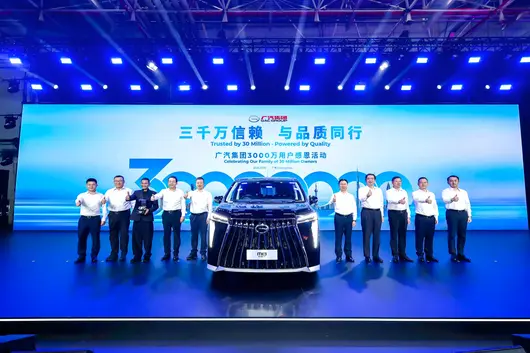

On July 16, as the right-hand drive Trumpchi M8 PHEV slowly rolled off the production line, GAC Group officially crossed the industry milestone of cumulative production and sales of 30 million vehicles. Beginning in 1997 amidst external doubts about car manufacturing in Guangzhou, and now boasting six passenger car brands with user footprints spanning 110 countries and regions globally, over 29 years, GAC has used 30 million units of user trust to write a narrative of the Chinese automotive industry's growth: from joint-venture learning to independent rise, from local manufacturing to global layout.
In the current context of intensifying stock competition in the car market and accelerated industry reshuffling, the weight of the number 30 million far exceeds the simple superposition of sales scale. It is not only the inevitable result of GAC's persistence in quality fundamentals and practice of long-termism, but also a vivid footnote of traditional car enterprises actively breaking through the deadlock and reconstructing industrial value centered on users, further reflecting the clear path for the Chinese automotive industry to leap from scale expansion to high-quality development.

Quality as Anchor: Engraving Long-termism into Manufacturing Genes. When discussing GAC, one cannot avoid the word "quality". In the impatient atmosphere where the industry generally pursues "fast iteration, fast launch, fast volume", GAC always maintains a rare stability: new car development must fully experience "two winters and one summer" field verification, with a shortest cycle of 18 months, and a conventional stable cycle up to 21 months; before each model is launched, it must undergo "five highs, one mountain, one dust" extreme environment polishing, repeatedly verifying under extreme working conditions such as 60°C high temperature, -40°C extreme cold, high altitude, high salt fog, etc., which users may never encounter in a lifetime.
This obsession with quality did not come out of thin air. From absorbing the essence of Honda's Total Quality Management and Toyota's Lean Production during the joint-venture era, to constructing a complete system covering 12 major verification items and over 1,500 verification sub-items for the independent era, GAC has implemented "Quality First" from a slogan to the entire chain of R&D, manufacturing, and service. The Bulletproof Battery accumulation of 1.5 million vehicles, safe driving over 160 billion kilometers, Star Spirit Safety System protecting nearly 2 million users and avoiding 6.28 million potential risks, and the industry-first "Three Responsibility Commitment" service promise extending guarantees to the full vehicle usage lifecycle — behind these numbers is GAC's long-term practice of "Quality is the bottom line and also a belief".
In fact, with frequent price wars and endless marketing gimmicks today, the choice of 30 million users is itself the most powerful proof: Short-term price cuts might exchange for temporary sales pulses, but what truly supports enterprises traversing the cycle is always the two words "reliable" in users' mouths. GAC's growth logic is essentially exchanging long-term quality investment for users' long-term trust and repurchase.

Users as Core: The Cognitive Metamorphosis from "Car Maker" to "Travel Companion". If quality is the foundation of GAC's existence, then the systemic transformation centered on users is the core password for maintaining growth resilience in the new era. The "Panyu Action" launched in 2024, the core change was not the update of products, but the leap of thinking — from the traditional "Engineer Thinking", comprehensively shifting to "User Thinking".
This transformation is reflected in many details: A normalized "User Open Mic" mechanism allows R&D and product managers to face users' daily pain points directly, converting real feedback directly into product optimization directions; Channels accelerate sinking into counties, with plans to build 1,000 county-level authorized stores within the year, delivering car viewing and maintenance services to users' doorsteps; Targeting the charging anxiety of new energy users, the "9 Vertical 10 Horizontal" charging network covers 213 cities, realizing "a station within 1 kilometer in a straight line" in core urban areas; Online "Super Steward" promises 5-second response, 2-hour completion, so that user requests no longer fall into a black hole.
This 30 million user gratitude season, GAC launched new purchase, trade-in, and additional purchase triple benefits in conjunction with six brands, covering the full lifecycle of user vehicle usage, which is the concentrated embodiment of this thinking. The automotive industry has long entered the era of "Users First" from "Product King", whoever can truly hear users' voices and solve users' pain points can hold the basic market share in the stock market. GAC's transformation is essentially putting "Users First" from a slogan into every link of organizational structure, business processes, and service standards.

Global as Gameboard: The Progression from "Product Going Global" to "System Taking Root". It is worth noting that the 30 millionth complete vehicle chose the right-hand drive Trumpchi M8 PHEV, and was delivered to Thai car owners, this detail is quite symbolic — in the 30 million user territory, the overseas market is becoming an increasingly important growth pole.
Relying on the "One GAC 2.0" strategy, GAC is accelerating the upgrade from simple product export to full value chain system going global. In the first half of 2026, GAC independent brand export volume reached 121,500 units, a 132% year-on-year increase, already approaching the level of 2025 full year; International business covers 5 major sectors in 110 countries and regions, built 7 overseas production factories, and over 746 sales service outlets. From 207% month-over-month increase in Thailand market sales to establishing a full-link system of localized production to terminal sales in the European market, GAC's going global path is solid.
Chinese car companies going global has long passed the "exchange low prices for market" initial stage. GAC's system-based going global means R&D, production, supply chain, sales are fully localized, truly taking root locally and integrating locally. This approach that does not pursue short-term explosion but focuses on long-term operation is exactly the key for Chinese brands to establish reputation and stand firm in the global market.

Technology as Wings: Planting Seeds for the Next 30 Million. 30 million is a milestone and also a new starting point. Facing the industrial change of intelligent electrification, GAC did not lie on the credit book of scale, but continuously uses technical innovation to anchor the future. By the end of 2025, GAC cumulative independent R&D investment exceeded 62 billion yuan, patent applications exceeded 24,900 items; Star Origin Power, Star Spirit Architecture 4.0, Galaxy Smart Cockpit and other core technologies landed successively, co-building intelligent ecosystems with partners like Huawei, CATL, etc., Qijing brand charging high-end intelligent new energy track.

From joint venture exploration to independent rise, from intelligent progression to ecosystem expansion, GAC's four leaps have always resonated with the development of the Chinese automotive industry. The 29-year journey proves that the pragmatic and low-key Guangdong enterprise background, seemingly not enough to be clever, is the most reliable quality to traverse industry cycles.

30 million is not the end point, but the starting point to rush to the next journey. In the deep water zone of intelligent electrification, in the new arena of globalization, GAC has already built a solid foundation with the four cards of quality, users, technology, and globalization. And its growth path also provides a referenceable sample for more Chinese car companies: Adhere to long-term value, focus on user needs, establish brand with quality, seek the future with innovation, can only walk steadily and go far in the industry wave, so that the name of Chinese automobiles has more weight in the global market.
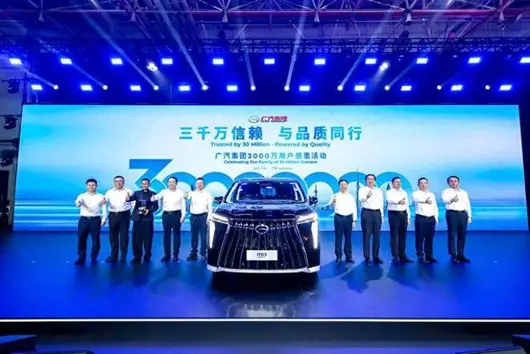

July 16, GAC Group 30 million user gratitude event held at GAC Trumpchi factory.

At the venue, GAC's multiple global production bases were connected simultaneously. GAC Honda P7, GAC Toyota bZ7, Qijing GT7, GAC AION N60, GAC Hyper S600 were rolled off the line sequentially as GAC's 29,999,995th to 29,999,999th vehicles. Finally, the right-hand drive GAC Trumpchi M8 PHEV made a shining debut on the on-site stage as the 30 millionth vehicle. The collective appearance of the new energy vehicle lineup rolled off the line became a direct verification of GAC's full-speed promotion of electrification and intelligent transformation.

[GAC Intelligent New Energy Matrix Shines On Stage]
Subsequently, Feng Xingya handed the key of the 30 millionth vehicle to Thai owner Mr. Tony Jaa. This moment captured was not just a number, but a warm testimony of GAC and global users "two-way commitment".
This trust spanning mountains and seas is the confidence with which GAC breaks through amidst industry changes. In the first half of this year, GAC Group's sales reached 773,100 units, a year-on-year increase of 2.35%, among which new energy vehicle sales grew by 68.8% year-on-year; overseas exports exceeded 120,000 units, a significant increase of 132% year-on-year, achieving a steady pace during the industry's deep reshaping period.
"Quality is the bottom line that GAC will never compromise on." Feng Xingya stated in the concluding remarks. In GAC's development, scale growth has always been based on quality. For many years, GAC Group has adhered to the concept of "Quality First", integrating Honda's Total Quality Management (TQM), Toyota's Lean Production System (TPS), and Lingnan culture to build a quality management model centered on "Integrated Innovation". The ultimate goal is to build good cars that allow users to drive with confidence, use with peace of mind, and sit comfortably.
Feng Xingya announced that effective immediately, GAC officially launched the "GAC Group 30 Million Vehicle Rollout - Renewal Gratitude Season". GAC Honda, GAC Toyota, GAC Trumpchi, GAC AION, GAC Hyper, and Qijing Automotive, the six passenger car brands, will launch characteristic policies around new purchases, trade-ins, to additional purchases, etc., to reward every companionship and support.

[GAC Group 30 Million Vehicle Rollout - Renewal Gratitude Season Officially Launched]
Taking 30 million as the new starting point, GAC will drive innovation, embark on a new journey of electrification and intelligence, and allow cutting-edge technology to truly translate into user-perceivable peace of mind and convenience.
In the power domain, Xingyuan Power developed by the "National Distinguished Engineer Team" covers three major technologies: Xingyuan Extended Range, Xingyuan Plug-in Hybrid, and Xingyuan Super Dual Engine, which will be mass-produced on more models. Each product must undergo 100,000 hours of bench and whole vehicle verification, with equivalent mileage exceeding 10 million kilometers, ensuring that performance remains stable as a rock in all scenarios and regions.

[GAC Xingyuan Power Allows Users to Choose "No Longer Compromising"]
In the three-electric systems field, GAC continues to tackle industry pain points such as battery ultra-fast charging and low-temperature range, has built a pilot production line for all-solid-state batteries, launched extreme energy consumption technology, and the mass-produced Quark electric drive motor's highest efficiency breaks through 99%, reaching the industry's highest level.
In the intelligent connected field, the Super Brain Xingling Architecture continues to evolve, connecting six major systems: intelligent driving assistance, intelligent cockpit, power, chassis, body, and vehicle networking, achieving "One Brain Unified Command", with overall performance improved by 40%; Xinghe Smart Cockpit achieves end-cloud integration, making the car a true partner that can "think and understand human hearts". GAC will also fight side by side with top partners such as Huawei, CATL, DiDi, Tencent, and Alibaba to build a stronger AI intelligent ecosystem.
As of now, GAC Group's cumulative R&D investment exceeds 62 billion yuan, and the global R&D team exceeds 6,800 people. Continuous technical investment is driving GAC's products to evolve from commuting tools to smart mobility partners, mobile smart spaces, and green energy ecosystems.
Conclusion:
From the rollout of the first whole vehicle to the delivery of the 30 millionth vehicle, GAC has experienced a 29-year development history. Behind the number 30 million lies the choice and trust of tens of millions of users, GAC's long-term commitment to quality and safety, the determination to transform towards electrification and intelligence, and also a microcosm of China's automotive industry growing from big to strong and shifting from scale expansion to value leap.
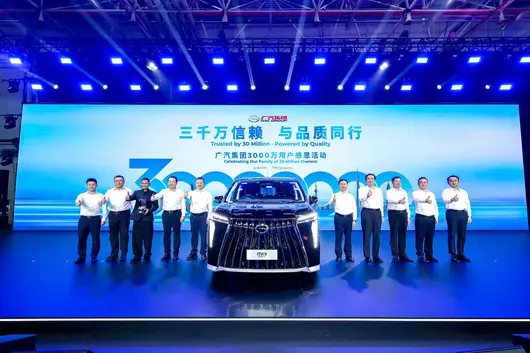

On July 16, the GAC Group 30 Million Users Gratitude Event was held at the GAC Trumpchi factory. Relevant leaders from Guangdong Province, Guangzhou City, and Panyu District, Executive Vice President and Secretary-General of China Automotive Industry Association Fu Bingfeng, GAC Group Chairman Feng Xingya, General Manager Ge Xianqing, other members of the leadership team, industry partners, suppliers and dealers' representatives, as well as domestic and international car owners' representatives, employee representatives, media representatives, etc. all attended together to witness the milestone moment of GAC welcoming its 30 millionth user.

[Attendees Witness GAC Welcoming 30 Million Users Milestone Moment]
From the first complete vehicle off the line to the delivery of the 30 millionth vehicle, GAC has experienced a 29-year development journey. Behind the number 30 million is the selection and trust of tens of millions of users, GAC's determination to long-term adhere to quality and safety, the determination to transform towards electrification and intelligence, and it is also a microcosm of the Chinese automotive industry growing from large to strong, from scale expansion to value leap.
Global Synchronization: Intelligent New Energy Matrix Highlights Transformation Progress
At the event site, GAC's multiple global production bases were connected simultaneously. GAC Honda P7, GAC Toyota Platinum Wisdom 7, Qijing GT7, GAC AION N60, and GAC Hyper S600 went off the line sequentially as vehicles numbered 29,999,995 to 29,999,999 respectively for GAC. Finally, the right-hand drive version GAC Trumpchi M8 PHEV made a shining debut on the on-site stage as the 30 millionth complete vehicle. The collective debut of the entire lineup of new energy off-line models became a direct proof of GAC speeding up its electrification and intelligence transformation.

[GAC's 30 Millionth Complete Vehicle - Right-hand drive GAC Trumpchi M8 PHEV Rolls Off the Production Line]

[GAC Intelligent New Energy Matrix Shines on Stage]
Subsequently, Feng Xingya handed the key of the 30 millionth vehicle to Mr. Tony Jaa, a Thai car owner. This moment captures not just a number, but a warm testimony of the mutual pursuit between GAC and global users.

[Feng Xingya (Left) Hands New Car Keys to Thai Owner Tony Jaa (Right)]

[Ge Xianqing (Left 1) Awards Honorary Owners of All GAC Group Brands]
This trust spanning mountains and seas is the confidence for GAC to break out amidst industry changes. In the first half of this year, GAC Group sales reached 773,100 vehicles, a year-on-year increase of 2.35%; among them, new energy vehicle sales increased by 68.8% year-on-year; overseas exports exceeded 120,000 vehicles, a significant increase of 132% year-on-year, running a steady rhythm during the period of deep industry restructuring.
Quality as Foundation: Building Strong Confidence for 10 Million Users' Travel
"Quality is the bottom line GAC will never compromise." Feng Xingya said in the concluding speech. In GAC's development, scale growth always takes quality as the background. For many years, GAC Group has always adhered to the "Quality First" concept, integrating Honda's Total Quality Management (TQM), Toyota's Production System (TPS), and Lingnan Culture, building a quality management model centered on "Integration and Innovation". The focus of all these is to build good cars that let users drive with peace of mind, use with ease, and ride comfortably.

[Witnesses of Important Milestones in GAC's Development Journey Tell the Story of GAC Walking with Quality]

[“National Excellent Engineer Team” GAC Powertrain Independent R&D Team Tells the Journey of R&D Innovation]

[GAC Styling Design Team Tells the Journey of Design Innovation]

[GAC AION Intelligent Ecological Factory]
From the R&D end to the manufacturing end, GAC has established a strict quality control system for the full chain: Every new car before launch must undergo extreme environment tests such as high cold, high heat, high altitude, high humidity, high corrosion, mountainous areas, sand and dust, etc., "Five Highs, One Mountain, One Dust", completing "Two Winters, One Summer" field road tests; relying on test tracks and laboratories covering 12 major items of the complete vehicle and over 1,500 verification sub-items to achieve systematic quality verification; GAC AION Intelligent Ecological Factory, as the "Global First New Energy Vehicle Lighthouse Factory", ensures stable volume quality with a digital intelligent manufacturing system.

[GAC Star Spirit Security Protection System]
At the core safety technology level, the Star Spirit security protection system builds four protection dimensions, with eight key systems adopting dual redundant design, having protected nearly 2 million users and avoided 6.28 million potential travel risks; Cassette batteries have cumulatively been installed in 1.5 million vehicles, with safe driving mileage exceeding 160 billion kilometers; the service side also increases guarantee simultaneously, GAC was the first in the industry to launch the autonomous brand "Three Responsibilities" policy, actively underwriting battery and intelligent driving assistance issues that users focus on, eliminating users' concerns about using cars. It is exactly these safety defense lines and service commitments that support the brand confidence behind GAC's 30 million sales.
User-Oriented: Building a Full-Cycle Warm Service System
"What users care about, we keep in mind; what users expect, we go all out." Feng Xingya said, this user-centric concept has long been deeply integrated into GAC Group's development genes. For many years, GAC Group has always adhered to the corporate philosophy of "People-oriented, Trust as Way, Innovation First", among which the core meaning of "People-oriented" is user-oriented.

[GAC "User All Open Mic" Event Site]
On one hand, to face problems directly and listen to users' voices, GAC regularly holds the User All Open Mic activity, inviting users to "home" for face-to-face communication. At the same time, a full-process closed-loop management mechanism is established to ensure that every suggestion is properly handled, and common issues are optimized for all users in the first instance.
Furthermore, GAC has also established an exclusive user insight department, promoting a full-process change from problem discovery to solution, guaranteeing that every user request has a response and every matter has a settlement in terms of organizational mechanisms.
On the other hand, the service network accelerates penetration simultaneously. At the channel end, promoting service network sinking into county levels, planning to add 1,000 county-authorized stores within the year; at the response end, launching the "Super Butler" service to achieve 5-second response and 2-hour request resolution, guaranteeing that user requests are directed and handled quickly. At the energy replenishment end, building a "9 Verticals and 10 Horizontals" energy replenishment network, already covering 31 provinces and 213 cities nationwide, achieving "a station must exist within 1 kilometer straight line" in core urban areas, with self-operated charging pile quantity exceeding 27,000, among which supercharging piles exceed 20,000, providing convenient energy replenishment services for new energy car owners.

[GAC Energy "9 Verticals and 10 Horizontals" Energy Replenishment Network]
The core theme of this gratitude event is to express sincere feedback and thanks for the long-term support of 30 million users. At the event site, Feng Xingya announced that, starting from today, GAC officially launches the "GAC Group 30 Million Vehicles Off-Line · Renewal Gratitude Season", with GAC Honda, GAC Toyota, GAC Trumpchi, GAC AION, GAC Hyper, and Qijing Automotive six passenger car brands launching characteristic policies around new purchase, trade-in to additional purchase respectively, to reward every bit of companionship and support.

[GAC Group 30 Million Vehicles Off-Line · Renewal Gratitude Season Officially Launched]
Tech Centric: Empowering Real Travel with Cutting-Edge Technology
Taking 30 million as a new starting point, GAC will drive innovation and embark on a new journey towards electrification and intelligence, truly transforming cutting-edge technology into user-perceivable peace of mind and convenience.
In the power field, Xingyuan Power developed by the "National Excellent Engineer Team" covers three technologies: Xingyuan Extended Range, Xingyuan Plug-in Hybrid, and Xingyuan Super Dual-Motor, and will be mass-produced in more models. Every product must undergo 100,000 hours of test bench and complete vehicle verification, with equivalent mileage exceeding 10 million kilometers, ensuring that performance remains steady as a rock under all scenarios and all regions.

[GAC Xingyuan Power Allows Users to Choose "No More Settling"]
In the "Three Electrifications" field, GAC continues to tackle industry pain points such as battery ultra-fast charging and low-temperature range, having built an all-solid-state battery pilot production line, launched ultimate energy consumption technology, with the mass-produced Quark Electric Drive Motor highest efficiency exceeding 99%, which is the highest level in the industry.
In the intelligent connectivity field, the Super Brain Star Spirit Architecture continues to evolve, connecting intelligent driving assistance, intelligent cockpit, power, chassis, body, and internet of vehicles six systems, achieving "One brain unified command", with comprehensive performance improved by 40%; Galaxy Intelligent Cockpit achieves terminal-cloud integration, making the car a true partner "capable of thinking, understanding people's hearts". GAC will also fight alongside top partners such as Huawei, CATL, Didi, Tencent, and Alibaba to build a more powerful AI intelligent ecosystem.
As of now, GAC Group's cumulative R&D investment exceeds 62 billion Yuan, and the global R&D team exceeds 6,800 people. Continuous technology investment is driving GAC's products to evolve from commuting tools to intelligent travel partners, mobile smart spaces, and green energy ecosystems.
Standing at the new starting point of 30 million vehicles, GAC will continue to take user needs as anchors, quality as the foundation, technological innovation as the core driver, and global layout as the development path, accelerating to advance towards Ecological Tech GAC.

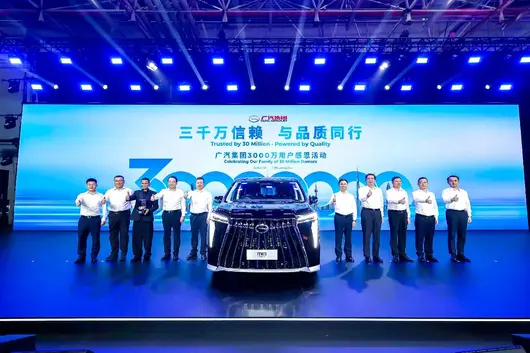
July 16, the GAC Group 30 million user gratitude event was grandly held at the GAC Trumpchi factory. Guangdong Province, Guangzhou City, Panyu District relevant leaders, China Association of Automobile Manufacturers Executive Vice President and Secretary-General Fu Bingfeng, GAC Group Chairman Feng Xingya, General Manager He Xianqing and other leadership team members, joined hands with industry partners, representatives from supply and demand ends, domestic and overseas car owners, employees, and media guests to gather on site, jointly witnessing GAC entering a new development milestone of 30 million users.

[Attending guests witnessed the moment GAC welcomed the 30 million user milestone]
Deeply cultivated the automotive industry for 29 years, 30 million users' trust is the best witness of GAC consistently upholding quality bottom line and deepening user services, and is also the confidence of the enterprise firmly in electric and intelligent transformation, reflecting the transformation of China's automotive industry from scale growth to high-quality development. Relying on solid transformation layout, GAC steadily broke through during the industry's deep adjustment period. In the first half of this year, sales were 773,100 vehicles, a year-on-year growth of 2.35%; new energy sales year-on-year growth of 68.8%, overseas exports over 120,000 vehicles, a year-on-year significant growth of 132%, globalization development momentum is strong.
I. New Energy Matrix Debuts, Witnessing Global Two-Way Rush
This event adopted a global multi-base connection mode. GAC Honda P7, GAC Toyota bZ7, Qijing GT7, GAC Aion N60, GAC Hyper S600 five new energy models rolled off the production line in sequence. Subsequently, Right-hand drive GAC Trumpchi M8 PHEV appeared as the Group's 30 millionth vehicle in a heavy role, full category new energy matrix on display, intuitively showing GAC's whole-speed deep cultivation of new energy track transformation results.

[GAC 30 millionth vehicle — Right-hand drive GAC Trumpchi M8 PHEV rolls off the production line]

[GAC Intelligent New Energy Matrix Shines On Stage]
At the event site, GAC Group Chairman Feng Xingya handed over the key of the 30 millionth new car to Thai owner Tony Jaa. With user bonds spanning mountains and seas, it interprets the brand warmth of GAC's two-way rush with global users under the global layout.

[Feng Xingya (Left) hands over new car key to Thai owner Tony Jaa (Right)]

[He Xianqing (Far Left) awards honorary owners of all GAC Group brands]
II. Upholding Quality Bottom Line, Strict Systems Build Travel Foundation
"Quality is GAC's bottom line that will never be yielded." Feng Xingya emphasized in the event speech. For a long time, GAC has always stuck to the "Quality First" core concept, integrating Honda Total Quality Management, Toyota Lean Production Model, and Lingnan Craftsmanship Culture to build an integrated innovation quality management system with unique characteristics, creating travel products that let users feel relieved, worry-free, and comfortable with extreme quality.

[Witnesses of key nodes in GAC's development history tell the story of GAC walking with quality]

[“National Excellent Engineer Team” GAC Powertrain Independent R&D Team tells the R&D innovation history]

[GAC Aion Intelligent Ecological Factory]
In R&D and manufacturing ends, GAC built a full-chain quality control system. All new cars pass "Five Highs, One Mountain, One Dust" extreme environment testing and "Two Winters, One Summer" full scenario road testing, experiencing 12 major items and over 1500 rigorous validations. Relying on the global first new energy vehicle lighthouse factory's digital intelligent manufacturing capabilities, continuously and stably output high-quality products. On safety level, Xingling Security Protection System, cumulative 1.5 million vehicles equipped, Pellet Battery safe driving over 160 billion km, combined with industry's first independent brand "Three Responsibilities" bottom-line policy, all-round avoid car usage risks and dispel user concerns, building a solid travel safety line for tens of millions of users.

[GAC Xingling Security Protection System]
III. Deeply Focusing on User-Centricity, Full-Cycle Service Warms Thousands of Companionships
Upholding the corporate philosophy of "People are the foundation, Trust is the way, Innovation is the priority", GAC has always placed user needs first, building a full-cycle, refined heart-warming service system. The brand regularly carries out "Users Open Mic" face-to-face exchange activities, established an exclusive user insight department, built a demand closed-loop processing mechanism, ensuring user suggestions responded to one by one and matters implemented, targeted optimization of product and service shortcomings.

[GAC "Users Open Mic" Event Site]
Service layout continues to sink and upgrade, planning to add 1,000 county-level authorized stores this year, broadening service coverage; launched "Super Butler" service, achieving 5-second fast response, 2-hour demand completion. Meanwhile, built a "9 Vertical 10 Horizontal" charging network covering 31 provinces and 213 cities nationwide, self-operated charging piles over 27,000 posts, super charging piles break 20,000 posts, core urban areas achieve 1 km charging coverage full coverage. To return user companionship, GAC officially launched 30 Million Units Roll-off · Renewal Gratitude Season, six major passenger car brands simultaneously launched new purchase, trade-in, increase purchase exclusive rights, sincerely returning the trust of tens of millions of users.

[GAC Energy "9 Vertical 10 Horizontal" Charging Network]
IV. Technology Empowers Transformation, Anchoring New Future of High-Quality Development
With 30 million users as a brand new starting point, GAC will stick to quality original intention and deeply cultivate user value, drive brand upgrade with hardcore tech innovation, accelerate transformation into ecosystem-type tech auto enterprise. To date, GAC cumulative R&D investment over 62 billion yuan, established over 6,800 global professional R&D team, continuously conquering core technology barriers.

[GAC Xingyuan Power lets users choose "No Compromising"]
In power field, Xingyuan Power three technologies developed by National Excellent Engineer Team will go into full mass production, verified by 10 million km limits, adapted to all regions, all scenarios travel; in three electricity field breakthrough all-solid-state battery, super fast charging, low temperature range, industry pain points, Quark Electric Drive efficiency breaks industry top level. In intelligence field, Xingling Architecture, Xinghe Smart Cockpit continuously iterate, link with Huawei, CATL, Tencent, Alibaba and other leading enterprises co-build high-end AI intelligent ecosystem, let smart tech truly land as user-perceivable convenience and safety.
V. Gathering Strength for a New Journey, Continuing to Write New Heights for China's Auto Brands
Based on brand new development milestone, GAC will always with quality as foundation, user as center, innovation as core, globalization as path, continuously polish high-quality products, upgrade heart-warming service system, iterate frontier smart tech. In the future, GAC will continue to deeply cultivate green smart travel track, continuously improve industry ecosystem, walk hand in hand with tens of millions of users, achieve each other, continuously write new chapters of high-quality development of China's automotive industry.

On July 16, GAC Group achieved the historic milestone of delivering the cumulative 30 millionth vehicle. 30 million vehicles represent a strong answer sheet of 29 years of deep industry cultivation, and are also a microcosm of the era where the Chinese automotive industry rose from local roots to go global. Unlike the industry's traditional "vehicle export" shallow overseas mode, GAC relies on the "One GAC 2.0" systematic globalization strategy, completing a leap advancement from "single vehicle export" to "whole industry chain local rooting", with an integrated layout of R&D, production, supply, sales, service, and energy, using deep localization to solidify the global competitiveness behind the height of 30 million production and sales.

From the first vehicle off the line to the delivery of the 30 millionth vehicle, GAC has gone through a 29-year development journey. Behind the number 30 million is the choice and trust of tens of millions of users, the determination of GAC to long-term stick to quality and safety, the determination to transform towards electrification and intelligence, and also a microcosm of the Chinese automotive industry growing from large to strong and from scale expansion to value leap.
Global Synchronization: Intelligent New Energy Matrix Highlights Transformation Progress
At the event scene, GAC connected multiple global production bases simultaneously. GAC Honda P7, GAC Toyota bZ7, QiJing GT7, GAC Aion N60, GAC Hyper S600 went off the line sequentially as the 29,999,995th to 29,999,999th vehicles of GAC respectively. Finally, the RHD version GAC Trumpchi M8 PHEV made a brilliant debut on the on-site stage as the 30 millionth vehicle. The collective appearance of the new energy vehicle matrix going off the line became a direct verification of GAC's full-speed promotion of electrification and intelligence transformation.

[GAC 30 Millionth Vehicle - RHD Version GAC Trumpchi M8 PHEV Rolls Off Production Line]

Subsequently, Feng Xingya handed over the key to the 30 millionth vehicle to Thai owner Mr. Tony Jaa. This moment frozen is not just a number, but a warm witness of mutual striving between GAC and global users.


This trust spanning mountains and seas is exactly the confidence for GAC to break through in the industry changes. In the first half of this year, GAC Group sales reached 773,100 vehicles, a year-on-year increase of 2.35%, among which new energy vehicle sales increased by 68.8% year-on-year; overseas exports broke through 120,000 vehicles, a year-on-year surge of 132%, running a steady rhythm during the industry's deep reshaping period.
Quality as the Foundation, Solidifying Confidence for Millions of Users' Travel
"Quality is the bottom line that GAC will never yield." Feng Xingya stated in the concluding speech. In GAC's development, scale growth has always been based on quality. For many years, GAC Group has always adhered to the "Quality First" concept, integrating Honda Total Quality Management (TQM), Toyota Lean Production Method (TPS) and Lingnan culture, building a quality management model centered on "Integration and Innovation". Everything falls back to building good cars that users can drive with confidence, use with ease, and sit comfortably in.


[GAC Aion Intelligent Ecology Factory]
From the R&D end to the manufacturing end, GAC has established a strict quality control system for the whole chain: Before each new car is launched, it must undergo extreme environment tests such as high cold, high temperature, high altitude, high humidity, high corrosion, mountain areas, sand and dust, etc., "Five Highs, One Mountain, One Dust" tests, and complete "Two Winters One Summer" actual road tests; relying on test sites and laboratories covering 12 major items and over 1500 verification sub-items of the whole vehicle to achieve systematic quality verification; GAC Aion Intelligent Ecology Factory, as the "Global First New Energy Vehicle Lighthouse Factory", ensures stable mass production quality with a digital intelligent manufacturing system.

[GAC Xingling Safety Protection System]
At the core safety technology level, the Xingling Safety Protection System builds four protection dimensions, and eight key systems adopt dual redundancy design, having protected nearly 2 million users and avoided 6.28 million potential travel risks; Mag Battery cumulative installation reached 1.5 million vehicles, safe driving mileage exceeded 160 billion kilometers; service side synchronized addition guarantee, GAC pioneered in the industry by launching the independent brand "Three Responsibilities" policy, proactively covering user concerns about batteries and intelligent driving assistance problems, eliminating user concerns about car usage. It is precisely these safety lines and service commitments that support the brand confidence behind GAC's 30 million sales.
User Orientation: Building a Heartwarming Service System for the Full Cycle
"What users care about, we keep in mind; what users look forward to, we go all out." Feng Xingya stated. This user-centered concept has long been deeply integrated into the development gene of GAC Group. For many years, GAC Group has always adhered to the corporate concept of "People as Basis, Trust as Way, Innovation as Priority", among which the core meaning of "People as Basis" is exactly being user-oriented.

On the one hand, to face problems directly and listen to users' voices, GAC holds user "All Open Mic" activities regularly, inviting users to the "home" for face-to-face communication. At the same time, establish a full-process closed-loop management mechanism to ensure that every suggestion can be properly handled, and common issues are optimized for all users at the first time.
In addition, GAC has also established a dedicated user insight department, promoted full-process transformation from problem discovery to solution, and ensured that every user request has a response and every matter has a result from the organizational mechanism.
On the other hand, the service network accelerates penetration simultaneously. In terms of channels, promote the service network to sink into counties, with a plan to add 1,000 county-authorized stores within the year; in terms of response, launch "Super Butler" service, achieving 5-second response, 2-hour request completion, ensuring user requests are directly handled quickly. In terms of energy replenishment, build a "9 Verticals 10 Horizontals" energy replenishment network, already covering 31 provinces and 213 cities nationwide, core urban areas achieve "a station must exist within 1 kilometer straight line", self-operated charging pile quantity exceeds 27,000, among which super charging piles break through 20,000, providing convenient energy replenishment service for new energy car owners.

[GAC Energy "9 Verticals 10 Horizontals" Energy Replenishment Network]
The core theme of this gratitude activity is to express sincere feedback and thanks to the long-term support of 30 million users. At the event scene, Feng Xingya announced that from now on, GAC officially launches "GAC Group 30 Millionth Vehicle Off-Line · Renewal Gratitude Season", GAC Honda, GAC Toyota, Trumpchi, GAC Aion, GAC Hyper and QiJing Motors six passenger car brands will launch characteristic policies around new purchase, trade-in to additional purchase, etc., to feedback every companionship and support.

Technology Centripetal: Empowering Real Travel with Frontier Technology
Taking 30 million as a new starting point, GAC will drive innovation and move towards a new journey of electrification and intelligence, allowing frontier technology to truly transform into safety and convenience perceptible by users.
In the power field, Xingyuan Power developed by the "National Excellent Engineer Team" covers three technologies: Xingyuan Range Extender, Xingyuan Plug-in Hybrid and Xingyuan Super Dual-Engine, which will be equipped with more models for mass production. Every product must undergo 100,000 hours of bench and whole vehicle verification, equivalent mileage exceeds 10 million kilometers, ensuring that performance remains stable as a rock under all scenarios and all regions.

In the "Three Electrics" field, GAC continues to tackle industry pain points such as battery super fast charging and low-temperature range endurance, has already built a full solid-state battery pilot production line, launched extreme energy consumption technology, mass-produced Quark Electric Drive Motor maximum efficiency broke through 99%, which is the highest level in the industry.
In the intelligent connectivity field, Super Brain Xingling architecture continues to evolve, connecting intelligent driving assistance, intelligent cockpit, power, chassis, body, and vehicle networking six major systems, achieving "one brain unified command", comprehensive performance increased by 40%; Galaxy Smart Cockpit achieves endpoint-cloud integration, making the car a true "thinking, understanding human heart" partner. GAC will also fight side by side with top partners such as Huawei, CATL, Didi, Tencent, Alibaba, etc., to build a more powerful AI intelligent ecosystem together.
As of now, GAC Group cumulative R&D investment exceeds 62 billion yuan, global R&D team exceeds 6,800 people. Continuous technology investment is driving GAC's products to evolve from mobility tools to intelligent travel partners, mobile smart spaces, and green energy ecosystems.
Facing the future, GAC will continue to take user needs as the anchor point, quality as the foundation, technological innovation as the core driver, and globalization layout as the development path, accelerate the advance to ecological technology GAC, walking side by side with more users, achieving each other, and rushing together towards a smarter, greener, and broader future.
Finally
From selling vehicles one by one to global markets, to factories landing overseas, to industry chains rooting locally, GAC lifts the industry height of cumulative 30 million vehicles production and sales with the globalization logic of "Not just product overseas, but more about rooting growth". Under the wave of electrification and intelligence transformation of the global automotive industry, GAC jumps out of the traditional export mode, using localization, systematic, and ecological long-termism, providing a reproducible new model for Chinese car brands' globalization. In the future, with the continuous deepening of the global industry chain, GAC will continue to take Chinese intelligent manufacturing as the foundation, rooting in every market in the world, and writing a brand new chapter for Chinese cars going global.
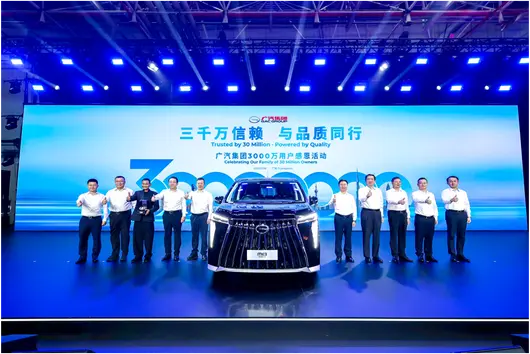

On July 16, as a right-hand drive GAC Trumpchi M8 PHEV slowly rolled off the production line, GAC Group officially reached the milestone of producing its 30 millionth complete vehicle. From the first complete vehicle rolling off the line to breaking through the 30 million mark, GAC has traversed a 29-year development journey. This number is not merely a report card on the scale of a car manufacturer, but also encapsulates the evolution of China's automotive industry: from starting with joint ventures and growing independently to breaking through in new energy globalization. In the current era of deep industry reshaping and escalating competition, GAC's 30 million moment combines the persistence of the manufacturing original intention with transformation strategies for the future, offering a referenceable practical path for the high-quality development of Chinese car companies.


The underlying support for the 30 million scale is the long-term persistence on quality and safety. As one of the earliest car companies in China to carry out joint venture cooperation, GAC systematically absorbed mature experiences of Honda's comprehensive quality management and Toyota's lean production in its early development, and combined it with its own practice for fusion innovation, forming a quality management system with unique characteristics. This quality gene runs through the entire chain from R&D to manufacturing. Before the launch of each new car, it must undergo extreme environment tests such as 'Five Highs, One Mountain, One Dust' (high cold, high heat, high altitude, etc.), complete 'Two Winters and One Summer' on-site road tests, covering over a thousand verification sub-items for the whole vehicle; at the production end, represented by the GAC AION Smart Eco Factory, digital intelligent manufacturing guarantees the stability of mass production quality, becoming the world's first new energy vehicle lighthouse factory. Safety technology and service guarantee are increased simultaneously, forming the second line of defense of quality. The eight key systems of the Xingling Security Guard System feature dual redundant designs, the Magazines Battery installed on 1.5 million vehicles with over 160 billion kilometers of safe driving, and the industry-first independent brand 'Three Responsibilities' policy, forming a complete closed loop from technology bottom layer to service bottom line. In the stage where China's car market shifts from incremental to stock, the core ruler of user choice is returning to the essence of products. GAC's 30 million user trust accumulated over 29 years is essentially holding the bottom line of manufacturing that 'quality is not waived', which is also the core foundation of China's automotive industry from becoming large to strong.
Another signal of this milestone ceremony is the comprehensive acceleration of GAC's electrification and intelligence transformation. The 29,999,995 to 29,999,999 complete vehicles shown on site are all new energy models, covering six brands: GAC Honda, GAC Toyota, GAC Trumpchi, GAC AION, GAC Hyper, and Qijing Auto; and the right-hand drive Trumpchi M8 PHEV as the 30 millionth vehicle was finally delivered to a Thailand owner's hands, linking the two major trends of new energy transformation and globalization going out. Data confirms the actual results of the transformation. In the first half of this year, GAC Group's overall sales were 773,100 vehicles, a year-on-year increase of 2.35%; among them, new energy vehicle sales increased by 68.8% year-on-year, and overseas exports broke through 120,000 vehicles, a year-on-year increase of 132%. Under the industry background where the fuel car market is generally under pressure, new energy and exports are becoming the dual engines pulling growth. This growth is built on long-term R&D investment. As of now, GAC's cumulative R&D investment has exceeded 62 billion yuan, and its global R&D team has over 6,800 people. From Xingyuan Power's three technical routes, to the Quark Electric Drive with efficiency breaking 99%, to the completion of the all-solid-state battery pilot production line and the continuous evolution of Xingling Architecture, technical reserves are gradually being converted into product competitiveness. Unlike the path of some car companies betting solely on independent new energy, GAC promotes dual-line transformation of joint ventures and independence, forming a collaborative and complementary new energy matrix. In the current situation where joint venture car companies are generally facing transformation pain, this model retains the quality and manufacturing advantages of the joint venture system, and uses the technology vitality of the independent sector to drive overall upgrades, exploring a feasible direction for the electrification of joint venture brands.
The accumulation of 30 million users further validates the industry consensus of 'user-centric'. Current car market competition has long extended from the product end to the full lifecycle experience, and user operation capability has become an important component of the brand moat. GAC's practice lands on mechanism and service ends. On the mechanism level, it regularly holds face-to-face exchanges of 'User Open Mic', establishes demand full-process closed-loop management, and sets up a dedicated user insight department, guaranteeing user voices reach the decision layer from the organizational structure. On the service network level, it promotes channel sinking to counties, plans to add 1,000 county-level authorized stores this year, launches 'Super Steward' to achieve rapid response, and improves user experience with efficiency improvement. To address the charging pain points of new energy users, GAC built a '9 Vertical 10 Horizontal' charging network, with over 27,000 self-operated charging piles, achieving 'a station within 1 kilometer straight line' in core urban areas, alleviating user anxiety with infrastructure perfection. From 'selling products' to 'operating users' is a common transformation direction in the industry, and GAC's practice shows that user operation is not marketing jargon, but needs to be implemented in a full chain from organization, channels to ecosystem. 30 million users are both the accumulation of past reputation and the starting point of the future user ecosystem. Only by truly placing user demands in the core position can scale effects be converted into continuous brand value.
Looking back at the node of 30 million vehicles, GAC's development track is a microcosm of the upgrade of China's automotive industry, from learning advanced manufacturing experience through joint ventures, to independent mastery of core technology to achieve overtaking by changing lanes, and then participating in global competition with new energy products. In 29 years, Chinese car companies have completed the leap from catching up to running side by side, and then to leading in some fields. Behind the number of 30 million is the era trend of the entire industry from scale expansion to value leap. 30 million is not the end, but the starting point of a new round of competition.
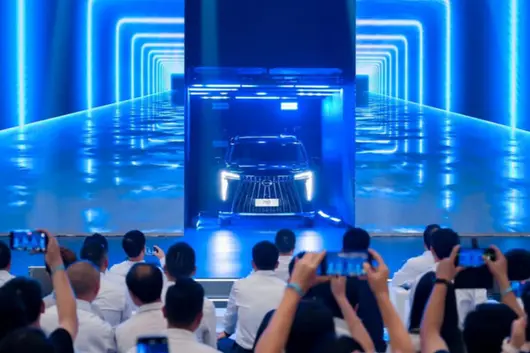

On July 16, GAC Group's 30 million user appreciation event was held at the GAC Trumpchi factory. From the first complete vehicle coming off the assembly line to the delivery of the 30 millionth vehicle, GAC has undergone 29 years of development. Behind this number 30 million is GAC's long-term determination to maintain quality and safety, the determination to transform towards electrification and intelligence, and also a microcosm of China's automotive industry growing from large to strong and from scale expansion to value leap.

At the event venue, GAC's global multi-site production bases were connected synchronously. GAC Honda P7, GAC Toyota Platinum 7, Enjun GT7, GAC AION N60, and GAC Hyper S600 came off the assembly line sequentially as the 29,999,995th to 29,999,999th vehicles of GAC. Finally, the right-hand drive version of GAC Trumpchi M8 PHEV made a dazzling debut on the on-site stage as the 30 millionth complete vehicle. The collective appearance of the new energy vehicles on the full line became an intuitive verification of GAC's full-speed promotion of electrification and intelligence transformation.

Subsequently, GAC Group Chairman Feng Xingya handed the key to the 30 millionth vehicle to Thai owner Mr. Tony Jaa. This moment not only froze a number but also the warm witness of GAC and global users "moving towards each other".

This trust spanning mountains and seas is GAC's confidence to break out in the industry transformation. In the first half of this year, GAC Group's sales volume reached 773,100 vehicles, a year-on-year increase of 2.35%, among which the sales volume of new energy vehicles increased by 68.8% year-on-year; overseas exports broke through 120,000 vehicles, a significant year-on-year increase of 132%, running a steady rhythm in the industry's deep reshaping period.

"Quality is the bottom line GAC will never surrender." Feng Xingya stated in the summary address. In GAC's development, scale growth has always been based on quality. From R&D to manufacturing, GAC has established a strict quality control system for the whole chain: before the launch of each new car, it must undergo extreme environment tests of "five highs, one mountain, one dust" including high cold, high heat, high altitude, high humidity, high corrosion, mountainous areas, and dust; complete "two winters and one summer" on-site road tests; using test grounds and laboratories covering 12 major categories and over 1,500 verification sub-items of the whole vehicle to achieve systematic quality verification; GAC AION Intelligent Ecology Factory, as the "Global First New Energy Vehicle Lighthouse Factory", guarantees stable mass product quality with a digital intelligent manufacturing system.

In the core safety technology level, the Star Intelligence Security Protection System builds four protection dimensions. Eight key systems adopt dual redundancy design, having protected nearly 2 million users and avoided 6.28 million potential travel risks; Magazine Batteries cumulatively equipped 1.5 million vehicles, with safe driving mileage exceeding 160 billion kilometers; the service side simultaneously increased guarantees, GAC launched the proprietary brand "Three Responsibilities" policy in the industry first, proactively providing a safety net for user concerns about batteries and intelligent driving assistance, dispelling user concerns about using cars. It is precisely these lines of safety defense and itemized service commitments that support the brand confidence behind GAC's 30 million sales.
"What users care about, we keep in mind; what users expect, we do our best." Feng Xingya stated. This user-centric concept has long been deeply integrated into the development gene of GAC Group. For many years, GAC Group has always adhered to the corporate concept of "People First, Trust as the Way, Innovation First", among which the core meaning of "People First" is putting users first.

On the one hand, to face problems directly and listen to the user voice, GAC regularly holds User Open Mic events, inviting users to "home" for face-to-face communication. At the same time, establishing a full-process closed-loop management mechanism ensures that every suggestion can be properly handled, and common problems are optimized for all users first.
On the other hand, the service network is accelerating penetration simultaneously. In the channel end, service network sinking to counties is promoted, with plans to build 1,000 county-level authorized stores in the year; in the response end, "Super Butler" service was launched, achieving 5-second response and 2-hour request handling, ensuring user requests are handled directly and quickly. In the charging end, "9 Vertical and 10 Horizontal" charging network is being built, already covering 31 provinces and 213 cities nationwide, achieving "a station every straight 1 kilometer" in core urban areas, with self-operated charging piles exceeding 27,000, among which supercharging piles exceed 20,000, providing convenient charging services for new energy car owners.
The core theme of this appreciation event is to pay sincere feedback and gratitude to the long-term support of 30 million users. At the event, Feng Xingya announced that effective immediately, GAC officially launches the "GAC Group 30 Millionth Vehicle Delivery • Renewed Gratitude Season", GAC Honda, GAC Toyota, GAC Trumpchi, GAC AION, GAC Hyper and Enjun Automotive six passenger car brands will launch characteristic policies around new purchase, trade-in to add-on purchase respectively, to reward every companion and support.

With 30 million as a new starting point, GAC will move towards a new journey of electrification and intelligence with innovation driving, making frontier technology truly transform into user-perceivable peace of mind and convenience.
In the power field, Star Source Power developed by the "National Distinguished Engineers Team", covering Star Source Extended Range, Star Source Plug-in Hybrid and Star Source Super Dual Engine three technologies, will be equipped in more vehicle mass production. Every product must undergo 100,000 hours of bench and whole vehicle verification, with equivalent mileage exceeding 10 million kilometers, ensuring that under all scenarios and all regions, performance remains as steady as a rock.

In the "Three Electrics" field, GAC continues to tackle industry pain points such as battery super fast charging and low-temperature range, having built an all-solid-state battery pilot production line, launched extreme energy consumption technology, the mass-produced Quark Electric Drive Motor maximum efficiency broke through 99%, achieving the highest level in the industry.
In the intelligent connectivity field, the Super Brain Star Intelligence Architecture continues to evolve, connecting six systems of intelligent driving assistance, intelligent cockpit, power, chassis, body, and vehicle networking, achieving "one brain unified command", comprehensive performance improved by 40%; Star River Intelligent Cockpit achieves Edge-Cloud Integration, making the car become a real "thinking, understanding people" partner. GAC will also fight side by side with top partners such as Huawei, CATL, Didi, Tencent, and Alibaba to build a more powerful AI intelligent ecosystem.
As of now, GAC Group's cumulative R&D investment exceeds 62 billion yuan, with a global R&D team exceeding 6,800 people. Continuous technical investment is pushing GAC's products to evolve from tools for transportation to intelligent travel partners, mobile smart spaces, and green energy ecosystems.
Looking to the future, GAC will continue to use technological innovation as the core driver, use global layout as the development path, accelerate towards eco-tech GAC advancement, and move towards a smarter, greener, and broader future with more users.