首頁Lotus

搜尋歷史
熱門搜尋
經銷商登入 / 註冊

Neta Auto might really be "resurrected".
The funniest part is, the company coming to save it is named Taiyi Shenglian.

Seeing this, I guess many people's first reaction is similar to mine: Did they come up with this name on the spot?
Turns out, it really is the case.
Taiyi Shenglian was established in April this year, specifically as the entity for this restructuring. Now it is prepared to pay 3 billion yuan to acquire approximately 70.62% of the equity of Neta Auto's parent company, Hozon New Energy. In mythology, Taiyi Zhenren used a lotus to reshape Nezha's body, and by 2026, the capital market actually reenacted this story.

I can only say, after so many years of marketing in the auto industry, the most effective wave of communication this time was completed by the Industry and Commerce Bureau.
But after playing this gimmick, I am still quite curious, why is there still someone willing to spend 3 billion to save Nezha at this time?
A few years ago, if someone invested 3 billion into a new energy vehicle company, it seemed nothing strange. But by today, the market is completely different.
Is China still lacking in automobile brands?
Everyone just open the sales list and scroll down; BYD, Geely Galaxy, Leapmotor, Changan Qiyuan, Chery, Aion, plus a bunch of brands still struggling to squeeze onto the table. 100,000, 150,000, 200,000, every price bracket is almost full.

And at this time, someone returns holding 3 billion yuan to pull a Neta that has been halted for a long time back up.
I can only say, friend, your head is really stubborn.
After all, one of the topics discussed most in the industry has long changed from "Who can still enter" to "How many more need to be eliminated".
So let's first see how this 3 billion yuan plans to be spent.
According to the currently disclosed restructuring draft, Taiyi Shenglian will contribute 3 billion yuan. Approximately 1.167 billion yuan will be used to clear related creditors and pay bankruptcy expenses. The amount that can truly be injected into the company to support production resumption and operations is about 1.833 billion yuan. Taiyi Shenglian will eventually acquire approximately 70.62% of Hozon New Energy's equity.

So everyone, don't be stunned by the number "3 billion to resurrect Nezha". The money truly available to start working again is just over 1.8 billion.
Is 1.8 billion a lot? If I put it in my bank card, it's enough for me to research how to spend it for a lifetime. But in an auto company, you have to restrain yourself a bit.
It is precisely because of this, when I saw the first phase of this restructuring plan, I actually felt they were still taking it easy this time.
First, resume production of Nezha X, mainly for overseas markets, with an annual sales target of 10,000 units, and simultaneously restore official spare parts, maintenance, repair, and existing service networks.

Especially when seeing "10,000 units", I even felt a bit relieved, finally no one is shouting for tens or hundreds of thousands of sales at the very start.
The thing Neta is currently most anxious about might not even be reaching "returning to mainstream new energy brands" on such a grand scale. First, get the factory turning again, call back suppliers, and ensure owners of old cars with broken cars have someone to repair them. If these few things can be done smoothly, that counts as taking a big step forward.
Actually, the old owner part is also easily overlooked by everyone.
After a car brand collapses, the awkward ones are never the onlookers. Onlookers at most contribute one sentence: "I told you so."

The ones with real headaches are those who have already handed over over 100,000 yuan. Who will repair my car? Are there still spare parts? If problems arise, can I still find the manufacturer?
So this time, the restructuring plan puts resuming after-sales service and official spare parts supply in the first phase. I think this order is at least correct.
After all, if you want to sell cars again, you first have to ensure those who have already bought your car aren't that panicked.
But speaking of this, problems arise. What does Neta have left that is worth someone spending 3 billion to take over?
If we talk only about the four words "Neta Auto", I think everyone should not think it is too valuable first.
Neta has indeed been spectacular before. In 2022, sales exceeded 150,000 units and it took the number one annual sales spot among new forces. But automobiles are quite cruel; after brand voice drops, consumer memory refreshes particularly fast.
If you were sales champion two or three years ago, today if a Neta X is set up again in a shopping mall, consumers might still first ask a question: "Has their business returned to normal?"
This sentence hurts quite a bit. Because many auto companies can recover production capacity with money. But brand credibility drops, and picking it back up is not that simple, especially for big-ticket items like cars that people prepare to use for many years.

So the valuable things Neta still has, I think, need to be looked at behind the brand. Including factory, production lines, molds, R&D systems, supply chain relationships, complete vehicle manufacturing capabilities, and overseas systems built up in the past. These things might be more interesting to investors than the name "Neta" itself.
Especially do not forget who is behind Taiyi Shenglian.
Although Taiyi Shenglian is the investment entity established specifically this time, several layers of equity and personnel relationships point to the Shanzi High-Tech system. Shanzi High-Tech's current main business already includes automotive parts and complete vehicles two major sectors. Under it there is also the Belgian Punch (making powertrains), and the American ARC (making airbag gas generators).

Moreover, in these years, Shanzi High-Tech has never given up on moving towards complete vehicles.
It previously acquired Red Star Auto, did complete vehicle factory revitalization, and now there is also the Shanzi Youqian complete vehicle business under it. Zhu Renjie, who is in charge of Shanzi Youqian, previously worked at Tesla as Director of Manufacturing Engineering and participated in the formation of the Shanghai Gigafactory body manufacturing team.
Putting this string of things together, the matter roughly makes sense.
Neta lacks money, Shanzi High-Tech lacks a "ready-made complete vehicle company".
Shanzi High-Tech has parts, manufacturing experience, and some overseas resources, but from "I can make things for others" to "I can make a complete vehicle and sell it", there is still a fairly wide gap in between.
R&D systems need to be built, supply chains need to be built, production, certification, sales, after-sales all need to be built. If truly starting from zero, money aside, time alone would be enough to drink a pot of tea (quite a long time).
Neta just happens to have basically walked through these things already. Even if now many links are already broken, it at least once reached annual sales of 150,000, has products truly mass-produced, has a supply chain, has a factory, and has sold cars overseas.

So standing from Shanzi High-Tech's angle, spending 3 billion to save a laggard new force sounds quite adventurous.
But if it is spending 3 billion to acquire an automobile company that already possesses complete vehicle R&D, production, supply chain, overseas business, and "dual qualification" foundation, then stuffing their parts, manufacturing, and overseas resources into it, suddenly does it not seem so ridiculous?
Especially previously, when Hozon New Energy was seeking a management trustee, they specifically mentioned maintaining "automotive manufacturing dual qualifications", and later the Shanzi system also established a complete vehicle sales related company in Tongxiang.
This basically already has their thoughts written on their face. What they truly value is never just the Neta brand, more still the complete vehicle manufacturing, sales, and overseas business foundation that Neta has already set up.
One lacks money, one lacks a complete vehicle platform. Looking at it this way, Taiyi Shenglian "saving Nezha" slowly returns from mythological stories back to business.
And I think, this matter is quite representative of a certain way of playing in the automobile industry in the future.
In the past when capital had money, everyone was from zero starting to build a new brand with dozens or hundreds of billions.
Now the first elimination round has come to this, many brands might not be able to survive, but factories remain, equipment remains, supply chains remain, R&D systems have a little left.

So a failed automobile brand, at its cheapest time, might actually be when the set of vehicle manufacturing capabilities it left behind is most attractive.
Neta this time is roughly in this situation.
This also explains why the first step of the restructuring plan did not urgently focus on redriving the domestic market, but placed hope overseas.
Neta has already fallen behind domestically, but overseas has left a little foundation. In the first half of 2024, overseas deliveries exceeded 17,000 units. Thailand, Indonesia also had plans for local production, and Nezha X itself already has an overseas sales foundation.
Now taking over 1.8 billion plus to return and charge into this fiercely competitive domestic market, I am nervous for this money.
First, pick up the overseas business that has run through once, let factories, supply chains, and cash flow turn again. At least it is much more reliable than coming back to hard fight domestically.
So, back to the very beginning question. There are already so many Chinese automobile brands, is it necessary to spend money to resurrect Neta?
If it is just pulling Neta back to the domestic market, continuing to compete with Leapmotor, BYD, Changan, Geely in the 100,000 to several hundred thousand yuan new energy vehicle market, I think the meaning is indeed not great.
But first, restart Neta's overseas product lines as a敲门砖 (敲门砖 translates to "door-knob" i.e., entry tool) to open the overseas market, this business still has some chew.
As for whether this brand will have a chance in the future to ride the wind and fire wheels and kill back to the domestic market...
First see if Taiyi Shenglian can revitalize itself first.
Lotus Group (a wholly-owned subsidiary of Geely Holding Group) H1 2026 financial report is now out, this financial report has some highlights; as the enterprise clarified the narrowing of loss area, and simultaneously clarified the sales performance of the brand in different markets, let's take a look at the detailed data below.

Key data includes:
On August 21, 2026, Geely Holding completed 100% equity acquisition of Lotus UK; at this point its UK Hethel factory and Lotus Engineering consulting business are all completed internal integration; before this, Geely Holding only held 51%, Etika held 49%, such a joint venture state would affect Lotus development decisions, because Etika has veto rights on important decisions. Conversely, after full acquisition can completely break free from Etika's interference.
Believe the future will no longer have Lotus Engineering team handle tuning of certain group brand direct competitors situation, knowing that Xiaomi SU7 Ultra Nürburgring version was tuned by Lotus Engineering team.

The previous 'Lutess' is the current Lotus Automobile.
Clearly Lotus Car's name sounds better, why call it 'Lutess' before?
Lotus translates to Lotus (flower), Lutess is the phonetic translation of the word; and the reason for using Lutess this phonetic translation name was 'Lotus' trademark was already grabbed registered, then Lutess Car negotiated trademark transfer with the company unsuccessfully, so could only use phonetic translation name. But what belongs to who is belongs to who, Lotus Car is very important to the brand; subsequently Lotus launched rights protection via litigation, finally obtained 'Lotus' trademark, later changed brand name.

Believe old drivers still remember another car brand related to Lotus, this brand is 'Youth Lotus.'
However the one who grabbed this trademark was not Youth Lotus Car, but an auto parts company, now unnecessary to mention this company again; just need to explain, otherwise might wrongly accuse Youth Lotus Car. However Youth Lotus Car might not care, because Youth Lotus Car was a sub-brand launched by Zhejiang Youth Auto Group in 2006 in cooperation with Malaysia's Proton Group, Proton Car acquired the Lotus parent company in 1996, but purchased only 'Lotus Engineering' chassis tuning service.
Subsequently the Youth Auto Group wanted to register and use the Lotus Car brand, but also because of trademark registration issues could not use it; later could only use the 'Youth Lotus' brand name which was borderline.

The car products built by Youth Lotus Car were actually Proton GEN-2, not Lotus whole vehicles, technology aspect also had no deep Lotus participation; so product competitiveness was actually relatively limited, Youth Lotus brand name also seemed slightly strange in Chinese context, brand appeal was obviously not strong enough.
So in 2012 the cooperation between the two parties broke down, Youth Auto went bankrupt and liquidated in 2017.
Thus Youth Lotus Car became a thing of the past, however recently happened to encounter one by chance, it already looks quite aged. As for the future, naturally there is only one Lotus Car, no need to use the Lutess name anymore.


Only 21 months since launch, cumulative sales exceeded 800,000 units—Geely Xingyuan, with its "Xingyuan Speed" of "1 unit delivered per minute on average," once again shattered growth records in the Chinese new energy vehicle market. On August 10, Geely Xingyuan officially launched exclusive fan appreciation rights for 800,000 users: Starting August 11, 800,000 owners can log in to the Geely Galaxy APP to draw benefits such as Capybara IP merchandise, car accessories, charging service fee discount coupons, etc. All gifts come from the real demands of previous user research. Meanwhile, for users waiting more than (including) 28 days for delivery, Xingyuan specially sets exclusive [Xingyi Gifts], ensuring every expectation receives a response.
Behind the choice of 800,000 users lies the mutual pursuit of "Champion Strength" and "Champion Fan Appreciation Power"

The sustained hot sales of Geely Xingyuan do not rely on impulse growth catalyzed by short-term traffic, but rather a long-term value realization. In 2025, Geely Xingyuan won the sales champion in all categories of the Chinese auto market; in the first half of 2026, cumulative sales exceeded 249,000 units, up 21% year-over-year, firmly securing the sales champion position in all categories. In the A0-level pure electric sub-segment, its market share exceeds 30%—among every 3 users who choose an A0 pure electric sedan, 1 chooses Geely Xingyuan. In the first quarter of this year, Geely Xingyuan even made it into the top three global new energy vehicle sales, becoming the only model from a Chinese brand to enter this list.
Meanwhile, Geely Xingyuan has entered over 30 countries and regions globally, ranking in the top 2 for Chinese new energy hatchback exports from January to June 2026. In Brazil, sales exceeded 10,000 within just 5 months of launch, ranking first in Thai new energy sales in June. On August 5, Xingyuan officially launched in Australia, and will enter the EU and UK in the third quarter. From emerging markets to developed markets, Xingyuan is becoming a flowing Chinese business card.
Hard-core strength is the "Champion Confidence": "Good Battery, Good Handling, Great Safety, Great Comfort" are indispensable

Behind the 800,000 sales, there are no shortcuts. Geely Xingyuan turned all user concerns about small cars into product certainty.
Regarding the tri-electric reliability that users care about most, Geely Xingyuan gave the most direct response with "Good Battery". The entire series is equipped with CATL cells, regardless of version or batch, users don't have to open blind boxes. Coupled with the Shendun Battery Security System and full-domain liquid cooling temperature control technology, 30% to 80% fast charging takes only 19 minutes, CLTC maximum range 480 km, the capacity of Xingyuan batteries still remains 96.5% after 84,000 km of actual testing—using hard-core data to dispel user concerns about pure electric travel.

In terms of "Good Handling", Geely Xingyuan not only adopts the rear-wheel drive + independent suspension architecture same as luxury cars, but also welcomes the deep empowerment from the "Chassis Master" Lotus Engineering Team. In January this year, Xingyuan partnered with the Lotus Engineering Team to fully participate in winter chassis tuning carried out in Sweden. In the icy and snowy environment below minus 30 degrees, around the ESC electronic stability control system, G-TCS all-weather anti-skid system, torque control, and whole vehicle dynamic performance, multiple rounds of strict testing and calibration were conducted. What Lotus brought to Xingyuan was not the aggression of a sports car, but the precision, balance, and stability precipitated from a hundred years of track tuning experience. Tracks pursue limits, while home use emphasizes discretion. Xingyuan converts limit capabilities into peace of mind all the way, bringing a driving control experience that is easy to handle, stable, and not car sick, allowing beginners to get started easily. This chassis system also helped Xingyuan complete the 130 km/h hook test and 80.7 km/h moose test that small cars of the same class never passed before, leaving extreme safety margins for users. Previously, a car owner in Wenzhou encountered a vehicle going the wrong way suddenly in dense fog, twice emergency handling to turn danger into safety, which is precisely the strength endorsement of this "Track-level Tuning" chassis under extreme scenarios.
Good handling is the confidence for active risk avoidance, while "Great Safety" is the last line of defense for protecting users. Geely Xingyuan partnered with CCTV to successfully challenge continuous collision tests of 50 km/h front and 55 km/h side, and smoothly passed AEB 120 km/h braking stop + AES 130 km/h active avoidance. A car owner in Chengdu, after an accident where the vehicle was sandwiched front and back by a truck and nearly totaled, found the A and B pillars intact, zero intrusion into the passenger compartment, doors opened normally, and the owner safe and sound—afterwards he chose Xingyuan again without hesitation. This trust from real users outweighs any safety certification.

Beyond hard power, "Great Comfort" is a longer promise from Geely Xingyuan to users. In terms of products, Xingyuan for the first time downgraded the Thousand Miles Ocean Auxiliary Driving H3 solution from high-end cars to the A0-level market, covering highway NOA, 300+ scenario automatic parking, and 25 active safety functions. Coupled with Flyme Auto2 smart cockpit and quasi-B class spacious space, 70L super large front storage box and 10L co-pilot drawer, let small car users equally enjoy the comfortable large space of free storage.
On the service side, relying on Geely Group's comprehensive user system, over 2,300 self-built charging stations cover 220 cities, over 2,600 service networks across the country achieve full coverage for cities above the fourth tier, first non-operational owners enjoy a lifetime warranty for the tri-electric system—providing full-link guarantee from energy replenishment to after-sales, allowing users to buy with peace of mind and use with comfort.
"Galaxy-Style Fan Appreciation" continues to upgrade, going to beauty together with 800,000 users

Good products are the cornerstone, but what truly let Geely Xingyuan change from "1 car" to "800,000 users' common choice" is the emotional connection of mutual pursuit with users. From the beginning of launch giving Haagen-Dasz upon arrival to the dealership, Harbin Ice and Snow Carnival, to partnering with the World's No. 1 Wealth God Temple to send wealth blessings; from "Island Lie Flat Gift Pack" to Capybara surprise benefits, to today's 800,000 exclusive fan appreciation rights—Xingyuan has always played with users.
This emotion is also converting into more beautiful value. Relying on the "Our Xingyuan" charity plan, Xingyuan and car owners lit up the basketball court for basketball teenagers in Daliangshan, Sichuan, helped football children realize their dreams in the green field in Qiannan, Guizhou. This summer, Xingyuan joined forces with car owners to launch the "North Melon South Move" action, helping Henan melon farmers broaden sales channels, while sending cooling relief to outdoor workers under high temperatures. User kindness is gathered into concrete actions, making every choice become a power to convey beauty.
21 months since launch, sales exceeded 800,000 units—this is a hard-core answer paper that Geely Xingyuan has handed to the market and users, and even more a vivid witness to the value progression of Chinese new energy small cars. In the future, Geely Xingyuan will continue to take user needs as the core, uphold the "Good Battery, Good Handling, Great Safety, Great Comfort" champion product strength, especially based on the chassis tuning tempered by ice and snow of the Lotus Engineering Team, continuously refreshing the value standards of pure electric small cars, together with thousands of users, going to a new journey of beauty.

Lotus Cars announced its latest 2030 Strategy, which is a major push for sales and profitability, as well as a strategic adjustment of technology and routes.
By 2030, Lotus Cars aims to achieve annual production and sales of 30,000 units.
At the same time, it is no longer stubbornly adhering to the pure electric route, but moving forward with pure electric, hybrid, and fuel options.

However, performance cars are currently facing unprecedented changes: numerous new brands are flooding in, and traditional narrative styles are declining.
Consumers are redefining the standards for what constitutes a true performance car.
In this changing landscape, how Lotus Cars reshapes its brand and recreates its products to break through from the changes is self-evidently challenging.
To implement the 2030 Strategy, Lotus Cars is already laying out plans in earnest.
A major trump card Lotus Cars holds now is leaning on the Geely Group system, enabling it to secure more strategic resources to fight continuously.
Additionally, advancing along pure electric, hybrid, and fuel lines simultaneously can also help Lotus Cars expand its consumer base and open up markets in more countries or regions.
For Lotus, a more pragmatic and global chessboard is gradually unfolding.
The following are the core contents of the interview; we edited them without changing the original meaning.

Core Interview Content
Question: For 2030 to achieve an annual production and sales scale of 30,000 units, what will be the approximate sales distribution ratio between domestic and overseas markets? Will the brand subsequently deepen its investment in fuel models? Is there any information you can reveal on this?
Feng Qingfeng: At this stage, Lotus's sales in the US market mainly rely on sports cars produced in the UK, where tariff levels are relatively low.
China-made models face higher tariff barriers. Although adjusted down from previous peaks, the overall resistance remains significant.
Regarding fuel vehicles, the main layout for sports cars in the future will be hybrid, but in markets with strong demand for fuel vehicles, hybrid models can switch to pure fuel versions, such as in the Middle East and Saudi Arabia. Fuel prices are low, charging infrastructure is weak, and there is still some demand for pure fuel models locally.
The overall plan is hybrids accounting for 60%, pure electric 40%, with limited demand for pure fuel models.

Question: What is the specific pace of hybrid models in the overseas market? Lotus Cars has entered the US, Canada, and Brazil markets in the Americas so far. What are the expansion plans for other regions next? Recent US-Canada-Mexico races have seen high popularity, and the Geely Group is also involved. Could you ask if Lotus plans to carry out related market actions?
Feng Qingfeng: Regarding the Canadian market, delivery will start very soon. We seized a great market opportunity because when we were doing global product development certification, we completed all North American certifications in 2024.
Previously, when we entered the US market, the Eletre model had already announced its price and opened orders. Order performance was very good; once prices were announced, orders reached 6,000 units at one point.
With the recent China-Canada trade agreement lowering tariffs, we were able to enter the Canadian market at the fastest speed.
The South American market will gradually unfold starting with Brazil.
Let's talk about the European market pace. We will officially announce prices and open reservations in Europe this June, with formal delivery in the fourth quarter.
The overseas launch schedule for For Me has been delayed. The main reason is that the vehicle is equipped with an engine and needs to complete new Euro 7 emission standard certification. The certification cycle is longer than in China.
Next year, we will complete more global market certifications and enter markets in Australia, Malaysia, etc.

Question: Lotus has previously outsourced or cooperated on custom powertrains. Will Type 135 continue the outsourced model, or develop engines independently, or develop jointly with Geely?
Feng Qingfeng: For over 70 years, Lotus has never developed its own engines; power is entirely outsourced. The classic 3.5-liter model was procured from Toyota, and the 2.0-liter model was also outsourced.
However, after all outsourced engines arrive, Lotus performs secondary performance modifications: removing redundant non-performance parts and installing self-developed components. This improves power output on one hand, and optimizes overall durability on the other. However, the outsourced modification model has long constrained brand development.
After joining the Geely system and coordinating with this Focus 2030 Strategy transformation, Geely is assisting Lotus in engine development.
HORSE Power released the V6 model at the Beijing Auto Show. In the future, V6 and V8 models will be jointly developed by Lotus, Geely, and HORSE.
High-performance sports cars have another major technical difficulty, known as the pearl on top of the automotive industry crown: high-torque DCT transmission.
High-torque AT is relatively easier to implement. High-performance DCT that can bear hundreds or even over a thousand Newton meters of torque has an extremely high R&D threshold.
Relying on the collaboration among Geely, HORSE, and Lotus, we have already conquered this transmission technology.
Holding a full set of self-developed power resources, we have the confidence to implement the Type 135 project.
High-end high-performance powertrains are basically monopolized by top manufacturers and are not sold externally. Key power cannot be outsourced; it must be independently developed within the group.

Question: Many competitors are now launching intelligent shooting brake and intelligent sports car models. Many brands that originally did not涉足 this field are also joining in. How do you view this phenomenon?
Feng Qingfeng: More and more brands entering the performance car market indicates that the high-end performance consumer market truly exists and has considerable potential. This is a good thing and can drive more consumers to pay attention to and recognize the performance car track.
Lotus has a unique advantage. The essence of performance cars is lightweighting. Whether the body weight can be reduced directly determines the performance ceiling.
If a sports car body is too heavy, the overall performance, especially handling performance, will not go up.
We also have a first-mover advantage in electrification. The Evija pure electric supercar we launched has 2,000 horsepower, 400-plus kilometers of pure electric range, an overall weight as low as 1.6 tons, and air downforce up to 1.8 tons.
So performance cars have very high barriers. It is not simply stacking horsepower that creates a true performance car. Performance in all dimensions such as steering, braking, chassis, and aerodynamics must match.
In the fuel era, automakers could stack up high horsepower, and basically all supporting performance would be maximized simultaneously. So horsepower was basically equivalent to performance then.
But now many new cars only stack up high horsepower. Core performance such as chassis, braking, lightweighting, and aerodynamics cannot keep up completely. This is a common industry misunderstanding.
For example, our For Me vehicle weight reaches 2.5 tons. Yet we can still achieve a braking distance of over 33 meters because we have taken all supporting performance to the extreme. This is a true performance car.
Lotus's moat and barriers are deep chassis tuning skills and extreme lightweighting technology. This is our unique differentiated advantage.
Question: In what aspects will you deepen collaboration and simplify redundancies with the Geely Group?
Feng Qingfeng: Looking at the global automotive industry, ultra-luxury brands developing relying on large groups generally have more stable development. For example, Ferrari belongs to the Stellantis Group, and Lamborghini belongs to the Volkswagen Group.
In contrast, ultra-luxury brands developing independently from the group system, their development status is also visible to all.
The main reason is that the group can share huge R&D costs.
It is now the era of software-defined vehicles. Electronic architecture and software R&D investment are extremely high.
If Lotus independently develops a new electronic architecture, the investment would need to reach at least the level of billions.
With our 30,000 units annual sales volume, we simply cannot cover costs and achieve profitability.
So in the future, we will fully rely on group collaboration on mechanical architecture, electronic architecture, and software systems, sharing R&D costs according to sales volume.
If all technologies are independently invested, the business model will not work at all. 30,000 units in sales simply cannot achieve profitability.
Based on group collaboration, Lotus will continue to focus on its own field, deepening chassis intelligence. Active chassis technology, which is currently popular, Lotus has already deep layout. For Me is equipped with a full set of active chassis, supporting personalized selection and intelligent dynamic adjustment.
Once traditional chassis tuning is completed, it is in a fixed state. Active chassis is "alive" and can actively adjust in real-time based on road conditions, driving style, road surface environments like rain and snow, and changes in road adhesion. This is the technology we continue to deepen.

Question: In the new 2030 plan, will Lotus release more affordable models as scheduled? Do affordable products fit the super-luxury brand positioning of Lotus?
Feng Qingfeng: It does not mean a low price represents low positioning.
Especially within the personalized market, some products have low prices but can satisfy personalized consumer groups.
Why can't Lotus launch a 300,000 to 400,000 RMB one, like Elise and Eletre? It is very compact, but still has high premiums.
Actually, we have always had a dream, which is to restore a product like Elise. Small, two-seater, very agile.
But do not be like the past where there were no life scenarios other than driving.
For example, when I was in the UK, I drove an Elise. Even the luggage compartment couldn't fit a suitcase, and I had to change to another car to go to the airport. So, some life scenarios need to be integrated.
From a product dimension perspective, we hope that after Type 135 is realized in the future, we can make a small product similar to Elise.
Question: In the 2030 Strategic Plan, does Lotus have plans to return to F1 racing?
Feng Qingfeng: For Lotus, including for me personally, I dream of getting in because the Lotus DNA in F1 is too strong.
We have also had a lot of communication with these F1 organizations. They also hope Lotus can return to F1.
However, I think we still need to adjust based on our commercial development. We are exploring and contacting. Especially how to enter becomes very important.
Everyone knows F1 has newly approved the Cadillac team. As for whether China can get a new team approved, this needs further discussion. It is not something that can be decided at once. But this is Lotus's dream. We still need to work hard for such a dream.

Question: Ferrari launched its first electric car. There were many negative reviews, even internal reactions were not optimistic, triggering questions about whether super-luxury brands should continue to launch pure electric cars. In this situation, how do we think about the prospect of Lotus Cars?
Feng Qingfeng: Beauty is in the eye of the beholder because everyone has their own beauty in their hearts.
I think Ferrari is also at the transition of eras and needs to do some exploration. Whether it is successful will be verified by the market in the future.
But I think it needs to do such exploration, just like Lotus.
We are now returning to hybrid power. Actually, this is also exploration we did for many years in the pure electric field.
I think any enterprise should pay the tuition fee when it's time to explore.
In the past, I heard from various sources that Ferrari would not do pure electric. But it could not resist the tide of the times and eventually entered this field.
How to enter, each enterprise has its own strategy.
Question: We possess advanced technologies such as motor lightweighting, motor non-heating, chassis, etc. Can these technologies be opened up? Can we also move towards the supply chain direction to perform technology reverse output and supply products or technologies to other OEMs?
Feng Qingfeng: These advanced technologies are not entirely developed independently by Lotus. Most are developed jointly with suppliers.
For example, V8, V6, hybrid power systems, and motors with higher energy density were all completed with supplier cooperation.
Regarding reverse output, we are certainly very open. In fact, Lotus announced in 2024 that it is willing to open our chassis technology to society comprehensively.
Question: Historically, it seems no automaker could achieve slight profit or balanced profit with an annual sales of 30,000 units. So for Lotus, this may be a very big challenge.
Feng Qingfeng: It is not that only selling 30,000 units can generate profit. Ferrari made a profit of 700 million Euros with sales of 10,000 units. Of course, it is a relatively special brand, with sales slightly over 10,000 units. It already had high profitability when reaching 8,000 units.
Look at Porsche again. When it first did not enter the life vehicle field, sales were only 30,000 to 50,000 units. It also achieved very good profitability.
So for Lotus, the key is how to build the brand well.
The first pillar is actually how to build the brand well to obtain better premiums and higher gross margins.
As for the cost aspect, let me give an example.
Production in Wuhan and in the UK, the cost difference is huge.
This is exactly because of synergy. With Geely's synergy in manufacturing and procurement, and the sharing of manufacturing expenses. In the UK, we can only share ourselves, so manufacturing costs are very high.
Let's say an exaggerated figure, it might be five times the cost of manufacturing in China.
Therefore, we hope to reduce manufacturing costs through massive synergy.
In fact, compared to 2024, our overall costs in 2025 have already decreased significantly. Next, we will still use this synergy to create a "small and beautiful" company. "Small" refers to low costs, and "beautiful" refers to profitability.
Past calculations indicated around 60,000 units because expenses were very high then. Now with more synergy support from Geely, our costs can drop significantly.
For example, electronic architecture. If we had to invest ourselves, we would need to invest over 10 billion. But through Geely's synergy, we only need to bear a part of the shared expense.

Question: From now on to achieve a sales target of 30,000 units, what changes do you think need to be made?
Feng Qingfeng: If we want to make Lotus like other competitors by pushing down prices from the start, our costs cannot do it. We simply cannot do it.
This is not just an issue of economies of scale. It is not that if scale goes up, it can be done.
The key is that our requirements for products are very high. If we were to lower requirements, we certainly could bring costs down.
I mean, if I scored 80 points, I could do it with a little effort. But as a performance car, our requirement must be above 98 points.
We will not lower requirements to control costs. This is not what Lotus can do, and our whole system cannot do such things.
Of course, we also conducted a review. Therefore, we launched hybrid models. This is a correction of the past.
As for sales growth, I believe this year and next year, with the launch of the Lotus For Me model, there will be a significant increase.
Because the market is expanding. For example, in China, those who bought Lotus in the past were mainly small business owners and bosses.
Now it has expanded to corporate executives, especially executives in the financial sector. This is an expansion of the crowd.
Additionally, our markets are also expanding. We will enter Europe this year. Next year we will enter Australia, the UK, Malaysia, and other countries.
At the same time, our electric vehicles sold poorly in the Middle East. The main reason is that oil prices there are very cheap.
But after For Me entered the Middle East, the response was very good. Plus our future Type 135 and other sports car plans, we hope these new products keep up with the times and can change our current sales situation.
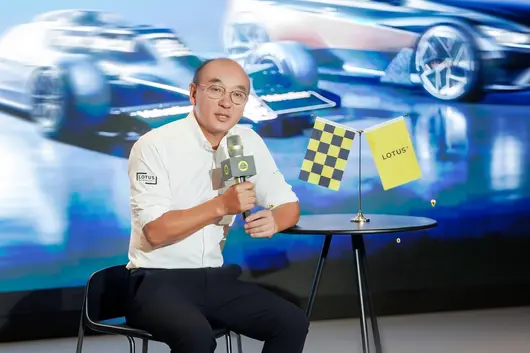

Lotus Cars announced its latest 2030 Strategy, which is a major push for sales and profitability, as well as a strategic adjustment of technology and routes.
By 2030, Lotus Cars aims to achieve annual production and sales of 30,000 units.
At the same time, it is no longer stubbornly adhering to the pure electric route, but moving forward with pure electric, hybrid, and fuel options.
However, performance cars are currently facing unprecedented changes: numerous new brands are flooding in, and traditional narrative styles are declining.
Consumers are redefining the standards for what constitutes a true performance car.
In this changing landscape, how Lotus Cars reshapes its brand and recreates its products to break through from the changes is self-evidently challenging.
To implement the 2030 Strategy, Lotus Cars is already laying out plans in earnest.
A major trump card Lotus Cars holds now is leaning on the Geely Group system, enabling it to secure more strategic resources to fight continuously.
Additionally, advancing along pure electric, hybrid, and fuel lines simultaneously can also help Lotus Cars expand its consumer base and open up markets in more countries or regions.
For Lotus, a more pragmatic and global chessboard is gradually unfolding.
The following are the core contents of the interview; we edited them without changing the original meaning.
Core Interview Content
Question: For 2030 to achieve an annual production and sales scale of 30,000 units, what will be the approximate sales distribution ratio between domestic and overseas markets? Will the brand subsequently deepen its investment in fuel models? Is there any information you can reveal on this?
Feng Qingfeng: At this stage, Lotus's sales in the US market mainly rely on sports cars produced in the UK, where tariff levels are relatively low.
China-made models face higher tariff barriers. Although adjusted down from previous peaks, the overall resistance remains significant.
Regarding fuel vehicles, the main layout for sports cars in the future will be hybrid, but in markets with strong demand for fuel vehicles, hybrid models can switch to pure fuel versions, such as in the Middle East and Saudi Arabia. Fuel prices are low, charging infrastructure is weak, and there is still some demand for pure fuel models locally.
The overall plan is hybrids accounting for 60%, pure electric 40%, with limited demand for pure fuel models.
Question: What is the specific pace of hybrid models in the overseas market? Lotus Cars has entered the US, Canada, and Brazil markets in the Americas so far. What are the expansion plans for other regions next? Recent US-Canada-Mexico races have seen high popularity, and the Geely Group is also involved. Could you ask if Lotus plans to carry out related market actions?
Feng Qingfeng: Regarding the Canadian market, delivery will start very soon. We seized a great market opportunity because when we were doing global product development certification, we completed all North American certifications in 2024.
Previously, when we entered the US market, the Eletre model had already announced its price and opened orders. Order performance was very good; once prices were announced, orders reached 6,000 units at one point.
With the recent China-Canada trade agreement lowering tariffs, we were able to enter the Canadian market at the fastest speed.
The South American market will gradually unfold starting with Brazil.
Let's talk about the European market pace. We will officially announce prices and open reservations in Europe this June, with formal delivery in the fourth quarter.
The overseas launch schedule for For Me has been delayed. The main reason is that the vehicle is equipped with an engine and needs to complete new Euro 7 emission standard certification. The certification cycle is longer than in China.
Next year, we will complete more global market certifications and enter markets in Australia, Malaysia, etc.
Question: Lotus has previously outsourced or cooperated on custom powertrains. Will Type 135 continue the outsourced model, or develop engines independently, or develop jointly with Geely?
Feng Qingfeng: For over 70 years, Lotus has never developed its own engines; power is entirely outsourced. The classic 3.5-liter model was procured from Toyota, and the 2.0-liter model was also outsourced.
However, after all outsourced engines arrive, Lotus performs secondary performance modifications: removing redundant non-performance parts and installing self-developed components. This improves power output on one hand, and optimizes overall durability on the other. However, the outsourced modification model has long constrained brand development.
After joining the Geely system and coordinating with this Focus 2030 Strategy transformation, Geely is assisting Lotus in engine development.
HORSE Power released the V6 model at the Beijing Auto Show. In the future, V6 and V8 models will be jointly developed by Lotus, Geely, and HORSE.
High-performance sports cars have another major technical difficulty, known as the pearl on top of the automotive industry crown: high-torque DCT transmission.
High-torque AT is relatively easier to implement. High-performance DCT that can bear hundreds or even over a thousand Newton meters of torque has an extremely high R&D threshold.
Relying on the collaboration among Geely, HORSE, and Lotus, we have already conquered this transmission technology.
Holding a full set of self-developed power resources, we have the confidence to implement the Type 135 project.
High-end high-performance powertrains are basically monopolized by top manufacturers and are not sold externally. Key power cannot be outsourced; it must be independently developed within the group.
Question: Many competitors are now launching intelligent shooting brake and intelligent sports car models. Many brands that originally did not涉足 this field are also joining in. How do you view this phenomenon?
Feng Qingfeng: More and more brands entering the performance car market indicates that the high-end performance consumer market truly exists and has considerable potential. This is a good thing and can drive more consumers to pay attention to and recognize the performance car track.
Lotus has a unique advantage. The essence of performance cars is lightweighting. Whether the body weight can be reduced directly determines the performance ceiling.
If a sports car body is too heavy, the overall performance, especially handling performance, will not go up.
We also have a first-mover advantage in electrification. The Evija pure electric supercar we launched has 2,000 horsepower, 400-plus kilometers of pure electric range, an overall weight as low as 1.6 tons, and air downforce up to 1.8 tons.
So performance cars have very high barriers. It is not simply stacking horsepower that creates a true performance car. Performance in all dimensions such as steering, braking, chassis, and aerodynamics must match.
In the fuel era, automakers could stack up high horsepower, and basically all supporting performance would be maximized simultaneously. So horsepower was basically equivalent to performance then.
But now many new cars only stack up high horsepower. Core performance such as chassis, braking, lightweighting, and aerodynamics cannot keep up completely. This is a common industry misunderstanding.
For example, our For Me vehicle weight reaches 2.5 tons. Yet we can still achieve a braking distance of over 33 meters because we have taken all supporting performance to the extreme. This is a true performance car.
Lotus's moat and barriers are deep chassis tuning skills and extreme lightweighting technology. This is our unique differentiated advantage.
Question: In what aspects will you deepen collaboration and simplify redundancies with the Geely Group?
Feng Qingfeng: Looking at the global automotive industry, ultra-luxury brands developing relying on large groups generally have more stable development. For example, Ferrari belongs to the Stellantis Group, and Lamborghini belongs to the Volkswagen Group.
In contrast, ultra-luxury brands developing independently from the group system, their development status is also visible to all.
The main reason is that the group can share huge R&D costs.
It is now the era of software-defined vehicles. Electronic architecture and software R&D investment are extremely high.
If Lotus independently develops a new electronic architecture, the investment would need to reach at least the level of billions.
With our 30,000 units annual sales volume, we simply cannot cover costs and achieve profitability.
So in the future, we will fully rely on group collaboration on mechanical architecture, electronic architecture, and software systems, sharing R&D costs according to sales volume.
If all technologies are independently invested, the business model will not work at all. 30,000 units in sales simply cannot achieve profitability.
Based on group collaboration, Lotus will continue to focus on its own field, deepening chassis intelligence. Active chassis technology, which is currently popular, Lotus has already deep layout. For Me is equipped with a full set of active chassis, supporting personalized selection and intelligent dynamic adjustment.
Once traditional chassis tuning is completed, it is in a fixed state. Active chassis is "alive" and can actively adjust in real-time based on road conditions, driving style, road surface environments like rain and snow, and changes in road adhesion. This is the technology we continue to deepen.
Question: In the new 2030 plan, will Lotus release more affordable models as scheduled? Do affordable products fit the super-luxury brand positioning of Lotus?
Feng Qingfeng: It does not mean a low price represents low positioning.
Especially within the personalized market, some products have low prices but can satisfy personalized consumer groups.
Why can't Lotus launch a 300,000 to 400,000 RMB one, like Elise and Eletre? It is very compact, but still has high premiums.
Actually, we have always had a dream, which is to restore a product like Elise. Small, two-seater, very agile.
But do not be like the past where there were no life scenarios other than driving.
For example, when I was in the UK, I drove an Elise. Even the luggage compartment couldn't fit a suitcase, and I had to change to another car to go to the airport. So, some life scenarios need to be integrated.
From a product dimension perspective, we hope that after Type 135 is realized in the future, we can make a small product similar to Elise.
Question: In the 2030 Strategic Plan, does Lotus have plans to return to F1 racing?
Feng Qingfeng: For Lotus, including for me personally, I dream of getting in because the Lotus DNA in F1 is too strong.
We have also had a lot of communication with these F1 organizations. They also hope Lotus can return to F1.
However, I think we still need to adjust based on our commercial development. We are exploring and contacting. Especially how to enter becomes very important.
Everyone knows F1 has newly approved the Cadillac team. As for whether China can get a new team approved, this needs further discussion. It is not something that can be decided at once. But this is Lotus's dream. We still need to work hard for such a dream.
Question: Ferrari launched its first electric car. There were many negative reviews, even internal reactions were not optimistic, triggering questions about whether super-luxury brands should continue to launch pure electric cars. In this situation, how do we think about the prospect of Lotus Cars?
Feng Qingfeng: Beauty is in the eye of the beholder because everyone has their own beauty in their hearts.
I think Ferrari is also at the transition of eras and needs to do some exploration. Whether it is successful will be verified by the market in the future.
But I think it needs to do such exploration, just like Lotus.
We are now returning to hybrid power. Actually, this is also exploration we did for many years in the pure electric field.
I think any enterprise should pay the tuition fee when it's time to explore.
In the past, I heard from various sources that Ferrari would not do pure electric. But it could not resist the tide of the times and eventually entered this field.
How to enter, each enterprise has its own strategy.
Question: We possess advanced technologies such as motor lightweighting, motor non-heating, chassis, etc. Can these technologies be opened up? Can we also move towards the supply chain direction to perform technology reverse output and supply products or technologies to other OEMs?
Feng Qingfeng: These advanced technologies are not entirely developed independently by Lotus. Most are developed jointly with suppliers.
For example, V8, V6, hybrid power systems, and motors with higher energy density were all completed with supplier cooperation.
Regarding reverse output, we are certainly very open. In fact, Lotus announced in 2024 that it is willing to open our chassis technology to society comprehensively.
Question: Historically, it seems no automaker could achieve slight profit or balanced profit with an annual sales of 30,000 units. So for Lotus, this may be a very big challenge.
Feng Qingfeng: It is not that only selling 30,000 units can generate profit. Ferrari made a profit of 700 million Euros with sales of 10,000 units. Of course, it is a relatively special brand, with sales slightly over 10,000 units. It already had high profitability when reaching 8,000 units.
Look at Porsche again. When it first did not enter the life vehicle field, sales were only 30,000 to 50,000 units. It also achieved very good profitability.
So for Lotus, the key is how to build the brand well.
The first pillar is actually how to build the brand well to obtain better premiums and higher gross margins.
As for the cost aspect, let me give an example.
Production in Wuhan and in the UK, the cost difference is huge.
This is exactly because of synergy. With Geely's synergy in manufacturing and procurement, and the sharing of manufacturing expenses. In the UK, we can only share ourselves, so manufacturing costs are very high.
Let's say an exaggerated figure, it might be five times the cost of manufacturing in China.
Therefore, we hope to reduce manufacturing costs through massive synergy.
In fact, compared to 2024, our overall costs in 2025 have already decreased significantly. Next, we will still use this synergy to create a "small and beautiful" company. "Small" refers to low costs, and "beautiful" refers to profitability.
Past calculations indicated around 60,000 units because expenses were very high then. Now with more synergy support from Geely, our costs can drop significantly.
For example, electronic architecture. If we had to invest ourselves, we would need to invest over 10 billion. But through Geely's synergy, we only need to bear a part of the shared expense.
Question: From now on to achieve a sales target of 30,000 units, what changes do you think need to be made?
Feng Qingfeng: If we want to make Lotus like other competitors by pushing down prices from the start, our costs cannot do it. We simply cannot do it.
This is not just an issue of economies of scale. It is not that if scale goes up, it can be done.
The key is that our requirements for products are very high. If we were to lower requirements, we certainly could bring costs down.
I mean, if I scored 80 points, I could do it with a little effort. But as a performance car, our requirement must be above 98 points.
We will not lower requirements to control costs. This is not what Lotus can do, and our whole system cannot do such things.
Of course, we also conducted a review. Therefore, we launched hybrid models. This is a correction of the past.
As for sales growth, I believe this year and next year, with the launch of the Lotus For Me model, there will be a significant increase.
Because the market is expanding. For example, in China, those who bought Lotus in the past were mainly small business owners and bosses.
Now it has expanded to corporate executives, especially executives in the financial sector. This is an expansion of the crowd.
Additionally, our markets are also expanding. We will enter Europe this year. Next year we will enter Australia, the UK, Malaysia, and other countries.
At the same time, our electric vehicles sold poorly in the Middle East. The main reason is that oil prices there are very cheap.
But after For Me entered the Middle East, the response was very good. Plus our future Type 135 and other sports car plans, we hope these new products keep up with the times and can change our current sales situation.

From 'Last Generation of Fuel Cars' to 'Multi-Energy Coexistence', Lotus Sports Cars clarifies in the 2030 Strategy: Lotus will no longer make all-electric sports cars; hybrid proportion will reach 60%, and annual sales of 30,000 units will achieve profitability.

On June 1, Lotus Group CEO Feng Qingfeng announced the brand's core plan for the next four years at the Focus 2030 Strategy Media Communication Meeting held in Beijing. Facing the reality of slowing global electrification policies, uneven charging infrastructure, and diverging consumer usage scenarios, Lotus actively adjusted the aggressive path of 'Full Electrification' since 2018, shifting to a multi-energy strategy of fuel, hybrid, and all-electric in parallel.
"What changes is happening in the market? Consumers have become clearer about usage scenarios for electric vehicles, hybrids, and fuel vehicles."
Feng Qingfeng stated at the communication meeting, "As a daily driving vehicle, electric vehicles are very suitable, but as a long-distance vehicle or a performance car, electric vehicles undoubtedly will face some challenges."
From five core sections: strategic adjustment, core technology, product matrix, global layout, to commercial goals, Feng Qingfeng detailed the clearer strategic layout of Lotus Cars.
I. Strategic Shift: No Longer Making All-Electric Sports Cars! From 'Full Electrification' to 'Multi-Energy Parallel'
Lotus announced in 2018 that Emira would become the last pure fuel car model, fully betting on electrification. However, in the Focus 2030 Strategy, the brand made a significant pullback.

Feng Qingfeng frankly stated that the global environment has changed: "In the past, governments, whether in Europe, UK, etc., all proposed strategies to support future electrification development, even governments proposing restrictions on fuel cars in a certain year, but undoubtedly all governments are postponing."
He gave examples, saying Italy's charging piles are mainly low power, and the Middle East has almost no commercial charging facilities, 'with no layout of charging facilities in action'.
Based on this, Lotus established a new power route combination: about 60% plug-in hybrid models, 40% all-electric models, and pure fuel only retains a small number of special markets (such as the Middle East).
Feng Qingfeng clearly stated: "For sports cars, we will pass on the all-electric road." Life vehicles will continue to develop all-electric, but sports cars will only do fuel and hybrid.
"The penetration rate of all-electric vehicles above $80,000 is less than 10%, even strong China is the same." Feng Qingfeng said, "In this market range, hybrids still have a lot of growth."
II. Core Technology: Self-developed V8 engine and torque gearbox, hybrid 'not a worm', chassis 'comes alive'
Lotus named its super hybrid technology 'Luyao', with the core selling point being no performance attenuation under no-fuel state.
Feng Qingfeng summarized the industry pain point and Lotus' solution with one sentence: "We used to say 'Full charge a dragon, depleted charge a worm', in the future depleted charge will no longer be a worm."
Take For Me (European name Eletre X) as an example; the car is equipped with a 900V Luyao Super Hybrid Architecture, total system power 952 horsepower, 0-100km/h acceleration 3.3 seconds with full charge, 3.5 seconds when battery power is only 10%, comprehensive range over 1400 km.
In the powertrain field, Lotus announced it will jointly develop a new V8 engine and large torque DCT gearbox with HORSE (Joint venture of Geely, Renault, Saudi Aramco). Feng Qingfeng called the large torque DCT 'The pearl on the crown of the automotive industry', 'To achieve over 900 Nm, this is also a very difficult, very big challenge'.
The new V8 hybrid supercar Type 135 is planned for launch in 2028, targeting 'Above 10,000 RPM', larger horsepower, lighter weight, and exploring the downscaling of F1 track technology (such as MGU-K) to mass production vehicles.
Regarding the chassis, Lotus emphasized that its core tuning capabilities are evolving through intelligence. "In the past, once a chassis was tuned, it basically became fixed... but with active chassis, changes are infinite."

Feng Qingfeng compared Lotus chassis tuning to a "Top-tier Conductor": "An orchestra can have any instrument, but only a good top-tier conductor can conduct a perfect symphony."
Lightweighting is still the bottom line for Lotus. Evija sets the benchmark with 2000 horsepower and 1.6 tons weight, "To surpass 1.6 tons, I think it is extremely extremely difficult". Feng Qingfeng explicitly refused to add weight-increasing configurations like refrigerators on sports cars.
III. Product Matrix: Fuel, Hybrid, All-Electric Each in Its Place
Under the Focus 2030 Strategy, Lotus forms three clear product lines:
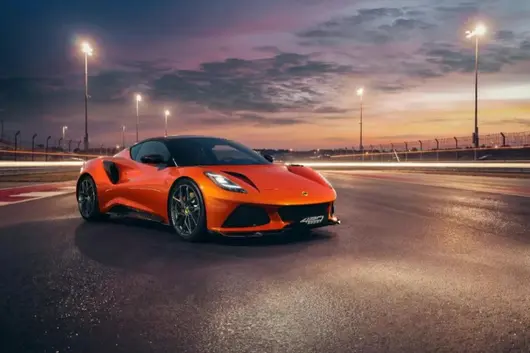
Fuel Sports Cars: Emira 420 Sport launched globally in May 2026, known as "The Emira model with the strongest power, lightest weight, and best aerodynamic performance to date".
Super Hybrid: For Me (China) has been launched and delivered; European version Eletre X will be released in Summer 2026, deliveries start in the fourth quarter. The car is evaluated by some European media as "A car that will change the European power landscape".
All-Electric Life Vehicles: Eletre, Emeya, and supercar Evija continue to be on sale. Among them, Eletre received UN R171.01 certification in May 2026, becoming the first China-manufactured electric vehicle to receive this certification.
Future Flagship: Type 135 V8 Hybrid Supercar, planned for 2028 launch, produced in Europe.

Feng Qingfeng emphasized that sports cars will no longer explore the all-electric route, while life vehicles retain all-electric. "There is still much all-electric technology worth us researching and exploring... We focus on life vehicles."
IV. Global Market: Regional Differentiated Layout, Channels Continued Expansion
To date, Lotus has a total of 216 sales stores globally, among them 67 in Europe, 63 in China, 48 in North America, 38 in other regions. The number of stores in China has increased from about 50 in 2025 to 63, with year-end target of 80, "Basically consistent with Porsche's channels".
Regional strategies show obvious differences:
China: As the main sales growth engine, Wuhan Factory and China R&D Center play core roles. User proportion after For Me launch increased by 50%, high-spec models over 70%, old owner repurchase rate reaches 20%. Customer group expanded from business owners, second-generation entrepreneurs to corporate executives and financial professionals, proportion of financial industry executives among small reservation users is about 30%.
Europe: UK Hethel is the sports car manufacturing and performance engineering center. Lotus will use Eletre X to enter the European hybrid market, filling the local hybrid blank of 'Fuel-based'. New markets like Berlin will enter soon.
North America: Restricted by 125% tariff and ICTS Act, China-produced all-electric models cannot enter the US, only UK-made sports cars can be sold. Canada becomes the breakthrough point — in May 2026, the first batch of 18 Eletre units exported to Canada, becoming the first mass-exported Chinese brand after tariff reduction. Lotus has 6 dealerships in Canada, planning to expand to 12 by the end of the year.
Brazil: On May 27, 2026, Lotus launched the brand in Sao Paulo, officially entering South America's largest market. Feng Qingfeng mentioned the deep local brand recognition: "Two Brazilian F1 drivers—Senna and Fittipaldi—were both Lotus F1 drivers." Lotus directly started operations with Emira, Eletre, Emeya full product line, Eletre PHEV expected to launch in 2027.
Middle East and Asia-Pacific: Middle East network is relatively complete; right-hand drive markets (Malaysia, Australia, etc.) wait for 2027 For Me right-hand drive model launch before expansion.
"Lotus was born global." Feng Qingfeng said, "We want to reutilize Geely's R&D system, supply chain system, and global manufacturing system for collaboration, so as to maximize Lotus' benefits."
V. Commercial Goal: 30,000 Units Break-even, Profit Path Clear
Lotus explicitly proposed that with Geely synergy and efficiency improvement, annual sales reaching 30,000 units can achieve continuous profitability.
"In the past, our break-even point was relatively high, had to achieve 50,000, 80,000 units to reach break-even point." Feng Qingfeng said, "Now through Geely's empowerment, Geely's synergy, and through our own collaboration between China and UK, let Lotus become a small but beautiful company, achieve 30,000 units can let the company gain good returns."
Ideal global sales structure is '3331': China 30%, Europe 30%, US 30%, other regions 10%. Due to US policy restrictions, US share will decrease, taken over by China and Europe.
Cost control aspects, Lotus and Geely have deep synergy in electronic architecture, intelligence, joint procurement and other fields, "Below the iceberg common costs greatly reduced, while above the iceberg retain 100% of personalized investment" — including chassis tuning, aerodynamics, lightweight materials, etc. Wuhan Digital Twin Factory will compress new car production cycle from 8-12 months to 3 months, engineer onsite requirement reduced from 200 people to a dozen people.
"With Geely, Lotus finally has bullets to counter Porsche." Feng Qingfeng said, "30,000 units can profit, this is rare in the automotive industry, but Lotus can."
Focus 2030 Strategy marks Lotus shifting from single electrification route to more pragmatic, more flexible global multi-power strategy. In the context of super luxury car market growth slowing, policy rhythm differentiation, Lotus relies on complete coverage of three power lines: fuel, hybrid, all-electric, and Geely system technology and supply chain synergy, trying to run out a sustainable profit path in the sub-division track of personalized driving experience.
As Feng Qingfeng said at the end of the communication meeting: "We haven't learned how to cash in on online traffic yet, need to learn a bit more." But for a brand that has always taken handling, lightweight, and aerodynamics as faith for 78 years, traffic might never have been its most concerned — what it truly cares about is, whether drivers can find that unique, unhomogenized feeling on every Lotus.


Editor | Klein
Produced by | Road Coffee in
Lotus Cars is trending again due to executive remarks.
On June 3, CEO Feng Qingfeng threw out the "1.8-ton watershed" theory during an interview, stating "If the weight exceeds 1.8 tons, it's a junk car." This statement quickly topped the Weibo trending list, becoming the rare No. 1 trending topic in the automotive circle. As the controversy spread, Lotus officially abandoned the Vision80 full electrification strategy, switching to a "Focus 2030" route running fuel, hybrid, and pure electricity lines in parallel.

From being acquired by Geely in June 2017 to now, Lotus has gone through nine full years. But there aren't many product highlights people remember; executive "extreme statements" and marketing failures often go viral. This Sino-foreign "hybrid" has "mixed" for nine years, and it seems to have only "mixed" for nothing?
The Divide of the "Junk Car" Theory
New energy vehicles are getting heavier, which is indeed a hot topic in the industry. If Feng Qingfeng only advocated that pure electric sports cars should focus on weight reduction, there would be no problem. But his expression was too aggressive, and the "targeting scope" was too broad.
More awkwardly, Lotus's own pure electric sedan Emeya's curb weight is 2455-2590 kg, and the limited supercar Evija also reached 1887 kg, both exceeding 1.8 tons. Performance models of the brother brand Zeekr are also "over the limit".

Considering the context, Feng Qingfeng probably meant that pure electric sports cars are hard to replicate the driving feel of traditional fuel sports cars, and the contradiction between performance and vehicle weight is sharper on electric vehicles, so Lotus abandoned the pure electric sports car route.
The corporate strategic judgment itself is beyond reproach, but making such "self-torn" extreme statements will inevitably provoke controversy. Judging by the result of topping the trending list and netizen mockery, this wave of "public opinion setup" clearly failed.
Looking back at Lotus's nine years, it is regrettable.
This brand known for extreme lightweighting, aerodynamics, and pure handling, instead of letting new products regain glory, relied on executive "extreme statements" and marketing failures to go viral frequently.
Feng Qingfeng's sharp remarks are not just this time.

In February 2025, he posted on Weibo saying "Only Lotus and Porsche are fast on corners," at that time Lei Jun claimed Xiaomi SU7 Ultra is "The fastest four-door mass-produced car on the surface," which was interpreted by netizens as a subtle mockery of Xiaomi, triggering Mi fan counterattacks.
More absurdly, some netizens mistakenly took "Lotus Holdings" (seller of MSG) as Lotus Cars, ran to Lotus MSG Douyin account to attack, forcing them to issue a video clarification: "I'm an honest man, I don't sell sports cars."
In July 2024, Feng Qingfeng promised Lotus "Positioned as a million-level luxury brand, will never participate in price wars". Only half a year later, new Eletre and Emeya prices dropped significantly, old owners collectively protested. At the same time, Eletre Chinese name "Summer Blossom" was boycotted due to homophone with "Sliding Down", Lotus was forced to apologize and stop using it.

The 2023 failures were even denser: Wuhan Lotus test drive cars sold as new cars, Eletre reduced configuration three times without informing owners, Suzhou Lotus center held a 50 million capital verification matchmaking event.
With so many "viral" events, it is hard not to feel that this enterprise has formed a path dependence relying on extreme remarks to grab eyeballs.For new brands, this may be an adventure under involution; but for luxury brands, this method is extremely damaging to the brand.
Forced Strategic Shift
Accompanying these viral events is tepid performance.
Lotus was acquired by Malaysia Proton Group in 1996, switched to Geely in June 2017. Before Geely took over, Lotus annual sales were only over 1,600 units. In 2018, Lotus released the Vision80 strategy, promising full electrification by 2027, and subsequently launched three pure electric models: Evija, Eletre, and Emeya.
In 2024, Lotus annual sales reached 12,134 units, up 74% year-on-year, achieving the best in history. But this momentum could not be maintained, 2025 full year sales were only 6,520 units, down 46% year-on-year. From 2021 to 2025, cumulative losses exceeded 3.1 billion USD.

Low sales forced the enterprise to shift strategy, in 2024 the official team had actually abandoned the full electrification strategy.
According to the new Focus 2030 strategic requirements, in the short term the enterprise needs to achieve a production mix of about 60% plug-in hybrids and 40% pure electricity. Feng Qingfeng predicted 2026 sales will reach over 10,000 units, and claimed that benefiting from Geely system support, through platform sharing, joint procurement, collaborative R&D, annual sales of 30,000 units can break even.
"Mixed" for Nothing?
Reviewing Lotus's transformation, the failure is essentially the result of "era misjudgment" combined with "structural vulnerability".
Lotus Cars deciding on a full pure electricization strategy at that time was not "radical", because this was almost the "political correctness" of the automotive industry at the time, transnational giants successively threw out more and more radical electrification transformation goals, Lotus can at most be considered a "follower".
In the past two years, transnational giants successively withdrew/adjusted electrification transformation goals, indicating that this is an "era misjudgment", not the mistake of Lotus Cars alone.

But the problem is, everyone being wrong doesn't mean everyone pays the same price. When the whole industry collectively readjusts strategy, different brands' risk tolerance and room for error correction vary greatly. BBA also paid a high price for failed transformation, but still have the fuel vehicle base to support them and still have room for adjustment.
As a small-scale brand, Lotus Cars does not have such large room for maneuver. If not for major shareholder Geely's electrification transformation success in recent years, Lotus Cars probably would not have had the chance for this strategic shift at all.
Specifically,Pure electrification and Lotus brand gene's "lightweighting" exist an irreconcilable contradiction. This contradiction exists in other brands known for performance, but no brand is more passive than Lotus Cars, but coincidentally it chose full electrification with an "all-in" posture at the very beginning, even leaving no transition space for itself.

Fair to say, Eletre and Emeya's chassis tuning and aerodynamic design are not inferior in the same class, but Lotus did not convert these technical advantages into brand stories, instead using "Junk Car Theory" such a rough way to self-denial, this is the biggest waste.
Another layer is that Lotus Cars, this Sino-foreign "hybrid", has inherent defects.
Looking now, a sports car brand famous globally + China leading new energy vehicle technology/supply chain, simply a "heaven chosen" match; but at that time, this model was not accepted by the market, the market viewed Lotus still in the "Geely rebadged"/"Zeekr rebadged" stage, for it obviously had no upward pulling power at all, instead more of a drag.
A luxury sports car brand with no leading story to tell, wanting to be reborn is hard as climbing to heaven, so it is no wonder Lotus Cars chooses to grab eyeballs with "extreme statements".

However, the situation is changing. The global automotive market has reached a deep consensus that "transformation must rely on the Chinese supply chain", and Chinese local brands' high-end transformation has also successfully achieved a counterattack against transnational giants. The global frenzy in grabbing Zeekr 9X, Lynk & Co 900 and other models means that at this time, the label of "Zeekr rebadged" is even a weapon for Lotus Cars to pass the level.
Nine years later, this "hybrid" Lotus Cars, its bloodline might be more "noble" than any pure-blooded transnational giant. At this time, stepping away from pure electricity obsession, turning to hybrid and fuel, instead might be its best time window.
However, if continuing to rely on "extreme statements" to grab eyeballs, instead of using products to rebuild the brand faith of "lightweighting" and "pure handling", any good window will be wasted. Lotus does not need trending topics, but a car that makes people forget trending topics.