首頁Lights Up

搜尋歷史
熱門搜尋
經銷商登入 / 註冊

——From the Dongrun Cup Finals: How an Auto Company Embeds Sports Marketing into Grassroots Soil
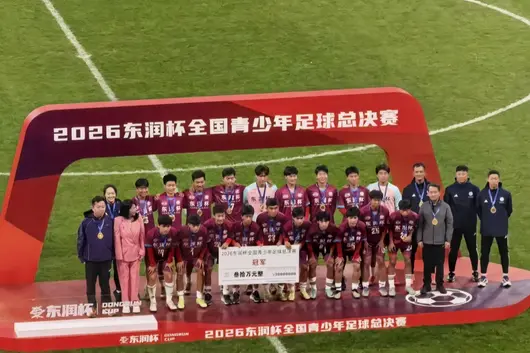
On October 24, Beijing Workers' Stadium welcomed a slightly different final. No professional elite clubs, no astronomical-price superstars. Standing under the spotlight were campus soccer teenagers from across the country. The 3rd Dongrun Cup National Youth Soccer Finals concluded here. Tsinghua High School and Shijiazhuang No. 2 High School staged a peak showdown, ultimately Tsinghua High School lifted the champion trophy. Dongrun Public Welfare Foundation Founder and Chairman Kong Dongmei, and BYD Head of Brand and PR Li Yunfei presented awards on-site to the winning teams and individuals, completing a highlight moment for campus soccer together with the children.

From an automotive media perspective, the most noteworthy aspect of this final is not "who won the title," but "who stood on the Workers' Stadium". The Workers' Stadium has hosted too many professional events and commercial matches. Fans are used to watching top foreign players and elite club showdowns here. But this time, ordinary high schoolers are running on this turf. Top-tier venues are no longer exclusive to a few. Ordinary teenagers who love soccer can also seriously complete their own finals under the same lights, with the same standards. This detail itself is a reconfirmation of the value of Chinese youth soccer: the fact that thousands of ordinary children play soccer deserves serious attention.

As the Dongrun Cup's top strategic partner, BYD partnered with Dongrun Public Welfare Foundation this time to let campus soccer teenagers step onto the Workers' Stadium stage. Event data also shows this isn't an isolated final show. This Dongrun Cup covered more than 20 provinces (districts, municipalities), reached 352 schools, benefited about 5,000 players and coaches; the finals gathered 22 teams in Beijing. Dongrun Public Welfare Foundation launched the Dongrun Cup National Youth Soccer Tournament in 2022, officially started in 2023, covered more than 20 provinces nationwide, cumulatively attracted over 1,000 campus teams, over 10,000 players and coaches to participate, over 30 participating players were selected for the National Youth Team, National Middle School Team, and U-series Elite Training Camps. In other words, the Workers' Stadium finals are the tip of the pyramid, while the base has spread to county-level campuses and ordinary high school teams.

This is exactly the missing link in current Chinese youth soccer. We often say we must respect the laws of soccer development, but the first law is to let more children have balls to kick and high-quality games to play. Shortage of high-level competition supply, grassroots campus teams lack equipment, teachers, and participation opportunities. These problems cannot be solved by one elite club's visit to China. Dongrun Cup attempts to make up for the resource shortages of grassroots campus soccer by a trinity of "event funding, teacher support, equipment donation," benchmarking international competition standards. BYD's involvement allows corporate power to enter this relatively slow-heating, but more patience-testing field.

From the sports marketing perspective, BYD's soccer layout presents a clear "dual-line structure". On the overseas end, it continues to connect with top soccer IPs, successively cooperating with Manchester City, Inter Milan, PSG and other elite clubs, appearing at the European Championship, Copa America and other international events. The previous "BYD Derby" Manchester City vs Inter Milan matchup received global fan attention, promoting brand globalization through soccer. On the domestic end, it directs resources to more grassroots campuses and counties: since 2024, it has continued to organize soccer teenagers to go to Germany, Japan, Spain, Thailand, Italy, Brazil, Mexico, over 200 person-times exchanged and sparred with overseas top clubs, and brought children into top courts like the European Championship, World Cup, etc. to broaden horizons; at the same time, it organized owner volunteers to go to remote areas such as Xinjiang and Guizhou, sent materials to children who love soccer, and opened public welfare classrooms. Ili, Xinjiang soccer teenagers went to Japan for exchange, Guizhou Yuanbao female team received equipment donations and public welfare classes. These moves are not as traffic-attracting as elite partnerships, but are closer to the daily routine of soccer public welfare.
A background worth noting is that BYD established a charity foundation as early as 2010, deepening its work in education support, poverty alleviation and disaster relief; at the 30th anniversary, it set up a 3 billion yuan education charity fund, covering 127 universities nationwide, motivating over 6,000 students. This cooperation with Dongrun Public Welfare, a national 5A-level foundation supervised by the Ministry of Civil Affairs, is essentially a combination of "public welfare platform + corporate power": Dongrun Public Welfare has focused on rural education for more than ten years, projects cover 31 provinces and regions, 324 counties nationwide, possessing mature county-level landing networks and youth assistance systems; BYD brings corporate resources, brand influence and international connections in the soccer field. What both sides want to fill is the resource gap in grassroots campus soccer, not just doing a one-time brand exposure.
As automotive media, we have seen too many sports marketing stopping at Logo exposure and stadium fencing. But the signal released this time by BYD is a bit different: it did not only focus on a few talented players, but balanced elite elevation and campus popularization; on one hand, creating opportunities for promising children to go abroad and exchange with overseas strong teams, on the other hand building the court into county-level campuses, expanding the participation base. This "pyramid-style" investment logic, short-term may not be as intuitive as sales conversion, but is more in line with the growth laws of youth soccer, and more in line with the long-term image a Chinese brand needs to establish in the globalization stage.
The hope for Chinese soccer will not come only from one Workers' Stadium final, but certainly from more ordinary children being seen, respected, and given opportunities for high-quality matches. When car companies string top courts, overseas resources, and public welfare networks into a chain, allowing campus soccer teenagers to stand on professional-level stages, the significance of this matter has exceeded sponsorship itself. BYD's soccer ledger calculates not only brand exposure, but also the soil of Chinese youth soccer. Once the soil is thicker, there will be more possibilities in the future.