首頁Leapmotor A05

搜尋歷史
熱門搜尋
經銷商登入 / 註冊

September 16, 2026, Huzhou. Leapmotor laid out the thickest stack of technical cards it has had in its 11 years on the table at once: 8,500 R&D engineers, 65% of vehicle costs self-developed and self-manufactured, three consecutive semi-annual profits, etc.
No slogans were shouted, no concepts were hyped. This launch event themed "Confidence" was more like a technical report from an engineering team—laying out one by one the underlying technologies hidden beneath the car body that users usually don't see.
As Leapmotor founder, chairman, and CEO Zhu Jiangming stated: "Leapmotor will not innovate for the sake of showing off skills; every innovation released this time will be implemented in the next generation of products, making good technology accessible to everyone."
The words "Confidence" were not shouted out of thin air. From 2015 to now, Leapmotor has walked a path recognized as much harder: full-domain self-research, deep self-manufacturing. While others look to suppliers for configurations, it chewed its way up the industrial chain step by step from battery cells to battery packs, from motors to controllers, from plastic particles to headlights. Now 18 manufacturing plants have been established, platform standardization reaches 90%, and 65% of vehicle costs are independently controlled.

In fact, many people only see Leapmotor's aggressive pricing but fail to see that its cost advantage does not come from cutting specifications, but from being nibbled out through full-link self-research.
The return on this investment is also straightforward: from selling 1,000 units annually in 2019 to now having monthly sales stable above 100,000 vehicles and ranking in the top three among China's new energy brands, and top four globally.
Even more rare is that the technical capability not only fed its own product line but also became an industry supplier—whole vehicle technology output to FAW, Stellantis, and the cooperating automakers for electronics, electric drive, and battery systems exceed 20, making technology external supply the second growth curve for Leapmotor.
01
Becoming the "Apple" of the Automotive Industry
"Broadband wireless communication was not invented by Apple, nor was the computer, neither were touch screens, digital cameras, nor MP3s. However, Jobs conducted excellent functional combination innovation, ecosystem innovation, and ultimate product innovation, achieving the Apple of today. Leapmotor also hopes for such innovation, striving to become the 'Apple' of the automotive industry." Standing at the 11th anniversary milestone, Zhu Jiangming set a new goal for Leapmotor.
In the past few years, Zhu Jiangming repeatedly compared Leapmotor to Uniqlo: "Leapmotor's positioning in the automotive industry should be like Uniqlo in the apparel industry, slightly more expensive than general products, but also with better quality."
Zhu Jiangming does not think these two things contradict.
He explained that Leapmotor's existing products will continue on the Uniqlo route, while the second brand to be launched next will do what iPhone did replacing feature phones.
The heaviest release at this Leapmotor Technology Day is undoubtedly the brand new LEAP 5.0 whole vehicle architecture. This architecture is not for existing model updates but is tailored specifically for the second brand to debut in 2027. The goal is clear: build a "new species of mobile space" that doesn't look like a traditional car.
How to understand? For example, traditional cars are like old houses with huge shared area, the engine occupies the front cabin, shock towers squeeze into the cabin, transmission shafts pass through the floor. The car looks big, but usable space is small. What Leapmotor does is return all this "shared area" to users, extending the cabin outward along the three dimensions of length, width, and height, achieving the official "Strong >100% Space Utilization Rate".
More importantly, space is no longer a fixed layout; seats and functional areas can be flexibly combined according to scenarios, switching between living rooms, cinemas, bedrooms, and coffee bars in the future.
Space reconstruction is just the skeleton. What truly makes this space "alive" is the Clover 5.0 Central Domain Control Electronic Architecture.

Traditional distributed architectures are like various departments managing their own turf, requiring layered approval for communication, many wiring harnesses, and slow response. Leapmotor's architecture goes further: true central integrated control, with only one central brain making decisions, other domain controllers only responsible for execution.
Full vehicle 48V power supply replaces traditional 12V, electricity capacity quadruples, and wiring harness weight is halved; full vehicle Ethernet uses a unified communication protocol, equivalent to paving an information expressway for the whole vehicle; the vehicle-cloud AgentOS makes the vehicle more fitting to user habits the more it is used. Ultimately, the total vehicle wiring harness is compressed to within 500 meters, the shortest in the industry.
Do not underestimate these 500 meters of wiring harness; behind it is the integration of the architecture, and the ceiling of a car's future OTA upgrade potential.
"After opening the doors of new energy vehicles, it remains 5 seats, 6 seats, 7 seats, with no changes. Functional areas are like original feature phones. Apple started designing with iPhone, making phones multi-functional, and that is innovation." Zhu Jiangming hopes the second brand will become "a completely new species."

02
Invest 50 Million Yuan to Upgrade Intelligent Driving for Existing Owners
If the architecture is the foundation, then intelligent driving is the strongest technical tag under current user perception.
This time Leapmotor presented the LWM World Model Intelligent Driving, taking a path somewhat different from the industry mainstream: not relying on BEV perception conversion, not depending on massive rule code, but letting the model truly understand road conditions and reason scenarios.
Leapmotor Technology Electronic Product Line Head Zhou Hongtao's statement is very direct: "The World Model lets vehicles move from 'remembering road conditions by rules' to 'truly understanding road conditions'."
The cloud large model is responsible for knowledge base precipitation and fleet collaborative learning—a vehicle encountering complex road conditions learns to handle it, and all vehicles can synchronize mastery through the cloud, hitting the pain point of long-tail scenarios being difficult to implement in the intelligent driving industry.
More solid is the commitment. Zhu Jiangming clarified on site: "As of the end of August, all 350,000 units of LiDAR version vehicles already delivered will be upgraded to World Model Intelligent Driving for free, and the use will be free for a lifetime."

You know the earliest over 10,000 users used the Orin-X platform, completely different from the mainstream 8650 Snapdragon platform architecture now; algorithm porting is equivalent to redeveloping the entire system, and the investment for just this item is at least 50 million yuan.
For other companies, this calculation would likely be "batch adaptation" or "gradual elimination". But Leapmotor chose the most arduous path. Zhu Jiangming explained in an interview: "Users are the foundation of Leapmotor's development. Early users with LiDAR and advanced intelligent driving chips are the core supporters of the brand."
Behind this is a deeper logic. Leapmotor Intelligent Driving's starting point was not high; in the past few years, its voice on the intelligent driving track was far less than that of a few top new forces.
The turning point occurred in October 2025, when Leapmotor internally ran three technology routes simultaneously: 2.0 was two-stage end-to-end, 3.0 increased the large model proportion and weakened rules, 4.0 directly made one-stage end-to-end World Model. These three lines raced for a few months; in the third-party test early this year, the 4.0 solution won with a comprehensive intervention rate only one-third of that of top car companies.
Even more ruthless is, Leapmotor brought this advanced intelligent driving down to the 100,000 RMB segment vehicles. In order to move the World Model from cloud to vehicle end, Leapmotor adapted 200 TOPS, 640 TOPS, 1,280 TOPS three computing power levels, and even A10 within 100,000 yuan can be used.
03
Plug-in Hybrid Goes Global, Battery Opens Source
As intelligent driving sinks, power layout complements all. The release of MM-i multi-mode hybrid electric drive this time marks Leapmotor officially entering the plug-in hybrid track, also completing the "pure electric + range extended + plug-in hybrid" full power map.
Many people ask, range extended sells well, why make plug-in hybrid? The answer is overseas and in complex domestic scenarios. Leapmotor Electric Drive Product Line Head Wu Cun stated: "Overseas new energy charging infrastructure lags far behind domestic, hybrid vehicles still have a 5 to 10-year or even longer lifecycle overseas."
From a global view, many places in Europe, Southeast Asia have imperfect charging facilities, users travel long distances more, requiring high acceleration at medium-high speeds. Traditional hybrid either weak in pure electric, or lack power at high speed. Leapmotor reconstructed this system from the bottom layer directly.
Three original creations sound professional, landing benefits are straightforward: generators can also participate in driving, system peak power 206kW, 28% stronger than same class; dual electromagnetic clutch coaxial integration, whole electric drive only 106kg, 40% lighter than same class, 25% smaller volume, A0 level small cars can also fit; intelligent control lets shift time shrink from 400ms to 150ms, lower than human perception threshold, switch process completely seamless.
Say plainly, it is combining the advantages of range extended and plug-in hybrid, city pure electric quiet and fuel-saving, highway direct drive powerful and not fuel-consuming.

While power system completes, battery technology also takes a step forward. CTC3.0 high-low voltage fusion battery, did something no one dared in the industry: cancel independent low-voltage batteries used for hundreds of years.
Anyone who drives knows this pain point: car sits for a long time loses electricity and won't start, every few years have to spend hundreds of yuan changing battery, lead-acid battery waste not eco-friendly. Leapmotor integrates low-voltage power supply module into power battery interior, sharing protection and thermal management system, low-voltage electricity capacity directly increases 7 times, maintenance-free for life, single car saves over 2,000 yuan in replacement costs.
Even more ambitious is, Leapmotor directly opens relevant patents to the entire industry. Calculate an account: if the entire industry uses them, over a million low-voltage batteries can be saved from scrapping every year, good for users, good for the environment.
Except for these technologies about to land, the scene also showed many reserves: fully self-developed embodied AI robots, 94% comprehensive efficiency three-level mixed transmission electric drive, self-developed all-solid-state LiDAR... but Zhu Jiangming's attitude is very clear, and also interesting: "Robots that can be walked are not a skill, robots that can make money are what can be presented."

This is very Leapmotor—over 11 years, it has never been the one shouting slogans the loudest, but the one working hard to make technology solid.
04
Technology Always Greater Than Sales Volume
Zhu Jiangming divides Leapmotor's 11 years into two segments: the first ten years are on foundation-laying, the next ten years will start building high-rise buildings. Back to the launch event theme "Confidence". What is a car company's confidence? Not the number of 100,000 vehicles monthly sales, not the overwhelming marketing, but holding core technologies in hand, standing on a solid manufacturing system, holding user trust in heart.
When the industry is frivolous, people who calm down to do underlying technology, short-term look slow, long-term walk the furthest.
Zhu Jiangming said one sentence at the climax of the Technology Day: "Technology always greater than sales volume, sales volume without technology support is unsustainable." Leapmotor proved one thing with 11 years: this technology road is hard, but if walked through, it is the hardest confidence.
Saying this words at Leapmotor's current node carries weight. Consecutive monthly sales broken 100,000 vehicles, ranking top three among China's new energy brands, top four among global new energy brand sales, products enter 45 countries and regions—looking from data, Leapmotor has passed the stage of needing to prove itself "can sell cars".
Zhu Jiangming has his eyes on further places: "The first ten years mainly doing foundation, building capabilities, the next ten years to accumulate wealth and make a big breakthrough. Enterprise without innovation has no future."
Interesting is, just around the Technology Day, Leapmotor simultaneously announced another set of numbers: First half of 2026 exports 96,300 vehicles, year-on-year growth 372.6%. Overseas market demand for hybrid products is still growing, and EU is tightening restrictions on China's plug-in hybrids.
Leapmotor's response is localization—leveraging Stellantis factories in Spain, Malaysia for production, rather than building from scratch. Zhu Jiangming's judgment on this is: "China already has many car companies built factories in Thailand, we hope Leapmotor does not go build factories, collaborate with them, able to utilize their factories is the best, reducing duplicate investment."
From "Uniqlo of the Car Circle" to "Apple of the Automotive Industry", what separates is not technology, is business model. Uniqlo good at making quality solid, bringing price down; Apple good at recombining existing technologies, changing product form. Leapmotor wants to do both things at once—build cars using Uniqlo's way, define second brand using Apple's logic.
As Zhu Jiangming said: "Technology and innovation are the confidence of enterprises facing the future, and also the core competitiveness."
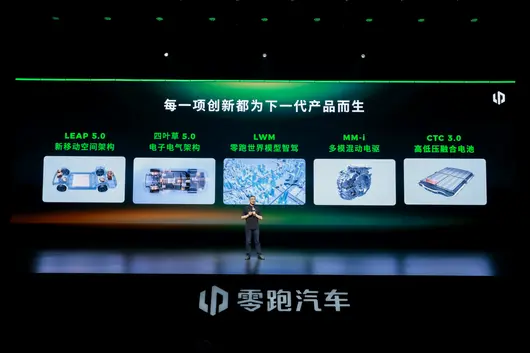

On September 16, the 2026 Leapmotor Technology Day, themed on 'Confidence', took place. A set of LEAP 5.0 vehicle architectures, as well as LWM world model intelligent driving, MM-i multimodal hybrid electric drive, and CTC3.0 high-voltage-low-voltage integrated battery, three core technologies, were released on site, showcasing the results of its self-developed achievements since its establishment 11 years ago.

On the same day, Leapmotor announced that the subscription for the additional share issuance on FAW's equity investment had passed the CSRC review and completed registration. China FAW, a central state-owned enterprise, officially became a strategic shareholder holding 5%. Beyond the 3.744 billion yuan, what Leapmotor truly obtained was the credit endorsement of a central enterprise and the systematic industrial resources backed by a central enterprise group.
The day the status was finalized coincided with the day technology was complemented, which didn't seem like a coincidence. When the two parties signed the contract last December, the cooperation direction specified was the joint development of plug-in hybrids and extended-range powertrains. What Leapmotor released that day was indeed its first plug-in hybrid electric drive, the MM-i. From FAW paying platform licensing fees to Leapmotor for the Hongqi project to opening CTC3.0 patents to the entire industry, Leapmotor is taking what it has accumulated over 11 years, taking it out of its own products, and placing it on the industry's shelves.
What is Leapmotor's Confidence Actually?
The first question this technology day aims to answer is what the two words 'Confidence' refer to.
Zhu Jiangming, founder, chairman, and CEO of Leapmotor Technology, elaborated on the situation of the domestic automotive industry and new energy brands in 2026. In a stage where the industry faces challenges, Leapmotor's monthly sales reached 100,000 units and it has been profitable for three consecutive half-years, demonstrating its significance. Daring to talk about investment in a contracting market itself requires a foundation.
The first layer of the foundation is R&D density. Leapmotor has a total of 10,000 employees, with 8,500 in R&D, and Sales, HR, Finance, and Public Relations totaling 1,500 people.

The second layer is full-domain self-research and deep self-manufacturing, autonomously controlling 65% of the vehicle cost, built 18 parts factories, with a platform universality rate of 90%. However, Zhu Jiangming set a bottom line for this model: core components developed and manufactured in-house must have PPM and 3mis superior to suppliers before being released to the market. Quality must be ensured first, and cost optimization comes second. This statement directly responds to the most common external doubts regarding vertical integration: self-research is not about saving money, but about keeping quality in our own hands.
The third layer is where the true confidence lies: these technologies already have buyers. There are 5 external partnerships for electronic systems, electric drives have received designations from 8 OEMs, and battery systems have 10 external partnerships.
The strongest piece of evidence is the Hongqi G117. In March 2025, an announcement from the FAW Electronic Bidding Platform stated that the joint development of the Hongqi brand G117 vehicle and the technical procurement of platform licensing fees had a buyer: Zhejiang Leapmotor. An OEM paying platform licensing fees to another OEM is in itself a recognition of status; this speaks more to the role Leapmotor plays in the industry than any self-positioning could.
Betting on 2027
LEAP 5.0 is not prepared for existing models; it bets on a brand that hasn't been born yet.
The architecture is divided into physical and electronic layers. The physical layer enlarges the cabin simultaneously along the X, Y, and Z axes. Integrating the super air conditioning unit and swapping out the powertrain increased cabin length by 19%. The vertical layout of shock absorbers plus miniaturized shock absorber tower packages increased front legroom width by 37.5%. The flat low floor plus native integrated smart lift roof increased cabin height by 63.7%, ultimately achieving a space utilization rate of over 100%. The electronic layer is Cloverleaf 5.0, featuring 48V power for the whole vehicle, vehicle-wide Ethernet, and Vehicle-Cloud AgentOS. The central domain controller makes decisions while other domain controllers only execute, compressing the total vehicle wiring harness to within 500 meters.

Cao Li, Head of Vehicle Product Line at Leapmotor Technology, described this new species more specifically. It might replace some hotel functions, camping scenarios, and temporary rest, even offices, and leisure cafes and restaurants. The premise he emphasized is worth noting: the strongest attribute of the second brand is first solving the problem of advanced assisted driving.
This also explains why Leapmotor set a hard metric for intelligent driving. Zhu Jiangming said the goal is to achieve 100 kilometers of no-touch driving in urban areas by the end of this year.
The second brand will start debuting and delivering in the fourth quarter of 2027. Leapmotor now sells 100,000+ units monthly, with the main sales range between 100,000 and 200,000 yuan. This is a clear upward move.
A 100% utilization rate is a scenario worth contemplating. Whether it can transform from a concept at the launch event into a reason for users to pay for will have to wait until 2027 for an answer.
Pressing Intelligent Driving Down to 100,000
Leapmotor's approach to intelligent driving is the reverse of others. Others use compute power and headcount to drive prices up, while Leapmotor wants to pack the same capabilities into the entire model line.
It is sufficient to clarify three things about the characteristics of LWM world model intelligent driving: it does not rely on BEV perception, does not depend on rule-based code, and LiDAR is used only for safety redundancy. The cloud base model is responsible for learning and inference, while the vehicle-side real-time model handles decision-making. Rules only provide a fallback for traffic regulations such as traffic lights, reducing code volume by 90%. Compute power can be deployed on different platforms of 200, 640, and 1280 TOPS. The result is advanced assisted driving reaching models under 100,000 yuan, including the A10.
Zhou Hongtao, Head of Electronic Product Line at Leapmotor Technology, put forward his own viewpoint. He does not believe that intelligent driving requires throwing money and piling up personnel to be produced, on the grounds that the vast majority of peers who previously invested thousands of people are now cutting back significantly. This judgment is consistent with Leapmotor's path. Since one cannot trade headcount for progress, one must find space in algorithm efficiency.

Leapmotor has sold 350,000 LiDAR-equipped model vehicles that can be upgraded for free to the world model version and used for free for a lifetime. Among them, the earliest over 10,000 units used the Orin X platform, while Leapmotor now primarily uses the Qualcomm 8650 platform. Porting is equivalent to redeveloping an entire set of algorithms. Zhu Jiangming explained the decision-making process: those over 10,000 older users bought early when AI chips were expensive; they spent so much money to support Leapmotor, so if it was not usable after purchase, they would feel very sad. Therefore, we are willing to spend even more effort to upgrade them.
Regarding catching up to Tesla FSD, his answer was quite clever. There is no comparability with Tesla; Chinese cars cannot go to the United States, and FSD cannot easily land in China either. This is unsolvable. You can say anything, because neither can outmatch the other.
To spread the cost, intelligent driving must increase volume. Leapmotor is on the path of using scale to replace adoption. The cost of this path is slowness, but the benefit is that once it is proven, the coverage will be larger than others.
Filling the Plug-in Hybrid Gap
MM-i is not just filling a power form; from the day it was defined, it has been aimed at the overseas market.

Wu Cun, Head of Electric Drive Product Line at Leapmotor Technology, stated the positioning very directly: mainly for foreign markets. The reason is that charging facilities abroad are backward, and the hybrid market will last another 5 to 10 years or even longer. Foreign users have higher requirements for medium-to-high speed acceleration capabilities, while Toyota and Honda's iMMD are very weak at medium-to-high speeds. He gave a comparison: acceleration from 80 km/h to 120 km/h for vehicles in the same class is generally 8 seconds, while Leapmotor can achieve 4.5 seconds. The essence of new energy is not to eliminate internal combustion engines, but to decarbonize. If hybrid technology can deliver a pure electric experience while reducing carbon emissions, it is new energy technology.
However, there is a consensus among multiple domestic brands this year that hybrid models with small batteries still have a market in China, and multiple models have already started to enter the market. Leapmotor promoting them vigorously in China cannot be ruled out.
With the release of MM-i, Leapmotor has completed its full power layout covering pure electric, extended range, and plug-in hybrid, spanning from A0 to D-class. The overseas expansion line is also well-aligned; products have entered 45 countries and regions globally, with over 1,000 overseas stores, and cumulative exports over the past two years of overseas business exceed 200,000 vehicles,
Leapmotor's Exclusive Strategy
Leapmotor doesn't sell parts; it sells a complete, proven solution.
Zhu Jiangming explained the external supply model very clearly. Collaboration with FAW and Stellantis is at the platform level, sharing platforms. There are two ways to implement it: one is produced in Leapmotor's factories, and one is produced in the partners' own factories, but Leapmotor provides a packaged kit of core components including battery packs, electric drives, all controllers, lights, etc. His judgment is that this core kit saves at least 1,000 to 2,000 yuan compared to the other party selecting multiple suppliers themselves, and it is faster, has shorter commissioning time, and lower risk.
It is worth noting that Leapmotor announced opening relevant patents for high-low voltage integration to the entire industry. OEMs usually treat patents as a moat. Companies willing to open source want the industry to follow their own standards; this is already the mindset of a supplier.
Discussing the issue of overseas collaboration reflected Zhu Jiangming's vision. He stated that automobiles must pursue localization and there is also collaborative space with domestic automakers. For example, many Chinese automakers have already built factories in Thailand. Leapmotor hopes not to build factories repeatedly; it is best to use their factories to reduce duplicate investment. This aligns with the concept of systematic overseas expansion that Leapmotor has always emphasized. Rather than each building factories from scratch, it is better to utilize existing capacity.
When discussing embodied intelligent robots, Zhu Jiangming was very pragmatic. He said humanoid robots are still in a very early stage; while they can move now, there is a long growth process before they can work. Short-term, humanoids will not be the focus. He values non-humanoid, shape-shifting embodied intelligence more. The criteria for judgment are whether they can complete work and whether costs can be lower.
Sharp Perspective: Technology and Innovation are the Foundation for the Future
Quite a bit was released at this technology day; what is truly noteworthy is where they are going. One part is for the 2027 second brand, another part is sold to shareholders like FAW, and a third part is directly opened to the entire industry.
Zhu Jiangming's attitude towards competition is very straightforward. He said competition is inevitable, and only competition can drive enterprise progress, allowing consumers to buy better products for less money. However, he simultaneously raised a premise: do not compete on the internet; we must truly compete on product strength.
Three lines are laid out at the same time: FAW's equity and powertrain collaboration, Stellantis's overseas channels, and the second brand's upward move in the fourth quarter of 2027.
The challenges are also real. Zhu Jiangming's own saying is to anticipate danger in times of peace; all things are unlikely to go smoothly. The industry has entered negative growth, and the larger the scale, the greater the difficulty in taking the next step up.
Zhu Jiangming stated: "Technology and innovation are the foundation for enterprises facing the future and are also the core competitiveness."
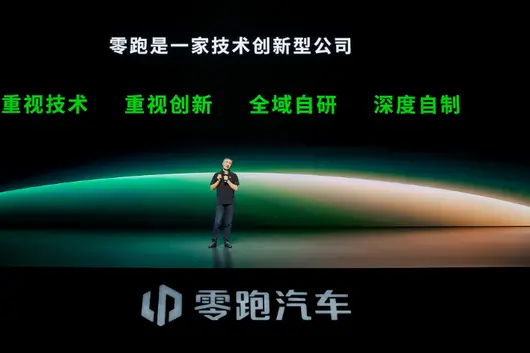


The value of the Leapmotor model lies in verifying a possibility: In the industrial cycle where new energy vehicles return from "tech consumer products" to "manufacturing commodities," vertical integration and cost efficiency remain the core propositions that cannot be bypassed.
By Intelligent Driving Network / Zero Sauce
Edited by Langlang Mountain and Mingzhi Mountain
Starting from the 2025 Leapmotor 10th Anniversary event, Leapmotor founder Zhu Jiangming and the management team have been preparing for the Leapmotor Technology Day in September this year through subsequent public events and media exchanges.
As the most important "appetizer" of the Leapmotor Technology Day, Leapmotor opened its Huzhou Super Five-Electric Factory to the media for the first time one week before the event—a core component self-research and self-manufacturing cluster with a total construction area of about 500,000 square meters, covering five major factory zones: batteries, electric drives, domain controllers, headlights, and electronics/power.
Just one day before the factory opened, major domestic automotive enterprises including Leapmotor announced their August sales, and Leapmotor once again led the New Force automakers with a new car sales volume of 103,129. Combining with the Q2 financial reports of each company, it can also be found that while Leapmotor's sales continue to grow, it has also become the only New Force automaker to achieve profitability for three consecutive semi-annual periods.
With the industry profit margin compressed to 3%, why can Leapmotor still make money? Placing this profit accounting in the factory makes it clearer.
01.
The Cost Ledger: Location Economics
The cost logic given by Leapmotor can be summarized in one sentence: full-domain in-house R&D, deep manufacturing, eliminating supplier gross margin.
Since the brand's establishment, 18 component factories have been built, and 65% of vehicle costs are under the enterprise's independent control.

Calculating with the industry supplier's common 15% gross margin, the 65% self-research and self-manufacturing ratio can save about 10% of costs compared to the external procurement mode—65%×15%≈9.75%, this arithmetic is self-consistent.

The Huzhou Electric Drive Integrated Factory is a specimen of this logic.
It concentrates the four core processes of stator manufacturing, rotor manufacturing, controller manufacturing, and electric drive system final assembly into one factory zone, reducing the production links of 3 times packaging, 3 times transportation, and 3 times warehousing and delivery of stators, rotors, and controllers.
Leapmotor calculated that the transportation packaging inventory dimension for a single electric drive system can save about 50 yuan. Based on an annual production of 1 million sets, a total manufacturing cost of about 50 million yuan is saved. This process model also applies to battery and electronic control factories.
Saving 50 yuan per vehicle is indeed not a very significant number, but reducing physical transport saves "links", not "materials".
This means Leapmotor's cost reduction path is process efficiency, not lowering material standards. The two are two philosophies: the former builds "cheap" on management precision, while the latter builds "cheap" on sacrificing experience.
On the side of the Electric Drive Integrated Factory, there is even an undeveloped river transport route. During the visit, Leapmotor relevant personnel also revealed to the Intelligent Driving Network that this factor was indeed considered when the factory was built. If this route can be navigated smoothly subsequently, transportation costs can continue to decline.

This "Location Economics" can be expanded to Leapmotor's entire Huzhou factory area. It is revealed that Leapmotor chose Huzhou instead of Jinhua or Hangzhou to build the factory. The two core reasons given by the official are: first, local government policy support; second, Huzhou has a superior location and convenient transportation, capable of covering supply to core markets such as Anhui.
Subsequently, Leapmotor will continue to expand the scale of component self-manufacturing. Production lines such as compressors, on-board power supplies, and electronic oil pumps were put into production one after another last year and are still in the production ramp-up phase. With the expansion of production scale, there is still further space for manufacturing costs to decline.
This space will be further amplified by platform commonality rates. Leapmotor vehicle architecture has an 88% component commonality rate. Under the same platform, a large number of components such as chassis parts, interior and exterior trim parts, seats, etc., achieve sharing except for styling and body shells. This means R&D costs, mold costs, and procurement costs are amortized on a larger sales volume base.
These two numbers, 65% and 88%, directly influenced Zhu Jiangming's pricing strategy: "cost pricing".
This pricing model, which is not oriented by brand premium but based on its own cost capability, gives the space saved by vertical integration to consumers. This forms an essential difference from the industry common "competitive benchmark pricing" or "brand premium pricing".
It is worth noting that Leapmotor's vertical integration is not a BYD-style full-chain heavy asset model. Leapmotor adopts an "invest in equipment only, not factories" light asset strategy. Among the 18 component factories, it focuses on high-value-added core components, while traditional interiors, tires, wheels, etc., are still resolved through external procurement or joint ventures.
This "selective vertical integration" allows it to achieve a specific balance between fixed asset investment and cost control.
02.
The Technology Ledger: Quality Economics
At the technical level, the five factories in Huzhou of Leapmotor constitute a complete chain of evidence: with micron-level even nanometer-level manufacturing precision as input, and PPM-level defect rate and 100% inspection coverage as output, ultimately realized as product failure rates below the industry average and promising lifetime warranties.
Electric Drive Integrated Factory: From Rotor Dynamic Balancing to 40PPM
Quality hazards in the electric drive system often arise in transport and assembly links. Leapmotor concentrates the four core processes in the same factory zone, eliminating intermediate transport loss, but this is only physical integration; what truly determines the yield is precision control within the process.

In the rotor dynamic balancing link, Leapmotor controls the positive and negative electrode calibration error at ≤100mg, far better than the industry common standard of 200—500mg, with the minimum remaining unbalance ≤0.1gmm/kg, equivalent to the rotor working center of gravity eccentricity ≤0.1μm. This precision directly determines the NVH performance and energy loss of the electric drive system—the larger the unbalance, the stronger the vibration induced by periodic centrifugal force, and the more energy the motor consumes to overcome vibration resistance. The electric control assembly link adopts a high-precision intelligent servo press, with pressure precision ≤0.5%FS and displacement precision ≤10μm, doubled compared to the industry mainstream standard. The direct benefit of precision improvement is ensuring the integrity of sealing rings and avoiding high-voltage insulation failure caused by water vapor intrusion. In the EOL testing link, NVH measurement system accuracy is ≤2dB (industry mainstream 3dB), and 100% off-line detection and speed/torque range test coverage are achieved.
The cumulative result of these technical investments is: Leapmotor oil-cooled electric drive 3mis quality average is 40PPM, less than one-ninth of the industry average 360PPM. As a comparison, Leapmotor promises a lifetime warranty for the electric drive system—the confidence of this commitment is not marketing rhetoric, but a loss probability calculation supported by 40PPM quality data.
SMT Factory: Chip-Level Environment Control and 99.995% Welding Yield
Domain controllers are the "brains" of intelligent electric vehicles. A circuit board the size of an A4 paper integrates about 8,000 electronic components. If any one is misaligned by 10μm or has a poor solder joint, it may lead to infotainment lag, function malfunction, or even safety hazards. Leapmotor's SMT factory raises the manufacturing environment to chip-level: temperature fluctuation ±0.5°C, humidity ±1%RH, cleanliness 100,000 grade, full-domain electrostatic protection voltage <100V. The purpose of this environment control level is to reduce the three quality control risks of poor welding, refusal of welding, and electrostatic breakdown from the production source.

In terms of process precision, the ultra-high speed precision placement link placement precision reaches ±15μm, better than the industry mainstream 25—30μm level; 3D optical reinspection precision is also ±15μm, process capability CPK ≥ 2.0, reaching top industry quality control standards; nitrogen vacuum reflow welding achieves welding yield > 99.995%. Three inspection links achieve 100% off-line full inspection, defective products automatically sorted and isolated. In May 2026, Leapmotor intelligent driving domain controller installation volume was 34,822 sets, ranking 5th in the industry, and promised an electronic control lifetime warranty. High welding yield and full coverage detection mean the base of after-sales repair rates is significantly compressed, and software OTA iteration efficiency is no longer dragged down by hardware defective products.
Battery Factory: 10nm Cleaning and 99.9% Welding Yield
The safety and consistency of power batteries depend on the "marching together" ability of hundreds of cells. Leapmotor battery factory module line automation rate reaches 90%, planned and designed independently by Leapmotor. The core logic is using machine certainty to replace human intervention uncertainty.

Cell nanoscale plasma cleaning raises cleanliness to 10nm, 10 times the industry average 100nm precision. Cleanliness directly determines coating adhesion and cell performance consistency. Spider arm cell stacking shortens single cell processing speed to 1 second, 20% higher than the industry traditional mechanical hand, but speed is not at the cost of precision. Ring spot Busbar welding reduces spatter by more than 99%, process yield rate reaches 99.9%, fundamentally reducing cell short circuit and thermal runaway risks. Airtightness test differential pressure sampling resolution 0.1Pa, reaching industry head standards, ensuring battery pack airtightness. Battery capacity test through high-precision SOX model controls SOC deviation at <3%, better than the national standard ≤5% requirement, reducing "hidden power" and the wooden bucket effect.
The production line achieves 100% full inspection and data traceability. The final result is: Leapmotor battery failure rate is about 30% of the industry average level, and promises a battery lifetime warranty. For users, this means slower range degradation and higher vehicle resale value; for enterprises, this means the probability distribution of after-sales battery replacement costs is significantly shifted left.
Headlight Factory: Grade 100 Cleanliness and 4-Camera 100% Visual Full Inspection
Headlight manufacturing seems far from "safety core", but Leapmotor's headlight factory technical standards are not downgraded due to this.

The factory has the industry's first 100% fully automated injection molding dark factory. The core area cleanliness reaches Grade 100 (chip-level), 10 times the sterile operating room cleanliness. Vacuum aluminum plating thickness is controlled at 0.1μm, reaching top industry standards, directly determining reflectivity and durability—the higher the reflectivity, the better the night lighting effect; the more uniform the plating, the stronger the thermal shock and aging resistance.
In the visual inspection link, four 20 million pixel high-definition industrial cameras are used to perform 100% beam pattern inspection and missing/leak installation inspection from four angles. Compared to the industry's usual two-camera configuration, it achieves double inspection redundancy. The direct benefit of this technical investment is to prevent defective products from flowing out, avoiding driving safety hazards and after-sales claims for users caused by headlight beam pattern deviation or assembly defects.
Electronics & Power Factory: 10μm Assembly Precision and Aerospace/Military Grade Standard
The Electronics & Power Factory is responsible for the manufacturing of three core components: electronic oil pumps, on-board power supplies, and heat pump compressors. Among them, Leapmotor electronic oil pump production line automation rate reaches 100%, leading the industry.
In the outer rotor assembly link, the production line achieves intelligent positioning through visual guidance, combined with high-precision sensors to control face dimension precision at 10μm—this level is better than the industry precision pump 15μm conventional standard, reaching aerospace/military grade requirements. The precision of face gap directly determines the volumetric efficiency of the pump: if the gap is too large, oil leakage increases and volumetric efficiency drops; if the gap is too small, friction resistance rises and mechanical losses intensify. 10μm precision control is to find the optimal balance point between leakage and friction.
In the on-board power supply signal board installation link, the production line uses 2D vision cameras to guide robots to complete automatic assembly, assembly precision also reaches 10μm, reaching the industry high-end level.

The heat pump compressor executes 100% online finished product insulation dielectric strength test. Test voltage is 2500V, higher than the industry common 2000V standard; test precision is controlled at ±3%, better than industry ±5% error level. Higher test voltage and stricter precision standards mean the missed inspection probability of insulation failure is further suppressed, and product reliability obtains substantial improvement.

The technical parameters of the five factories are not isolated. They all point to a quantifiable cost reduction result:
High technology brings not vanity on the spec sheet, but product stability supported by high yield, and loss reduction converted by stability—including manufacturing cost loss, after-sales repair loss, and brand trust loss.
Leapmotor dares to promise a lifetime warranty for the three core systems of electric drive, electronic control, and battery. Its underlying logic lies here: when manufacturing precision compresses the failure rate to 1/3 or even 1/9 of the industry average, the lifetime warranty is no longer risk gambling, but a cost-controlled service经过精算 (actuarially calculated).
Serving users, and serving customers.
03.
The Business Ledger: Tier 1 Economics
Among the information released in this open day, the component external supply is the most significant.

According to Leapmotor official news, the Huzhou headlight factory is Leapmotor's first headlight manufacturing factory facing external customers, and has reached cooperation with Stellantis and FAW, supplying full category lighting fixtures for different vehicle models;
Subsequently is the electric drive. Leapmotor's wholly-owned subsidiary LingSheng Power signed an agreement with Peugeot-Citroen (under Stellantis) to provide electric drive assembly development, factory prototypes, and special testing services for it. This means external supply jumps from finished components to the joint development stage.
Higher up is the vehicle architecture. Opel brand under Stellantis plans to adopt Leapmotor's latest pure electric architecture and core components of battery technology, retaining Opel's own design, chassis, and cockpit systems. Cooperation upgrades from "selling parts" to "selling platforms".
Along with the component penetration, there is continuous binding at the capital and equity level. In October 2023, Stellantis invested in Leapmotor for about 1.5 billion euros, obtaining about 20% equity (later increased to about 21%). In May 2024, both parties established a joint venture Leapmotor International, Leapmotor holds 49% equity, Stellantis holds 51% equity and leads it, responsible for sales and channels in markets outside Mainland China. In May 2026, both parties intend to further expand cooperation to joint procurement and shared production lines.
"Partnering to go global" at the channel level is the direct product of this binding. Leapmotor utilizes Stellantis's existing production capacity and channel networks in Malaysia, Spain, Brazil, etc., achieves local production in CKD/SKD mode, avoids trade barriers while reducing capital investment. This forms a sharp contrast with the heavy asset path of most Chinese automakers building overseas factories independently. Leapmotor International achieved profitability just two years after establishment, with overseas gross margin stable at 18%—20%, higher than the domestic level.
This "reverse technology export" has symbolic significance in the history of China's automotive industry.
In the past 40 years, China's automotive industry was dominated by the narrative "market for technology"; while the model of Leapmotor and Stellantis—Chinese automakers provide core technology, international giants provide brand and channels—is rewriting this narrative.
But Tier 1 business is not only for shareholders. Besides Stellantis, Leapmotor's component business has obtained cooperation from more than ten domestic and foreign automakers. Among them, FAW has reached cooperation with Huzhou headlight factory, supplying full category lighting fixtures for different vehicle models.
FAW's addition shows that external supply is an open business facing mainstream Chinese automakers. Leapmotor summarizes it as "Vehicle + Tier 1" dual-wheel drive.
"Vehicle + Tier 1" is not without precedent: BYD's FinDreams series external supply, CATL budded from ATL power battery department, are all paths verified on China's automotive industry chain.

Leapmotor's difference lies in the path sequence: first rely on self-supply to scale, then seek external supply.
Monthly sales of 100,000 units are the "order basic platform" of these component factories. External supply is incremental amortization, not a last resort. This model is coherent, but whether it can be established depends on whether external supply customer quantity and revenue proportion can be disclosed with data, whether internal and external supply pricing is fair, and whether external customers are willing to place orders with a vertical system of whole-vehicle peers for the long term.
It needs to be noted that vertical integration is not a consensus in the intelligent electric vehicle era. Most automakers choose "in-house R&D + external procurement" to maintain flexibility in technology generation switching.
But Leapmotor's self-manufacturing scope is actually selective: it does high value, high coupling components—domain controllers, electric drives, battery packs, headlights, electronics/power; while cell links etc. are not fully self-manufactured. This selective vertical integration is both different from "closed in-house R&D", and exactly the reason it dares to open orders to external customers.
Final Thoughts:
Of course, any business model has its applicable boundaries. Leapmotor's "full-domain in-house R&D + deep manufacturing" model is no exception.
First is scale dependency.
The cost reduction effect of vertical integration highly relies on sales volume to amortize fixed costs. Zhu Jiangming once publicly stated that new energy vehicle startups need "1 million annual sales to survive". Leapmotor's target for 2026 is to sprint to 1 million vehicles. Once the scale growth slows down, the capacity utilization rate of 18 component factories will decline, and its cost advantage will be quickly eroded by fixed costs.
Second is the "glass ceiling" of technical depth.
Leapmotor still has obvious boundaries at the core material level: cells come from external procurement (such as CATL), chips come from suppliers such as Qualcomm, NVIDIA, Leapmotor does not do wafer-level in-house R&D. This means during periods of raw material price volatility in batteries and chip supply tightness, Leapmotor's cost control capability will still be subject to pressure from upstream transmission.
Finally is the uncertainty of overseas policy. The EU's countervailing tariffs on Chinese electric vehicles, Malaysia's mandatory export quota requirements for new whole-vehicle factories, and the difficulty of building local supply chains in Europe all lay down variables for Leapmotor's global path.

Can the Leapmotor model be replicated? The answer is likely negative.
Its founder team comes from Dahua Technology, with deep electronics manufacturing genes; its "cost pricing" strategy requires extremely strong strategic firmness, which is not common in the capital-seeking new energy track; its "partnering to go global" global path relies on deep interest binding with international giants like Stellantis, having irreproducible contingency.
But the value of the Leapmotor model does not lie in becoming a template, but in verifying a possibility: In the industrial cycle where new energy vehicles return from "tech consumer products" to "manufacturing commodities," vertical integration and cost efficiency remain the core propositions that cannot be bypassed.
Monthly sales of 100,000 is just the visible result above the iceberg. Below the iceberg is a systemic capability reconstruction about how to build a good car.
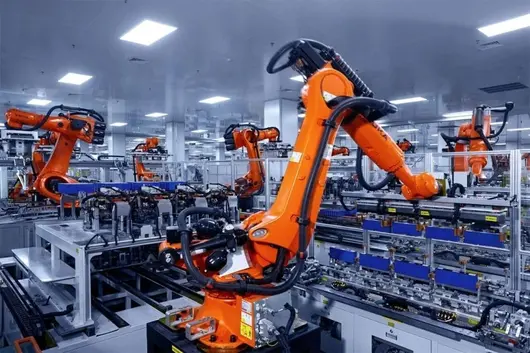

In the elimination phase of new energy vehicles, how can one survive? Leapmotor broke out of a sea of red competition and led far ahead. What does it rely on? Let's look at Leapmotor's "assets",The answer is actually just four words: Self-Research and Self-Manufacturing.
Leapmotor's half-year report is out -- revenue 38.11 billion reached a new high for the same period, net profit 210 million for three consecutive half-years, H1 global sales 356,000 units made it into the global new energy top four (BYD, Tesla, Geely, Leapmotor), and July became the first new force to exceed 100,000 deliveries in a single month.

Some believe that in today's highly mature supply chain, car companies don't need to manufacture everything themselves.
But the reality is that batteries, motors, and electronic controls account for over 50% of the total vehicle cost. If these lifelines are held by suppliers, car companies are left with only design space for the body and seats, essentially regressing into assembly plants. When the price war intensifies, car companies without self-research barriers won't even have the room to lower prices without considering suppliers' moods.

Among new forces, Leapmotor is not the only one that can achieve full-stack self-research, and all have achieved good results; Zeekr, Fangchengbao and other "factory second generations", supported by the R&D and manufacturing foundation of parent companies, start off just as fast.
The new energy track seems to compete on sales volume and visibility, but it is actually a contest of industry chain control. Those brands that are unwilling to put in the hard work in core links such as intelligent driving, intelligent cockpit, and three-electric systems, overly rely on external procurement, and only understand "opportunism", will find it increasingly difficult in the elimination round.
Leapmotor's Self-Research and Self-Manufacturing Results Begin to ShowLeapmotor's differentiation lies in it having truly made "self-research" a systematic cost control method. Zhu Jiangming explicitly stated in the internal letter for the 10th anniversary that Leapmotor's vehicle self-research and self-manufacturing ratio covers 65% of core component costs, with a final goal of over 80%.

Self-research and self-manufacturing is Leapmotor's solid foundation for "quality not expensive", not just a slogan. This is mainly reflected in several specific actions:
First is the platform integration of core components such as batteries and electric drives.
The three-electric systems, especially power batteries, account for a large portion of the total vehicle cost, so seeking profits from upstream is a required course for car companies. Leapmotor's approach is to accelerate full-stack self-research from cells to PACK; At the same time, for solutions like 800V silicon carbide high voltage, because the battery packs and core components like electric drives achieved self-research and platform unity, it was possible to "overnight" switch the entire C series and B series.
Without the foundation of self-research and self-manufacturing, this speed would be impossible.
Second is converting self-research advantages directly into price and configuration competitiveness.
For example, B01 and B10, bringing global 800V and 3C fast charging, AR-HUD configurations that were previously only available in the 200,000 yuan class directly to the 100,000 yuan class, relies on mass production of self-researched components reducing BOM costs.
A10 brought LiDAR and advanced intelligent driving into the 100,000 yuan range for the first time, with monthly sales near 30,000 units. It expands the path of scale efficiency together with the newly launched A05 starting at 63,900.
Against the backdrop of generally pressured industry vehicle profit margins,Leapmotor was still able to maintain a 12.6% gross margin, where vertical integration played a decisive role.
Zhu Jiangming summarized this model as "transferring 10% gross margin from the parts link to users, while the whole vehicle still maintains a healthy 14%-15% gross margin" -- core components held in one's own hands provide the confidence to offer concessions.
Third, this ability has begun to be exported externally.
On August 24, Leapmotor Automobile held a deepening strategic cooperation agreement signing ceremony with China FAW in Changchun. Both sides will carry out deep collaboration in fields such as new energy whole vehicles, intelligent assisted driving, powertrain, power batteries, intelligent chassis, and embodied intelligent robots.
In addition, overseas is also an important link. Leapmotor's H1 export volume reached 96,000 units, up 372.6% year-on-year, Europe has already deployed over 1,000 outlets. Leapmotor is leveraging Stellantis's overseas capacity to promote localization assembly and mass production in places like Malaysia, Spain, and Brazil.
Crossing over from an OEM to become a Tier 1 is itself an endorsement of technical strength.
Technology Reserves for the Next DecadeOf course, self-research is not omnipotent, and Leapmotor is also reviewing and improving its weaknesses. Regarding intelligent driving, although urban pilot assistance has been pushed to the entire series, there is still a gap compared to Huawei and XPeng's first-tier level.
This September's Annual Technology Conference, Leapmotor will release intelligent assisted drivingWorld Models that reach the industry's first-tier level, finally making up for this required course.
It will also releasea series of the latest technical achievements in the three-electric fieldto prepare for the next stage of advancement.
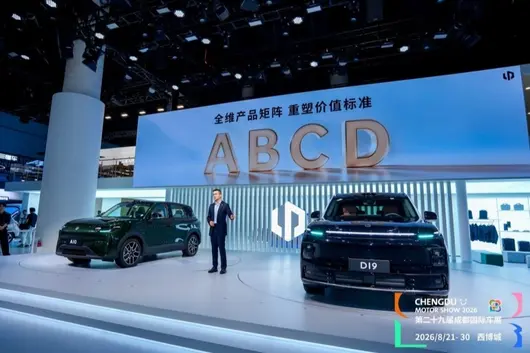
Closing RemarksIt is worth mentioning that Leapmotor's flagship SUV D19 sales in July also exceeded 10,000 units. Leapmotor, through the platformization of the ABCD series and a high proportion of self-research and self-manufacturing, has provided a development model for new energy car companies: players who can make self-research and self-manufacturing a moat have a higher chance of surviving in the elimination round.