首頁Joint Venture

搜尋歷史
熱門搜尋
經銷商登入 / 註冊

In just two years, transitioning from 'planning and layout' to 'all-out sprinting', SAIC's layout and perspective have rapidly expanded.

August 5, 2026, Shanghai World Living Room. SAIC Motor and General Motors officially signed a strategic renewal agreement, extending the SAIC-GM joint venture period by an additional 20 years to 2047. This is currently the longest-term agreement among existing joint venture car enterprises in China.
Overall structural breakthrough, new growth logic for the automotive group
This cycle-spanning renewal is particularly worth pondering in today's industrial context. The 2026 Chinese automotive market is already unrecognizable compared to the past, with independent brands breaking the 70% market share and the halo effect of joint ventures fading. However, SAIC answered with a 20-year renewal agreement: joint ventures are not obsolete; after completing a paradigm upgrade, they have entered a more vibrant 2.0 era.

SAIC-GM's renewal is not an isolated case. Since SAIC Volkswagen extended its joint venture term to 2040 in November 2024, to Audi deepening strategic cooperation with SAIC in April 2026 and establishing Audi Innovation and Technology Center in Shanghai, SAIC's first 'full value chain' R&D entity outside Europe, to General Motors' renewal this time — all three joint venture sectors have completed the construction of new cooperation models facing the smart and electrified era.
Unlike the past 'technology introduction, Chinese manufacturing' one-way flow, the upgraded Joint Venture 2.0 presents distinct common features: 'Co-creation and Co-research, Local Decision-making, Global Output'.
SAIC Volkswagen explicitly plans to launch 18 new models by 2030, of which 15 are exclusively developed for China; SAIC Audi relies on the next-generation high-end digital platform ADP to co-develop multiple new models customized for the Chinese market; SAIC-GM has established a new operational mode of 'Chinese R&D Manufacturing, Global Market Sales', and the Buick ZhiZhen E7 will start overseas exports this year.
At the same time, reform in the independent sector continues to deepen. The 'Major Passenger Vehicle' sector integrates SAIC Passenger Vehicle, General R&D Academy, and LingShu Technology, connecting the full link from product definition to marketing; the 'Major Commercial Vehicle' strategy anchors top three in light vans, new energy, and exports; the overseas Glocal 3.0 strategy shifts from product export to standard export in all aspects.
In just two years, SAIC's strategic puzzle across joint venture, independent, commercial vehicle, and overseas four sectors is fully complete, moving overall from 'planning and layout' to the new stage of 'all-out sprinting'.
The most direct change brought by the strategic loop is reflected in the market's real data. From January to July 2026, SAIC Motor's cumulative vehicle sales reached 2.384 million units, continuing to rank first among domestic vehicle enterprises.
Behind this group of numbers, structural breakthroughs in three dimensions are redefining the growth logic of China's largest automotive group.
Sales structure reshaping, growth momentum completed switching

Behind the continuously leading sales data, the source of growth has undergone systematic adjustments, and the model of a single sector pulling growth has been replaced by a pattern of diversified synergy. From an overall scale perspective, SAIC delivered 339,000 units in July alone, continuing the growth rhythm of the first half of the year, with independent, new energy, and overseas three business sectors releasing incremental growth simultaneously, and the operational structure continuously optimizing.

Obviously, independent brands have become the core support for group growth. From January to July this year, independent brand cumulative sales reached 1.725 million units, rising to 72.4% of the group's total sales, achieving seven consecutive months of year-on-year sales growth. Additionally, in sub-sectors, SAIC Passenger Vehicle growth performance was outstanding, with sales increasing 53.4% year-on-year from January to July, while SAIC-GM Wuling stably maintained a monthly sales scale of over 100,000 units, and SAIC Maxus simultaneously maintained a year-on-year growth rate of nearly 30%, with the pattern of independent brands blooming at multiple points gradually taking shape.
 In addition, the new energy business formed a pattern of independent and joint venture double-line acceleration. Official data shows, from January to July, SAIC's full-series new energy models cumulative sales reached 973,000 units, up 27.4% year-on-year, with growth rate higher than the industry average. Among them, IM Motors and SAIC Passenger Vehicle new energy sectors showed significant growth, while Wuling and MG multiple models maintained stable delivery. SAIC Volkswagen and SAIC-GM new energy products simultaneously increased volume, and joint venture new cars such as Audi E7X, ID.ERA 9X, etc., quickly entered the sub-segment mainstream interval after listing.
 Comprehensive view, the pattern of diversified sectors collaborative growth means SAIC's scale base no longer relies on a single category support, and the stability of growth and anti-cycle ability are further improved.
Technology rights equality lands, product matrix fully iterated
To be honest, achieving such results in 2026 is not easy for any car company, and the underlying power supporting sales structure optimization is the continuous new product launch and large-scale landing of cutting-edge technologies throughout the year, and also the product system covering the full price band that SAIC built around 'technology rights equality'.

Since the 2026 Beijing Auto Show launched the new product cycle, SAIC has cumulatively launched more than twenty smart-electric models, covering the 50,000 to 500,000 price range, while laying out pure electric, extended range, and plug-in hybrid all technical routes. Previously hard technologies such as semi-solid-state batteries, steer-by-wire, and AI-native architectures, which were stuck in the R&D stage, have gradually achieved mass production and installation.

Among them, the IM LS9 Hyper launched in July, as the group's 100 million vehicle milestone model, has become China's first mass-produced vehicle to land the steer-by-wire national standard, bringing high-end digital chassis technology into the 300,000 level market.
Of course, SAIC's cutting-edge technology is not limited to high-end models, price inclusiveness also became a core feature of product iteration.
For example, in the entry market, the 60,000-level Roewe i6 comes standard with the Qualcomm 8155 chip and Doubao Large Model, and the 90,000-level MG4X all series carries semi-solid-state batteries. In addition, the 120,000-level MG 07 downgrades the 800V high-voltage fast charging platform, and the 150,000-level Shangjie, Wuling Huajing S all series carries high-level intelligent driving solutions, allowing users of different consumption levels to access mainstream intelligent configuration.
 In addition, multi-brand stratification and positioning also allowed SAIC to form complete mobility scenario coverage: Wuling focuses on entry-level commuting, Roewe focuses on the home market, MG targets young consumer groups, IM Motors, and Cadillac layout high-end tracks, Maxus covers commercial mobility needs. At the same time, SAIC completed deep strategic cooperation with Huawei Qiankun and Audi, relying on external technology synergy to make up for product capabilities. After multiple new car listings, order data remained stable, reflecting market acceptance of the technology inclusiveness route.
It should be said that continuous new product launches and technology downscaling have allowed SAIC's product competitiveness to transform from single model blockbusters to balanced output of the full matrix.
Value chain going out, globalization strategy advancement
We also see, while SAIC completed structural upgrades in the domestic market, relying on Glocal 3.0 strategy, SAIC constantly pushes overseas business transformation from product export to full value chain going out, and the development logic of overseas markets has changed essentially.
 Official data shows, as of the first half of 2026, SAIC overseas cumulative vehicle sales exceeded 7 million units, business coverage 170+ countries worldwide, forming one 300,000-level core market in Europe and 5 50,000-level regional markets including Americas, ASEAN, etc., the group set 2026 European market 400,000 units annual sales target.

And SAIC's overseas operation core is also rapidly shifting from product output to technology output.
For example, in July MG held a technology conference in London, centrally displaying 'Hybrid+ hybrid technology', 'SolidCore solid/semi-solid battery technology', 'i-SMART intelligent driving technology' three global unified technology labels. In addition, simultaneously appearing Goodwood Festival of Speed released two-door pure electric small car MG Go! and sedan SUV Cyber Concept two concept cars, all became new business cards displaying Chinese smart manufacturing to the whole world.

Of course, SAIC's 'going out' has never been simple product and technology export, but it is 'going in' where beauty is shared, going into local manufacturing, supply chain, service industry and all aspects.
SAIC's local supporting system is further improving. Currently, SAIC has set up three R&D centers abroad, multiple vehicle KD factories and over forty self-owned ocean ro-ro ships, established direct sales companies in Belgium, Luxembourg, Thailand, Central Asia landing local production and exclusive service standards, commercial vehicle sector synchronously achieved Southeast Asia new energy heavy truck batch delivery.
For SAIC, overseas business does not only pursue sales scale expansion, but through technology, manufacturing, service standards synchronous output, build a sustainable localized operation system, providing a referenceable development path for domestic car enterprises globalization.
Car Cloud Summary
Overall, 2.384 million units cumulative sales, is the intuitive embodiment of SAIC industry accumulation, at the same time also its three development leaps together constitute enterprise high-quality development main line.
It can be said, SAIC has preliminarily completed independent and new energy diverse momentum switching. And at product end, it connected full price band mobility needs with technology rights equality, overseas business also achieved upgrade from selling cars to outputting technology standards.
In addition, relying on technology synergy of industrial investment enterprises such as Momenta, CXMT Technology, etc., SAIC synchronously responds to '15th Five-Year Plan' new quality productive force development requirements, with whole vehicle chain host identity connecting chips, AI, energy storage and other cutting-edge tracks.
In the second half of the year, Roewe Jiayue 07, MG 07 and other new products will be launched in succession, collaborating with overseas localized capacity continuous landing, this set of development model balancing scale and quality, may continue to release growth potential, truly providing reference for domestic automotive industry transformation.

Originally, due to serious ideological differences between China and the United States regarding the "joint venture" matter, Thomas Murphy, the chairman of General Motors who first proposed the "joint venture" model and came to China for cooperation talks in 1978, eventually returned in defeat. But no one expected that 48 years later, history would turn the tables.
On August 5, SAIC Group and General Motors announced in Shanghai that their joint venture relationship would be renewed for another 20 years, extending to 2047. If the first joint venture between the two parties in 1997 was inevitable, this time the announcement to extend the joint venture term to 2047 appears somewhat special. The reason lies in the fact that the United States and China are entangled due to various industrial competitions. General Motors and SAIC, as the largest automotive enterprises of their respective sides, what does their cooperation at this moment truly mean?

First, let's see what the official statement says: Both sides stated that this cooperation renewal is based on the foundation of nearly 30 years of successful cooperation. Against the background of profound changes in the global automotive industry, SAIC Group and General Motors cast a vote of confidence in the long-term value of the Chinese automotive market and the transformation capabilities and development prospects of SAIC General Motors. The shareholders will further coordinate technical research and development, supply chain and global market resources, providing continuous support for the intelligent electrification transformation, local innovation, global layout, and long-term healthy development of SAIC General Motors.
Breaking down this statement, it mainly contains two meanings: one is to convey confidence; two, both parties will coordinate technical research and development, emphasize intelligent electrification transformation, and focus on the global market.
First, the point of confidence is obviously very important. Just on August 3, the United States even included our Chaqia Melon Seeds, Sinian Dumplings, Seven Wolves, etc., in the import restriction list, let alone new energy vehicles.
Second, regarding the technical coordination between both parties, SAIC General Motors' intelligent electrification transformation, in just two lines, the word "global" is mentioned twice: global market resources, global layout; recalling that Tesla, also from the United States, "became a global benchmark factory and main export center for Tesla", this might mean SAIC General Motors intends to leverage China's supply chain advantages, bypass various restrictions from the United States, and increase the "export" role of SAIC General Motors.
Export May Be an Important Development Strategy
Public data shows that as of September 2024, the Tesla Shanghai Factory cumulatively exported 1 million Teslas in less than 4 years; throughout 2025, the Tesla Shanghai Factory delivered 851,000 new cars globally, accounting for half of its global sales, of which 626,000 were domestic retail, meaning exports were approximately 220,000.
Since Tesla's localization rate is over 95%, this means that while Tesla earns significant profits for its own shareholders, it is also earning large amounts of foreign exchange for China. The original purpose set by the Chinese automotive industry for joint venture was that one of its core demands was to earn foreign exchange. Not to mention Tesla's contribution to building a complete new energy vehicle industrial chain in China after its growth. Therefore, even for wholly foreign-funded projects like Tesla, their importance to the Chinese automotive industry is self-evident.
Back to SAIC General Motors. From the first batch of 50 Buick GL10s exported to the Philippines in 2001 to July 2022, SAIC General Motors cumulatively exported over 1 million vehicles; by the end of November 2025, this figure exceeded 1.3 million. Besides whole vehicle exports, SAIC General Motors' contribution to the Chinese automotive industry chain is no less than Tesla's.

From a global market perspective, General Motors began to gradually contract since 2015, successively withdrew from the passenger car markets in Western Europe and India, sold Opel's German headquarters, all whole vehicle factories in Western Europe; local whole vehicle manufacturing business in Thailand, two whole vehicle factories in India, retaining only major core profitable markets in the US, China, South Korea, Canada, Mexico, and Brazil.
Looking at China, on one hand, SAIC and Great Wall Motor and other enterprises successively took over some of General Motors' overseas assets, helping General Motors avoid greater losses; meanwhile, Chinese cars have seen exports climb continuously year after year, achieving technological leaps, and becoming objects of cooperation and joint ventures sought after by overseas brands such as Audi, Volkswagen, Stellantis, etc. As an old partner of China's automotive industry, General Motors keeping the SAIC General Motors high-quality asset is clearly a wise move.
Regarding the SAIC General Motors joint venture project, if it was said that China and SAIC needed to borrow General Motors' technology and products to develop themselves, and General Motors also needed to borrow the demand and scale of the Chinese market to develop itself; nowadays China and SAIC do not need General Motors as much as back then, while General Motors, besides still needing the demand and scale of the Chinese market, also needs to leverage SAIC Group's intelligent electrification technology and China's automotive supply chain advantages, in order to retain SAIC General Motors as an important fortress for General Motors to continuously profit and expand in the global market. This change in strength and status between each other has also given today's SAIC General Motors a completely different meaning.
Zhijing Model: Export May Be the Short-Term Optimal Solution
At today's press conference on SAIC General Motors renewing the joint venture for 20 years, SAIC General Motors clearly stated that in the future, both sides will rely on the local R&D system and mature domestic supply chain accumulated by the R&D center jointly established by the two parties in China Pan Asia, and empowered by SAIC Group's leading intelligent electrification technology capabilities in recent years, while inheriting General Motors' century-old technological heritage and global rigorous standards, continuing to provide high-standard products and services to the market.

SAIC General Motors also cited a case: the Zhijing Model. As the new sub-brand Zhijing of SAIC General Motors, its core is SAIC Group's intelligent electrification technology, plus Pan Asia's R&D advantages and mature domestic supply chain, plus General Motors' global product standards, a new species combining multiple advantages.
SAIC General Motors specifically mentioned that according to the plan, the Buick Zhijing E7 will officially be exported to overseas markets in October of this year, becoming the first high-end new energy vehicle model from the Buick brand and SAIC General Motors to go overseas, marking a new chapter in corporate transformation and globalization strategy.
Buick Zhijing will not only become a benchmark for jointly developed local products re-exported overseas, but also provide a new model of local innovation, global sharing joint venture export for multinational automakers. With the support of both shareholders, SAIC General Motors will continue to expand into international markets in the Middle East, Africa, South America, Mexico, and the Asia-Pacific region in the future, further enhancing the influence of Chinese local innovation achievements in the global market.

From these descriptions, it seems that the focus of SAIC General Motors' future market may rely more heavily on overseas markets. Public information shows that since the Zhijing brand was released in April 2025, a total of three models have been launched: Zhijing Shijia, Zhijing L7, Zhijing E7, all of which are new energy vehicles. As a new brand, once born, the Zhijing brand must face the vast ocean of China's new energy vehicles, and the intensity of competition is several times stronger than the era of Buick Century and Buick Sail, SAIC General Motors' early star models. It is unrealistic to expect Zhijing's new cars to be as popular upon launch as Buick Century and Buick Sail did back then. Therefore, whether it is SAIC or General Motors, they need to find a completely different management path for Zhijing. Overseas markets is probably the most realistic answer today.
According to the consulting firm AlixPartners, China's automotive exports will reach 10 million units in 2026, a year-on-year increase of 41%, which is 2.5 times Japan's annual automotive export volume. By brand, taking Chery Group as an example, cumulative sales from January to July of this year were 1.6343 million units, among which exports reached as high as 70%.
In the international market, precisely due to continuous optimism about China's new energy vehicles, the globally ranked third Stellantis Group signed a cooperation agreement with China's Leapmotor. Not only did it directly invest in Leapmotor Automotive, but it also established the Leapmotor International Joint Venture, exclusively responsible for the sales and production business of Leapmotor Automotive products in markets outside Greater China.
In addition, including the cooperation between Volkswagen and XPeng, the new cooperation between Audi and SAIC, both have similarities with this new joint venture of SAIC General Motors. That is to say, regardless of what barriers exist between countries, the global automotive industry, which was originally entangled together, is expanding cooperation with a deeper impact in a posture where they cannot be separated from each other.
Perhaps, for industries and capital, politicians and national industrial policies may undergo major changes every four years, but joint venture cooperation for the purpose of mutual benefit is the real market theme. Looking at the current development situation of China's new energy vehicles, the joint ventures that exist in large numbers in the Chinese market may be making the global automotive industry take a new look. For enterprises that have hitched a ride on China, there is no one who does not secretly rejoice in their hearts, such as General Motors, Audi, etc. And for those enterprises that previously completely did not look well upon joint ventures, they may now regret it. From this perspective, this new cooperation between SAIC and General Motors undoubtedly represents the most mainstream industrial trend at present, and also reveals the wisdom, ability, and breadth of the joint venture parties in assessing the situation.

Initially, the matter of "joint venture" was due to the serious ideological differences between China and the United States, making the initial proposal of the "joint venture" model, General Motors Chairman Thomas Murphy, who came to China to negotiate cooperation in 1978, return in defeat. But unexpectedly, 48 years later, history came full circle.
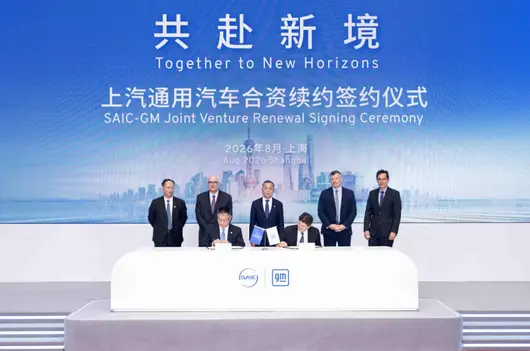
On August 5, SAIC Group and General Motors announced in Shanghai that their joint venture relationship would be renewed for another 20 years, extending to 2047. If the first joint venture in 1997 was the trend of the times, the announcement by both parties this time to extend the joint venture term to 2047 seems somewhat special. The reason is that the United States and we are entangled due to various industrial competitions. General Motors and SAIC, as the largest automotive companies of their respective sides, what does their cooperation at this time mean?
Let's first see what the official statement said: Both sides stated that this cooperation renewal is based on nearly 30 years of successful cooperation. Against the backdrop of profound changes in the global automotive industry, SAIC Group and General Motors have cast a vote of confidence in the long-term value of the Chinese automotive market and the transformation capabilities and development prospects of SAIC-GM. Both shareholders will further collaborate on technical research and development, supply chains, and global market resources to provide continuous support for the smart electric transformation, local innovation, global layout, and long-term healthy development of SAIC-GM.
Deconstructing this passage, it mainly contains two meanings: First, to convey confidence; Second, both parties will collaborate on technical research and development, emphasizing the smart electric transformation, and paying close attention to the global market.
First point, the confidence aspect is obviously very important. Just on August 3, the United States even included our Qiaqia Melon Seeds, Sinian Dumplings, Septwolves, etc., in the import restriction list, not to mention new energy vehicles.
Second point, regarding the technical collaboration between the two parties, SAIC-GM's smart electric transformation, in just two short lines, the word "Global" is mentioned twice: Global market resources, Global layout; Recalling Tesla from the United States as well, "Become a benchmark factory and major export center for Tesla globally", this may imply that SAIC-GM intends to leverage China's supply chain advantages to bypass various restrictions in the United States and increase the "export" role of SAIC-GM.
"Exports" or a Key Development Strategy
Public data shows that as of September 2024, the Tesla Shanghai Factory had cumulatively exported 1 million Teslas in less than 4 years; in 2025, the Tesla Shanghai Factory delivered 851,000 new cars globally, accounting for half of its global sales. Domestic retail was 626,000 units, meaning exports were approximately 220,000 units.
Due to the localization rate of Tesla being above 95%, this means that while Tesla is earning substantial profits for its shareholders, it is also earning large amounts of foreign exchange for China. The initial core demand set by the Chinese automotive industry for the purpose of "joint venture" was to earn foreign exchange. Not to mention the contribution of Tesla to building a complete new energy vehicle industry chain in China after its growth. Therefore, even a wholly foreign-owned project like Tesla is of no small importance to the Chinese automotive industry.
We return to SAIC-GM. From the first batch of 50 Buick GL10 exported to the Philippines in 2001 to July 2022, SAIC-GM's cumulative exports surpassed 1 million units. As of the end of November 2025, this figure has exceeded 1.3 million units. Besides complete vehicle exports, the contribution of SAIC-GM to the Chinese automotive industry chain is even greater than Tesla.
From a global market perspective, General Motors began to gradually shrink since 2015, withdrawing successively from the passenger car markets in Western Europe and India, selling Opel's German headquarters, all passenger car factories in Western Europe; Thailand local complete vehicle manufacturing business, two complete vehicle factories in India, retaining only the US, China, South Korea, Canada, Mexico, Brazil and other major core profitable markets.
On the Chinese side, on the one hand, SAIC and Great Wall and other enterprises have successively taken over some of General Motors' overseas assets, allowing General Motors to avoid greater losses; at the same time, Chinese-made cars have seen continuous growth in exports for many years, achieving technical leaps and becoming objects of cooperation and joint ventures for overseas brands such as Audi, Volkswagen, and Stellantis. As an old partner of the Chinese automotive industry, retaining "SAIC-GM" as this high-quality asset is clearly a wise move for General Motors.
Looking at the "SAIC-GM" joint venture project, if the past China and SAIC needed to borrow General Motors' technology and products to develop themselves, and General Motors also needed to borrow China's market demand and scale to develop itself; the current China and SAIC are no longer as dependent on General Motors as they were back then, while General Motors, besides still needing China's market demand and scale, also needs to leverage SAIC Group's smart electric technology and China's automotive supply chain advantages, to retain SAIC-GM as a key bridgehead for General Motors to continue to profit and expand in the global market. This change in strength and status between the two has also given today's "SAIC-GM" a completely different meaning.
"Zhijing Model": Exports or the Short-term Optimal Solution
At the press conference for the renewal of SAIC-GM joint venture for another 20 years today, SAIC-GM clearly stated that in the future, both parties will rely on the local research and development system accumulated in the R&D center established jointly in China by the two parties — Pan Asia — and the mature domestic supply chain, as well as the empowerment of SAIC Group's leading smart electric technology capabilities in recent years. At the same time, inheriting General Motors' century-old technical heritage and global rigorous standards, they will continue to provide high-standard products and services to the market.
SAIC-GM also gave an example: the Zhijing model. As the new sub-brand of SAIC-GM "Zhijing", its core is SAIC Group's smart electric technology, combined with Pan Asia's R&D advantages and mature domestic supply chain, plus General Motors' global product standards, a new species combining multiple advantages.
SAIC-GM specifically mentioned that according to the plan, Buick Zhijing E7 will be officially exported to overseas markets in October this year, becoming the first high-end new energy vehicle of the Buick brand and SAIC-GM Motors to go overseas, marking the opening of a new chapter in enterprise transformation and globalization strategy.
Buick Zhijing will not only become a benchmark for joint ventures developed locally and exported in reverse to overseas markets, but also provide a new model of "local innovation, global sharing" for joint venture exports for multinational automotive companies. With the support of both shareholders, SAIC-GM Motors will continue to expand into international markets in the Middle East, Africa, South America, Mexico and Asia-Pacific in the future, further enhancing the influence of China's local innovation results in the global market.
From these descriptions, it seems that the future market focus of SAIC-GM may rely more on overseas markets. Public information shows that since the Zhijing brand was launched in April 2025, a total of three models have been launched: Zhijing Shijia, Zhijing L7, and Zhijing E7. All three cars are new energy vehicles. As a new brand, the Zhijing brand had to face the vast ocean of China's new energy competition as soon as it was born, with fierce competition far stronger than the era when Buick's early star models Buick Century and Buick Sail were located. It is unrealistic to want Zhijing's new cars to sell well like Buick Century and Sail back then. Therefore, whether it is SAIC or General Motors, they need to find a completely different business path for Zhijing. "Overseas markets" are probably the most realistic answer at this time.
According to consultancy firm AlixPartners forecasts, Chinese car exports in 2026 will reach 10 million units, an increase of 41% year-on-year, 2.5 times the annual export volume of Japanese cars. Looking at brands, taking Chery Group as an example, the cumulative sales from January to July this year were 1.6343 million units, of which exports were as high as 70%.
In the international market, precisely out of continued看好 of Chinese new energy vehicles, the third-ranked Stellantis Group in the world signed a cooperation agreement with Leapmotor, not only directly investing in Leapmotor Automobile but also establishing a Leapmotor International joint venture company to exclusively be responsible for the sales and production business of Leapmotor Automobile products in markets outside Greater China.
In addition, including the cooperation between Volkswagen and Xpeng, the new cooperation between Audi and SAIC, all have similarities with this time SAIC-GM's "new joint venture". In other words, no matter what barriers exist between nations, the global automotive industry that was originally entangled is now carrying out cooperation with a more profound impact in a posture where they cannot live without each other.
Perhaps, for industry and capital, politicians and national industrial policies may produce major changes every four years, but joint venture cooperation for the purpose of win-win is the true market main melody. Looking at the current development situation of Chinese new energy vehicles, the "joint venture enterprises" widely existing in China's market may be making the global automotive industry look anew. For those enterprises that have boarded China's train, they are all secretly grateful in their hearts, such as General Motors, Audi, etc. And for those enterprises that previously completely did not看好 "joint ventures", they probably regret it now. From this perspective, this new cooperation between SAIC and General Motors undoubtedly represents the most mainstream industrial trend at the moment, and also reveals the high ability and vision of the joint venture parties to adapt to the times.

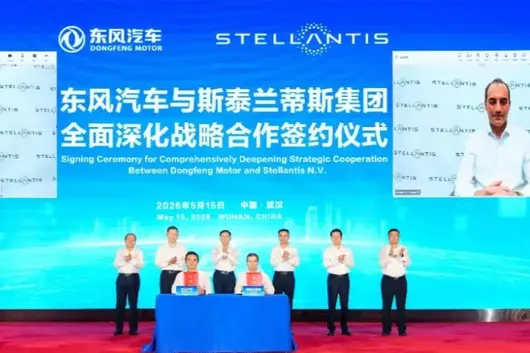
May 20, Stellantis and Dongfeng signed a non-binding memorandum of understanding, planning to establish a joint venture in Europe. Among them, Stellantis holds 51% equity, while Dongfeng holds 49%.
This joint venture will do four things: sell VOYAH brand new energy vehicles, localize production at Stellantis' Rennes factory in France, joint procurement, joint R&D.

After establishing the "Leapmotor International" joint venture with Leapmotor in Europe, Stellantis extended an olive branch to its old partner Dongfeng again this time, adding a layer of consideration for "localization production".
Does this mean Chinese automakers have completely changed their strategy for going global?
First, Clarify the Global Expansion Models
Before analyzing this, let's first clarify the several strategies Chinese automakers use for going global.
The first is whole vehicle export. Cars are built domestically, shipped on boats, and sold by dealers locally. This model is the simplest with the lowest investment, but it lacks market control; once tariffs rise, the price advantage disappears. Chery's early export to Russia followed this path; once tariffs were added, the rhythm was completely disrupted.
The second is KD assembly. Parts are shipped locally and assembled in local factories. This model is a step up from whole vehicle export, able to evade some tariffs and carry a "Locally Made" label. But honestly, many KD factories are just large screw-nailing plants; core parts are still shipped from China, with limited localization. Many Geely and Chery factories in Southeast Asia and the Middle East use this model. It solves some problems but not the root ones.
The third is building factories alone. Bringing money overseas to buy land, build factories, hire people, and build channels. This is the most "hardcore" way and the path taken by top independent automakers. Great Wall Motors and BYD have adopted this model. BYD's Thailand factory is already in production, the Brazil factory is under construction, and the Hungary factory is in planning. The benefit is becoming a true "local brand", evading import tariffs, and securing local government industrial subsidies. But the investment is high, the cycle is long, and management complexity increases by an order of magnitude.
The fourth is acquiring local brands. Geely acquired Volvo, later invested in Daimler, and acquired Lotus. This is the path Geely walked earliest and most systematically. Partial equity or binding with a local giant equals directly inheriting the other party's brand assets, channel networks, and local compliance capabilities. But integration difficulty is huge, with high risks of cultural conflict and management chaos.
And this cooperation between Stellantis and Dongfeng does not fit well into any of the above.
Strictly speaking, it is a combination of the third and fourth types.
Using Stellantis' existing French factories for production is borrowing the other party's manufacturing assets, not building independently; selling VOYAH using Stellantis' existing European sales channels is borrowing the other party's commercial assets. Moreover, the capital structure is shared equity, not Party A hiring Party B to help, but a true interest binding.
This model, I will temporarily call it "Grafting Global Expansion" — not planting a tree yourself, but grafting branches onto an existing big tree.

Why is this path worth attention? Because it solves several core pain points of going global.
Where Does Localized Production Really Matter?
Many people talking about localized production first think "evading tariffs". That's right, EU anti-subsidy taxes plus tariffs mean a Chinese EV pays dozens of percentage points more tax entering Europe, basically wiping out the price advantage. But tariffs are just one dimension.
More critical is the carbon footprint. The EU Carbon Border Adjustment Mechanism (CBAM) has started trial operation, and future import vehicle carbon emissions will also need to be considered. If cars are produced in Europe using European green electricity, the carbon footprint will be much better. In the next 5 years, the cost pressure in this area will increase.
Another point to consider is the supply chain.
Dongfeng is producing in European factories, but what about the supply chain? The memorandum wrote "joint procurement", which means some parts are still sourced from China, leveraging Dongfeng's procurement capabilities in China's new energy ecosystem to reduce costs. But the local supply chain must keep up gradually, otherwise, if geopolitical risks arise, production lines will stop.
Next, the brand. European consumers have high loyalty to car brands; Germans buy Volkswagen, French buy Peugeot. This is a habit of decades. Chinese new brands want to break this habit; product strength alone is not enough, there must be "trust endorsement". Stellantis' participation is this endorsement.
Of course, the cost is that the joint venture is led by Stellantis, and the voice in the European market is mainly in Stellantis' hands. This is a price that has to be paid.
Who Will Be Mainstream in the Next Three to Five Years?
My judgment is that in Europe, "binding with local giants" will become the mainstream.
The reason is simple, the European market is too hard to fight. Tariff barriers are highest, regulations most complex, consumers most picky, competition most intense. The whole vehicle export model will become increasingly difficult in the European market, forcing Chinese automakers to find a way out of localized production.
On the other hand, Stellantis needs to make up for the electrification shortcoming. Other Western automakers, such as Ford, General Motors, Renault and other traditional automakers, are struggling in transformation dilemmas. They have channels, factories, and brands, but lack new energy capabilities. This is exactly what Chinese automakers can provide.
Both sides have needs, so cooperation will increase.
The method may not necessarily be a joint venture form like Stellantis and Dongfeng, it could also be more flexible forms such as technology licensing, channel sharing, joint development, but the core logic is the same: not fighting alone, leveraging momentum to land. While in markets like Southeast Asia, Middle East, South America, building factories alone and KD assembly remain mainstream because barriers are relatively low and price advantages still work.
However, "binding with giants" is not without risk. Being tied up with a giant means destiny is partly in others' hands. What if Stellantis cooperates with Dongfeng today but finds a better partner tomorrow? What if joint venture performance fails to meet expectations? What if there are disagreements on product positioning and pricing strategies? Dongfeng Peugeot Citroën's history has already proved that the relationship between joint venture partners is not always smooth.
From Dongfeng Peugeot Citroën to European joint venture, over thirty years, the relationship between Dongfeng and Stellantis has completed a "two-way rush". Behind the role reversal is the accumulation and transformation of the Chinese automotive industry over decades. Chinese automakers are no longer satisfied with "selling cars"; they want "rooting". The prerequisite for rooting is learning to cooperate with locals.
Whether this time can succeed, we will wait and see.


As stated in the title, Chery (Chery) has confirmed it will enter the Japanese market through Electric Mobility Technologies (EMT), the joint venture is registered in Singapore, with participants including Chery, Jiangsu Yueda Group, Autobacs Seven, Gotion High-Tech and Anest among others.
According to media reports, the joint venture will launch a new brand named Emta in Japan. The first model is a pure electric light vehicle, commonly known as a K-Car, expected to officially launch in 2027. Product-wise, the new car will be built based on Chery's vehicle architecture, electric drive system and ADAS driving assistance technology, while the power battery will be supplied by Gotion.
In terms of production, this model is expected to be produced at Yueda's factory located in Yancheng, Jiangsu Province, China. The factory currently also undertakes production tasks for Kia and HiPhi (HiPhi). If the brand subsequently achieves scaled success in the Japanese market, the company does not exclude the possibility of establishing a production base in Japan after 2030. In terms of division of labor, Autobacs Seven will be responsible for sales network construction and channel operations, while Anest will undertake quality and after-sales support systems.

According to the plan, the Emta brand will launch a total of four models for the Japanese market before 2029, with the K-Car being the launch product. Afterwards, it will gradually expand to a series of larger-sized models, including hatchbacks, SUVs and a multi-purpose vehicle with a shape close to an MPV.
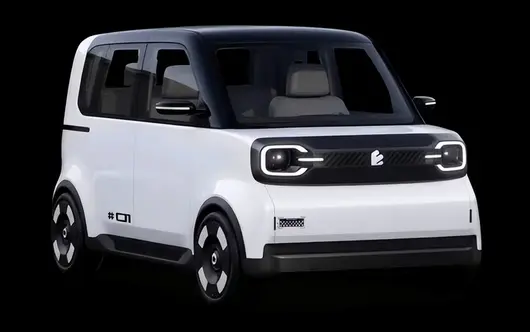
From the currently revealed teaser images, the outside world generally believes the first model may be named Emta #01. Regarding design language, the overall contour of the car has some similarity to Chery QQ Ice Cream, but it has been redesigned in details, including a more simplified front face styling, redefined headlight group structure and more miniaturized exterior mirror design, making it better comply with the strict requirements of the Japanese K-Car market for practicality and space efficiency. In terms of body dimensions, the new car is about 3400mm long and 1480mm wide, complying with the typical K-Car regulatory framework.
It is worth noting that this Emta K-Car will directly face competition from multiple local brands in the Japanese domestic market in the future, and will also welcome opponents from the Chinese camp, such as BYD Racco and other same-class small electric vehicle products planned to be launched in Japan by BYD. As multiple parties accelerate layout, the competitive landscape of the Japanese micro electric vehicle market is expected to heat up significantly.