首頁Huajing S

搜尋歷史
熱門搜尋
經銷商登入 / 註冊

Editor's Note: Wuling's "low-key adjustment" this time has pushed the person who understands Wuling the best to the most difficult yet most imaginative position.
Recently, SAIC-GM-Wuling completed a round of low-key personnel adjustments: former Deputy Party Secretary and Vice General Manager Han Dehong succeeded Yao Zuoping to serve as the company Party Secretary; Yao Zuoping was reassigned as General Manager Advisor and Director of the Technical Committee of the Smart Island Manufacturing System.

There was no high-profile press conference, nor lengthy press releases, but this step of "Deputy Secretary becoming Official Secretary" carries significant weight in the context of state-owned enterprise governance—it is both a handover between new and old generations, and a recalibration of organizational temperament amidst Wuling's triple pressures of new energy, overseas expansion, and brand elevation.
From Grassroots to Party Secretary
Han Dehong was born in 1982, joined SAIC-GM-Wuling in 2005, and has been within the system for 21 years by 2026. In the public resume, he did not follow a single technical line or single sales line, but was repeatedly "traversed across different terrains" by Wuling: early on, he went to the Indian joint venture company as General Manager Assistant, encountering emerging markets and cross-cultural joint ventures;
Back in China, he managed administration and public relations, understanding government, media, supply chain, and external relations; since 2016, he entered the sales system, serving as Vice General Manager of the Sales Company; during the New Baojun period, he worked on sales companies and brand communication, catching the wave when Wuling tested the shift from "cheap and usable" to "younger and intelligent"; then he went to the Indonesian market, participating in Southeast Asian localization operations; back at headquarters, he served as Deputy Party Secretary and General Manager Assistant, appearing publicly as Vice General Manager starting in 2024.
The keyword of this path is "full scenario": overseas, brand, sales, PR, party building, and operations are all covered. Compared to executives from pure technical or pure financial backgrounds, Han Dehong is more like an "organizational strategist"—this is what Wuling, such a "people's car company," needs now: to both defend the core market in lower-tier areas and articulate globalization, Smart Island, and new energy.
Behind the August Sales of 130,870 Units
When looking at sales, one cannot just look at the total number.

In August, SAIC-GM-Wuling's global sales were 130,870 units, of which new energy accounted for 83,788 units, representing about 64%—this shows that Wuling is no longer a company relying solely on the Hongguang MINIEV single product to rule the market, but new energy has become the main engine. More critically, the structure: Red Label Wuling 36,726 units, the core foundation still lies in commercial, county/township, and micro-business operator markets; Silver Label Wuling 47,139 units, undertaking household-oriented, quality-oriented;
Overseas exports 38,660 sets/units, cumulative overseas sales exceeded 1.6 million, exports have broken 30,000 for 5 consecutive months; Huajing S delivered 7,306 units, total deliveries since listing exceeded 25,000, climbing continuously for many months. The significance of Huajing S is not entirely in absolute volume, but in "whether Wuling can sell into the 100,000+ or even higher price bracket".
In the past, Wuling's strength lay in cost-performance and scale, weak in brand premium. If Huajing S can stabilize at 7,000-unit level monthly delivery, it proves Wuling is not only good at making "commuter miracle cars" but can also penetrate the mainstream new energy SUV market for family smart mobility.
But the risks are also clear: Silver Label and Red Label still face downward pressure year-on-year; traditional fuel micro-cars and entry-level markets are squeezed by price wars, channel inventory, and consumption segmentation. Wuling is currently not "without sales", but rather "sales structure is undergoing a transformation", and the transition period fears rhythm chaos most.
Han Dehong's appointment, on the surface is "44-year-old taking over 62-year-old"; the underlying layer is Wuling shifting from "lower-tier scale driven" to "new energy + overseas + intelligent manufacturing" three-line warfare.
Yao Zuoping's generation made Wuling a national brand where "whatever the people need, Wuling builds"; Han Dehong's generation needs to answer: when people need intelligence, need globalization, and need higher quality-price ratio, will Wuling dare to, and be able to, revolutionize once again.
Short-term, August data gave confidence: new energy nearly 84,000, overseas exceeded 1.6 million, Huajing S broke 7,306, the core foundation did not collapse. Medium-term, the real exam is three things—whether Huajing/Baojun can pull the brand price bracket up, whether Indonesia/India/Southeast Asia experience can become sustainable overseas profits, and whether the Smart Island manufacturing system can turn cost and flexible production into a moat.
Wuling's "low-key adjustment" this time is actually not low-key at all: it pushed the person who understands Wuling the best to the most difficult yet most imaginative position.

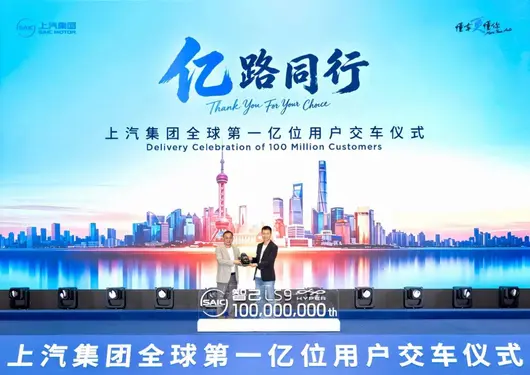
May 28, 2026, SAIC Group held a special vehicle delivery ceremony at Shanghai North Bund World Living Room. What makes it special is not how many leaders came, but because the protagonist changed to users, accurately speaking, it is SAIC's 100 millionth user globally.
100 million vehicles. This is a number never touched by a Chinese automotive group. From 1958 when workers hammered out the first Phoenix sedan with a hammer, to 2026 when over ten brands and nineteen models under its umbrella were delivered synchronously across continents, SAIC took 68 years to write itself into a new coordinate of the Chinese automotive industry.

Behind the 100 Million Vehicles, It's Not Just About Selling More
When many people see "100 million vehicles", their first reaction is: SAIC really sells a lot. This is not wrong, but only half right.
In the first four months of 2026, SAIC sold a cumulative 1.302 million vehicles, taking the crown as the top-selling car enterprise for four consecutive months. Among them, the share of independent brands is close to seven-tenths, new energy vehicles sold 412,000, and the overseas market surged 50.2% year-on-year. These numbers are indeed beautiful, but more worth looking at is the structure: independent brands account for 70%, overseas sales account for more than one-third. This shows SAIC is no longer the enterprise that relied on joint ventures for passive wins back then.

Starting from the localization of Santana, to Roewe creating the Internet car category, to the concentrated launch of high-end smart electric products like IM, Shangjie, and Huajing S, SAIC has taken a road that most traditional car enterprises are walking, but few walk smoothly: while stabilizing the core business in the joint venture sector, let independent brands truly stand up. Today, the outline of this road is quite clear.
Global Relay Delivery Is Not a Show, But Real Skill
The most interesting design of this delivery ceremony is "Global Relay". Outside the Shanghai main venue, delivery scenes in Nanjing, Liuzhou, Taiyuan, as well as the UK, Indonesia, Singapore and other countries and regions were lit up successively. Completing cross-continental, multi-brand, large-batch synchronized delivery on the same day tests not planning ability, but the hard strength of supply chain and channels.
SAIC has over 100 parts production bases overseas, over 3,000 dealer networks. It has built three R&D innovation centers such as London, as well as four production and manufacturing centers in Thailand, Indonesia, India, and Pakistan. Anji Logistics 42 Ro-Ro ships, 8 international routes connected Southeast Asia, Europe, Americas. The facts stacked out by these numbers are: SAIC is one of the few Chinese car groups that truly has global operation capabilities.

MG has been the top-selling Chinese brand in the European market for 11 consecutive years. In 2025, annual sales in Europe broke through 300,000 vehicles, and cumulative sales broke one million in the UK and European markets. This is not a small-scale export, but a head-on confrontation in mature markets. In March this year, the semi-solid-state batteries and Hybrid+ hybrid technology released by MG at the Frankfurt Technology Day, overseas monthly sales have already broken 20,000 vehicles. From "Product Going Global" to "Value Chain Going Global", SAIC's Glocal strategy is being realized.
What Truly Matters Is Whether "Understanding You" Can Be Done Properly
SAIC proposed a slogan called "Know Cars, Know You Better". The first half is basic skills, the second half is the dividing line.
At this delivery ceremony, SAIC did not invite celebrities to endorse, but found real users to tell stories: Luo Zhenyu from Dedao APP, as Huajing S Experience Officer No. 001, talked about Qiankun Intelligent Driving from the New Year's Eve Speech to walking into the factory to witness the launch; former national football player Yang Chen chose ID. ERA 9X, with the reason that Golden Extended Range and Long-termism concepts fit; charity blogger Liu Jia shaved the hair of left-behind children in Guangxi mountainous areas for five consecutive years, Buick not only assisted him, but he himself was also moved by the Zhijing E7 cabin. These stories are not big on their own, but put together, they spell out the signal SAIC wants to convey: Users are not the end point of payment, but the starting point of R&D and service.

Product itself. Volkswagen ID. ERA 9X globally launched Momenta R7 Reinforcement Learning World Model, one month after launch delivery broke 7,000 units; AUDI E7X plans to become Audi's first L3 level landing model globally; Buick Zhijing E7 based on "Xiaoyao" Super Fusion Architecture, one month after launch delivery broke 10,000. The common point of these products is: technology no longer stays on the parameter sheet, but becomes experience perceived by users.
100 Million Vehicles is a Period, Even More a Colon
To be honest, this number of 100 million vehicles is not rare among global automotive giants. Toyota and Volkswagen have long been members of the "100 Million Club". But for the Chinese automotive industry, this is the first time a local enterprise has crossed this line, the meaning is different.
What is more important is not the celebration, but how to go next. SAIC itself is also very clear, positioning this 100 million vehicle delivery as the "starting line of second entrepreneurship". From the establishment of Shanghai Internal Combustion Engine Parts Manufacturing Company in 1955, to the present day where the full brand matrix moves forward together in the global market, SAIC has proved that traditional car enterprises can also complete the "turning the elephant around". But the battle of intelligent electric transformation has only reached the halftime, the next competition will be more cruel, semi-solid-state batteries, AI large model onboard, L3 level autonomous driving landing, every item is a tough fight.
100 million vehicles are the answer sheet SAIC gave to the past, and also the test question given to the future. The tools for answering are already here: full value chain system, global layout, dual engine of independence and joint ventures running in parallel. Whether it can be answered well depends on how deep the sentence "Know Cars, Know You Better" can be implemented.