首頁Global Expansion

搜尋歷史
熱門搜尋
經銷商登入 / 註冊

Author | Janson
Editor | Zhihao
CheXiwu News on August 19, recently, Pony.ai and global mobility platform Uber announced further expanding strategic cooperation, planning to deploy more than 2,000 Pony.ai Robotaxis in 5 cities in Europe. This is one of the largest Robotaxi deployment plans in Europe, and consequently, Pony.ai's total overseas deployment plan exceeds 4,000 vehicles.
This cooperation between Pony.ai and Uber will be based on the existing commercial operations in Zagreb, Croatia, and expand to 5 European cities including Zagreb.

▲ Pony.ai Founder and CEO Peng Jun (right) and Uber CEO Dara Khosrowshahi (left)
Meanwhile, Zagreb Robotaxi service will soon integrate into the Uber platform, and users can call Pony.ai Robotaxis through the Uber App.
From single-city operations in Zagreb to 5 cities in Europe and over 2,000 vehicles, the cooperation between Pony.ai and Uber is crossing a key milestone.
Why can both parties quickly replicate the same set of technologies, products, and operational models across multiple cities?
In response, technology, platforms, and operations are organized into the same "Jointly Built Fleet" system.
Pony.ai is working with overseas partners to replicate the autonomous driving technology, mass-produced products, and commercialization capabilities verified in the Chinese market to broader overseas markets.
01.
From Zagreb to Five European Cities
Pony.ai and Uber Build Robotaxi Fleet Together
In this expansion, Pony.ai and Uber collaborated to explore a "Jointly Built Fleet" model involving both technology providers and mobility platforms.
Compared to full-chain self-operation, this division of labor can reduce redundant construction.
Pony.ai does not need to build a mobility platform and complete offline operational system from scratch in every overseas city, and Uber does not need to develop L4 autonomous driving systems itself.
Both parties can introduce partners familiar with the local market on the basis of their respective capabilities to promote vehicle management and city operations. Vehicle capital investment and asset ownership are also not using fixed schemes.
According to the cooperation framework disclosed by both parties, participating parties can assume multiple roles based on local market conditions. Who invests the vehicles and who holds the assets can be flexibly arranged in combination with specific cities.
This allows the same cooperation model to adapt to different markets, rather than redesigning a business architecture for every city.
Of course, jointly built fleets do not mean bypassing localization work. When Robotaxis enter new countries and cities, regulatory communication, vehicle access, testing verification, and operating licenses still need to be promoted. This part of the work is exactly the strength of local partners, especially partners with rich experience like Uber, while Pony.ai leverages its own technology and operational advantages to adapt products to local road environments, traffic rules, and user needs.
The value of local partners lies in supplementing city resources and operational experience, improving project implementation efficiency. Pony.ai still needs to be responsible for the safety, stability, and continuous iteration of the autonomous driving system.
Based on previous experience, Zagreb has already completed the preliminary verification of this model.

▲ Pony.ai Robotaxis in Europe
Zagreb has already completed the single-city verification of this model. In May this year, Pony.ai, Uber, and Croatian local company Verne cooperated to launch commercial Robotaxi services locally.
Next, the three parties need to verify whether this model can adapt to road, regulatory, and operational environments in different cities. Moving from single-city landing to regional replication is precisely the core value of "Jointly Built Fleets". Parties recombine existing capabilities, thereby reducing capital pressure and execution complexity for entering new markets, providing a foundation for Robotaxis to move from point landing to regional scale operations.
02.
From Technology Verification to Thousand-Vehicle Deployment
Why Pony.ai Received Uber's Increased Investment
The core reason for Uber expanding cooperation with Pony.ai is not complicated. The platform needs Robotaxi capacity that can serve in old town areas with complex European road conditions, accept orders during peak ride-hailing hours such as rainy days, and has a total cost of hardware and operations that is low enough.
Pony.ai has completed the leap from technology testing to commercial operations.
Currently, Pony.ai has carried out fully autonomous Robotaxi commercial operations in Beijing, Shanghai, Guangzhou, and Shenzhen, possessing 1,975 Robotaxis.
At the same time, Pony.ai's global autonomous driving road test mileage exceeds 100 million kilometers, of which fully autonomous road test mileage exceeds 40 million kilometers.
Complex roads, real users, and normalized operations jointly tested the safety and stability of its autonomous driving system.
But for Uber, for the technology to work is just the basis. Integrating Robotaxis into mobility platforms also requires ensuring that vehicles can provide long-term stable service in complex core urban areas where ride-hailing demand is most vigorous, rain or shine, and that the riding experience can be accepted by users. Service quality will not decrease after fleet scale expansion.
Pony.ai's user experience and scale fleet operation experience accumulated in domestic tier-one cities meet Uber's high requirements for operations in Europe, thus becoming Uber's largest autonomous driving partner in Europe.

▲ Pony.ai Robotaxis in China
Beyond technology, commercialization capability is equally critical. Pony.ai's Seventh Generation Robotaxi has achieved per-vehicle profitability in Guangzhou and Shenzhen, indicating that its Robotaxis not only can complete fully autonomous driving but also start to balance revenue and costs.
For Uber, only when the per-vehicle economic model is established can autonomous driving capacity expand from a small number of demonstration vehicles to a continuous operation thousand-vehicle fleet.
Another capability supporting scale expansion is automotive-grade mass production.
Pony.ai's Seventh Generation Robotaxi already possesses mass production and deployment capabilities, and its technology, safety, user experience, and cost control have all been tested by actual operations.
Compared to test vehicles modified for individual projects, standardized and mass-producible Robotaxis are more suitable for cross-city replication and can also provide a stable foundation for subsequent vehicle supplementation and fleet operations.
Beyond mass production capabilities, cost advantages further expanded Pony.ai's scale deployment space.
Pony.ai Founder and CEO Peng Jun previously stated that Pony.ai's vehicle costs are approximately one-fourth to one-fifth of Waymo's. This gap comes from the joint effect of technological R&D, supply chain, and engineering capabilities.
Lower vehicle investment means overseas partners can deploy more vehicles with the same funds, and also leave more space for return on investment after fleet expansion.
For Uber, what Pony.ai provides is not only L4 virtual drivers but also automotive-grade mass-produced vehicle models, verified user experience, and sustainable per-vehicle economic models.
This is also the key to Uber choosing to cooperate with Pony.ai for increased investment.
With this, Pony.ai's role in overseas markets has also changed. Pony.ai started providing Robotaxi products capable of batch deployment and autonomous driving capacity capabilities to global mobility platforms.
03.
Fleet Scale Expansion
Pony.ai's "Dual Engine" Begins to Turn
Europe 5 cities, over 2,000 vehicle fleet, global total planned scale of 4,000 vehicles. The scale means Pony.ai's overseas layout began to shift from single-city landing to regional scale operations.
In the future, what Pony.ai will form in Europe will no longer be several scattered projects, but a Robotaxi operational network covering multiple cities.
Thousand-vehicle scale is also an important watershed for Robotaxi commercialization.
Only when the number of vehicles reaches a certain scale can regional coverage density and capacity dispatch efficiency be improved, allowing users to hail cars more easily, and further improve the per-vehicle economic model by relying on more orders and scale effects.
Built upon the Seventh Generation Robotaxi per-vehicle profitability and cost advantages, Pony.ai already possesses the foundation to scale up the business model verified domestically to European thousand-vehicle fleets.
Europe provides a larger value space for this model.
European cities are dense, and shared mobility markets are mature. Labor and vehicle usage costs are relatively high, providing a larger commercial value space for Robotaxis.
Pony.ai's per-vehicle economic model that has run through is expected to obtain higher revenue and greater profit space locally. Better vehicle returns will also enhance the willingness of platforms and operational partners to expand deployment.
After scale expansion, what Pony.ai obtains is not just the number of vehicle deployments.
According to the business model of the jointly built fleet this time, European fleet operations are expected to bring it technical licensing, passenger fare sharing, and other ongoing revenue.
The more vehicles, the broader the covered cities, Pony.ai's revenue sources will also gradually shift from project cooperation to long-term returns linked to actual operational scale.
This is precisely the core of Pony.ai's "China + Overseas" dual-engine strategy.

▲ Pony.ai Robotaxis in the Middle East
The Chinese market undertakes product verification and industrialization tasks. Pony.ai relies on complex domestic urban road environments to hone technology, verify business models, and leverage mature automotive supply chains to promote automotive-grade mass production and continuous cost reduction.
The overseas market undertakes scale amplification and revenue growth tasks, replicating domestic-verified Robotaxi products and business models to high-value incremental markets.
The two markets thus form a mutually reinforcing cycle.
Domestically mature products and lower costs provide a foundation for overseas deployment; overseas fleet and service scope expansion releases greater commercial value, while bringing back operational experience under different roads, regulations, and user needs, pushing products to continue iteration.
Europe 5 cities is just an important step in this global expansion path.
Currently, Pony.ai has obtained autonomous driving test or operating licenses in markets such as the Middle East, Singapore, South Korea, Luxembourg, and Croatia, and proposed the target of entering over 20 cities globally in 2026 with fleet scale breaking 3,500 vehicles.
What Pony.ai outputs to overseas is no longer just a set of autonomous driving algorithms, but Robotaxi products, supply chain capabilities, and commercial operational methodologies verified in Chinese megacities.
At this point, Pony.ai's "China + Overseas" dual engine begins to truly turn.
04.
Conclusion: Robotaxi Enters the "Scale Operation" Stage
The next stage of Robotaxi competition is about who can truly organize technology, vehicles, orders, capital, and offline operations.
Uber's continued investment has also gradually formed a closed loop for Pony.ai's joint fleet model in Europe.
Over 2,000 new deployments, and the global 4,000 vehicle planned deployment expectation. If these can be successively converted into stable operating real fleets, what they verify is not just one enterprise's overseas path, but a Robotaxi commercialization methodology originating from the Chinese market and facing global replication.

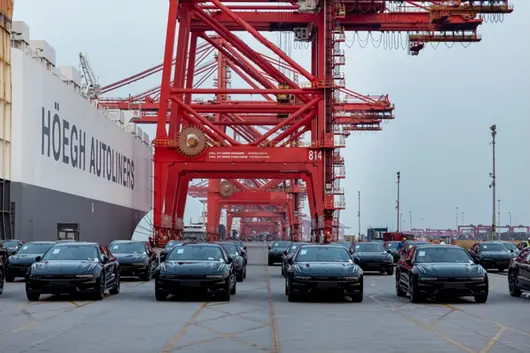
Early August, car makers typically "show off their results". BYD July sales 419,211 units, among them overseas sales 179,841 units, year-on-year increase of 124.3%, accounting for 43% of total sales; Chery Group sales 276,820 units, exports 202,533 units, year-on-year increase of 70.1%, becoming the first Chinese car company to exceed 200,000 monthly exports; Geely Automobile July sales 250,161 units, overseas exports 106,663 units, year-on-year increase of 202%.
Looking at these three sets of data and three representative car companies together, it is not difficult to find that going global has accounted for more than 40% of sales of top car companies.
From the performance of various car companies in the past, the features of going global reflected by this data are not accidental. BYD Chairman Wang Chuanfu has expressed on multiple occasions that BYD's goal is to become a "global new energy enterprise". The 43% proportion in overseas sales in July simply made this goal start to change from a slogan to reality. Chery Holdings Chairman Yin Tongyue also said: "Chery does not want to make easy money at home, but if Chinese cars only run within their own backyard, they will never produce world-class enterprises."

As for the reasons, there are several points worth paying attention to that might explain this. July new energy penetration rate created a historical high of 64.5%, but the retail scale of 1.52 million units itself was at a low level in the off-season. Fuel cars still have about 540,000 monthly sales, accounting for 35.5%. In addition, pure electric continues to strengthen internally within new energy, while plug-in hybrid/extended-range growth has slowed down. The incremental space in the domestic market is narrowing.
Considering the broader context, the attention given by top players to going global can be considered forward-looking preparation. And by this time, going global for more Chinese car companies has no longer been a "choice".
Behind the volume, the change of main battlefield is the general trend
The data of top car companies has raised the volume of going global, which also means that overseas has undoubtedly become the "main battlefield". BYD July overseas sales 179,841 units, accounting for 43% of total sales. January to July overseas cumulative 969,000 units, one step away from 1 million units. 8 RoRo ships fully deployed, annual capacity 1 million units, Thailand, Brazil, Hungary factories started production one after another, Spain's second European factory is under investigation. BYD's going global plan is huge, with the meaning of "going all in".
Chery Group July exports 202,533 units, accounting for 73% of total sales. Refreshing single-month export records for five consecutive months, January to July cumulative exports 1.146 million units, year-on-year increase of 71.2%. According to General Administration of Customs data, Chery is also a "big user" of going global. In 2025, the total export volume of Chinese automobiles is about 8.32 million units, Chery alone contributed 1.344 million units, accounting for more than 16%.

July data this year is even more pointed. Chery Automobile Co., Ltd. (9973.HK) July sales 261,876 units, year-on-year increase of 24.1%, entered the Fortune Global 500 List with the identity of a listed company for the first time, ranking 383rd, Return on Equity (ROE) 36.5%, ranking 30th among globally listed companies, and ranked first among Chinese enterprises. This shows that going global has become a key link for Chery to stand globally.
Geely's setup is also huge. Geely Automobile July exports 106,663 units, year-on-year increase of 202%, exceeding 100,000 units for two consecutive months, overseas proportion 42%. New energy exports 62,604 units, year-on-year surge of 616%, accounting for 59% of total exports. Zeekr brand July deliveries 35,837 units, year-on-year increase of 111%, winning the luxury pure electric sales champion in markets such as Australia, Malaysia, Mexico, etc.

The three top car companies combined went global by about 490,000 units, while the entire domestic narrow passenger car market July retail was also only 1.52 million units. This shows that going global for top car companies is no longer a "supplement", but the "top priority". Li Auto July deliveries 30,468 units, slight decrease of 0.9% year-on-year, but L9 still started local production in Kazakhstan. This is the first step it took overseas, showing that even new forces feel the pressure of "go global or perish".
Of course, trend is one thing, and reality issues cannot be ignored either. Does the "half of the sky" in volume equal the "main battlefield" in quality? This is a question worth further thinking. For example, Chery export proportion is 73%, but domestic monthly sales is only 74,000 units, overseas is three times domestic data. There is a risk here. If policies change suddenly in overseas markets, the impact will be huge.
Going global is really making money, or changing places to "compete"?
Volume is explicit, looking at sales proportion can tell. Profit is implicit, no matter which battlefield, this is an unavoidable issue. From the pricing space perspective, overseas markets indeed have more advantages than domestic. The price war in domestic car market has been fought for several years. July terminal average discount narrowed month-on-month, but overall is still in price competition. BYD Dynasty and Ocean series domestic main sales 100,000-200,000 yuan interval, price pressure is huge, but sold for good money abroad.
Chery's first complete financial report after listing also shows that Chery's average selling price per car overseas is 15,000 yuan more expensive than domestic. In Middle East, Jetour Traveler high-spec version sells to 450,000 yuan, twice as expensive as domestic. BYD's Fang Cheng Bao, Denza and other high-end brands are also accelerating going global, overseas single car average price far higher than domestic.

Geely's situation is also similar. Zeekr brand average price exceeds 300,000 yuan, positioning as luxury brand in Australia, Malaysia and other markets, premium pricing power far higher than domestic. Behind the new energy exports surging 616% year-on-year, it is high value-added products supporting, not low price walking volume. This shows that actually high-quality models overseas still have profit space.
However, hidden costs are also fierce. European Union imposing anti-subsidy duties on Chinese electric vehicles, United States market basically closed to Chinese car companies, tariff barrier costs should be calculated. So far, overseas is indeed worth fighting, but laying out overseas now might become more difficult, costs will also be higher.

After all, going global input is not a small number. BYD self-built 8 RoRo ships, built factories on three continents, input is billions level. Chery South Africa Roslin plant launched, Spain cooperation re-activated EBRO brand; Geely reached Ford Spain Valencia factory joint venture agreement and other operations behind, also money paving the way.
Currently mainstream car companies tried three going global modes, benefits and risk performance are completely different. For example, early Chery was pure product export model, profit margin medium, front investment low, but risk high, tariff and policy fluctuations could disrupt rhythm at any time. BYD walked product + capacity localization model, long term view profit margin higher, but front investment extremely high, testing global supply chain management and cross-cultural operation capabilities. Geely used technical cooperation + capacity sharing model, path lightest, but control ability will also correspondingly weaken.

New forces now have their own understanding. NIO July deliveries 35,934 units, year-on-year increase of 71%, battery swap station network in Europe continued to layout. Leapmotor July deliveries 101,267 units, year-on-year increase of 102%, first time breaking 100,000 units threshold, first half year overseas exports nearly 100,000 units, already exceeded last year full year. XPeng July deliveries 38,027 units, year-on-year increase only 4%, but in Germany completed XPeng Turing AI Smart Driving localization acceptance testing. Overall, new forces walk mostly differentiated route.
Can only say, going global has "profit" to earn, but absolutely not a smooth path. Overseas also need to "compete", but worth it depends on profit.
"Main battlefield" conversion behind, or domestic market incremental "not enough to share"
Going global why being pushed to "main battlefield" position, domestic market incremental space narrowing is fundamental factor. July new energy retail about 980,000 units, among them pure electric proportion about 60%, pure electric internal to new energy continues to strengthen, plug-in hybrid/extended-range growth slowed down. This means, "oil and electric" market share is being squeezed by pure electric quickly, pure electric acceptance is continuously improving.
New forces differentiation also proves this. Leapmotor July deliveries break 100,000 units, becoming domestic first single month deliveries exceed 100,000 units new force brand. Its success relies on covering 60,000-300,000 yuan full price product matrix, and overseas market simultaneous explosion. Li Auto July deliveries 30,468 units, slight decrease of 0.9% year-on-year, decrease of 1.4% month-on-month, only double decrease brand among top new forces. There indeed exists i6 due to supply chain issues reduced production about 4,000 units special situation, showing brand dependence on single model is still risk. NIO July deliveries 35,934 units, decrease of 11.5% month-on-month, even three brands collaboration exerting force, but still did not achieve effective complement between brands.

Another aspect, fuel car toughness is still there. July fuel car retail about 540,000 units, market share 35.5%. Sylphy, Lavida still firmly stable in sedan top three, Japanese SUV year-on-year decline over 10%, but not "cliff-like drop". Fuel car stock user replacement cycle still there, short term will not disappear. All this points to one core contradiction: domestic market "cake" is getting bigger, but cake stealing car companies do not yield to each other, competition is continuously intensifying.
BYD domestic monthly sales 239,000 units, already approaching single car company domestic share limit. Leapmotor at 100,000 unit level volume continue to climb, will face capacity bottleneck and supply chain pressure. XPeng July deliveries 38,027 units, new model MONA L03 orders hot but capacity ramp-up is its next biggest test. Xiaomi Auto July deliveries over 30,000 units, fourth consecutive month stuck at this threshold, Peng Cheng series September only listed deliveries, real volume pushing to fourth quarter.

Domestic auto market incremental space narrowing, stock competition new stage arriving, current Chinese auto market, "domestic demand pressure, foreign trade strength" structure or will be future relatively long term trend. Simply put, domestic market this piece of cake, already not enough to share. Not going global, wait to die; going global, maybe still have live road.
Conclusion
From July sales overseas data view, going global now is already car company "main battlefield". Domestic market growth slowing, fuel car won't die fast, stock competition intensifying, going global is inevitable choice. But overseas pricing space larger is fact, but tariffs, building factories, logistics costs not low, different mode profit structure difference huge. Who can win this "main battlefield" battle, now hard to say. Regardless of next battle situation how, Chinese car companies must be clear is, going global is not picking up money, more does not represent domestic market can relax vigilance, how to balance internal and external relations, choose suitable going global mode, is the key.

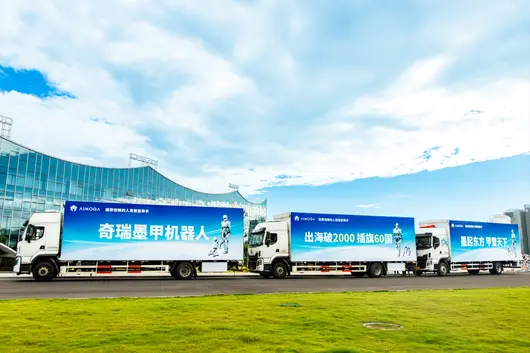
On the morning of July 30, the "Overseas Deliveries Break 2,000 · Flags Planted in 60 Countries" Moja Robotics Global Delivery Ceremony was held in Wuhu, Anhui. During the event, Moja Robotics announced that cumulative global deliveries surpassed 2,000 units, with products and services covering more than 60 countries and regions, and simultaneously held the global delivery milestone lighting and overseas departure launch ceremony. This not only signifies that the enterprise's global development has entered a new stage, but also reflects that Chinese robots are accelerating from product export to scaled, systematic overseas expansion, relying on real commercial scenarios.

Robot Fleet Waves Thousands of National Flags, Global Deliveries Break 2,000 Units
At 8:30 AM, within the Chery International Park, Moja Robotics robots lined up neatly, waving flags from more than 60 countries and regions in synchronization. The transportation fleet was poised for departure. With the global delivery milestone officially lit and the departure order issued, the transport vehicles loaded with Moja Robotics products slowly drove out of the park towards Wuhu Port. At this moment, the cumulative global delivery of Moja Robotics officially exceeded 2,000 units, with products and services covering more than 60 countries and regions. "Overseas Deliveries Break 2,000 · Flags Planted in 60 Countries", from a set of numbers, has become another important coordinate for the global development of Chinese robots.
During the event, representatives from the Wuhu Economic and Technological Development Zone, Chery Group, overseas partners, and media gathered to witness this important moment. From the first robot exported overseas to today surpassing 2,000 cumulative overseas deliveries, Moja Robotics completed the leap from product verification to scaled commercial implementation in just over two years, becoming one of the domestic enterprises to achieve scaled overseas delivery of robots relatively early.
For the robot industry, 2,000 units not only mean a breakthrough in delivery scale, but also signify that Chinese robots are beginning to form continuous operational capabilities in real commercial scenarios globally, and commercial applications are moving to a new stage of development.

Starting in Malaysia, Opening Global Markets in Real Scenarios
Moja Robotics' globalization story began in Malaysia.
In 2025, Moja Robotics entered the automotive marketing and service scenario in Malaysia for the first time, taking a critical step from "0 to 1" in the overseas market. From the initial display of prototype machines to the delivery of the first batch of orders; from product output to the construction of localized operation systems, the enterprise continuously explores development paths in the overseas market and gradually completes the transformation from "going out" to "taking root".
Taking Malaysia as the starting point, Moja Robotics continues to expand into Southeast Asia, Middle East, Europe, Africa, Latin America, and other regional markets. Since the beginning of this year, the enterprise's global layout has further accelerated: in March, it showcased at Automation Thailand 2026, demonstrating the application capabilities of robots in industrial manufacturing, intelligent services, and other fields; in July, Vietnam's first AI Experience Center officially went into operation, further promoting the commercial application of robots in automotive marketing and service scenarios, bringing new intelligent interaction experiences to local consumers.
To date, Moja Robotics has been widely applied in automotive marketing services, public space navigation, smart policing, medical navigation, business reception, and other scenarios, and has obtained international certifications such as EU CE and US FCC, providing strong support for continuously expanding the international market. From one country to more than 60 countries, from a one-time product display to long-term stable operation, Chinese robots are continuously exploring a path of global development with Chinese characteristics.

Relying on Industrial System Advantages, Exploring New Paths for Robot Overseas Expansion
Currently, competition in the robot industry is accelerating from product competition to system competition. "Robot overseas expansion is not only a test of product capabilities, but also of full-chain capabilities such as R&D, manufacturing, supply chain, channels, delivery, services, and localized operations." Zhang Guibing, Executive Vice President of Chery Automobile, General Manager of the International Business Division, and General Manager of Moja Robotics, stated that only by truly integrating into the local market can long-term development be achieved.
As an important part of Chery's intelligent strategy, Moja Robotics relies on Chery's nearly 30-year industrial accumulation in the global market, sharing a global R&D, manufacturing, supply chain, logistics, channel, and service system, achieving complementary advantages between the automotive and robot industries, providing solid support for scaled robot overseas expansion.
At the same time, Moja Robotics' domestic commercial applications have continued to make breakthroughs. In the first half of this year, 110 Moja Smart Police robots were gradually put into use in multiple cities, carrying out normalized services in scenarios such as traffic command, order guidance, and safety publicity; medical navigation, smart exhibition halls, public services, and other diverse application scenarios have continued to expand, further verifying the operational capabilities of robots in real scenarios.

From Product Overseas Expansion to Capability Overseas Expansion, Chinese Robots Accelerate Integration into the Global Market
With the continuous development of technologies such as artificial intelligence and embodied intelligence, the robot industry is ushering in an important window period for scaled application. The global market is not only a new space for industry development but also an important stage to test product competitiveness and commercial capabilities.
From cumulative deliveries surpassing 2,000 units to products and services covering more than 60 countries and regions; from deep cultivation in automotive marketing service scenarios to accelerated landing in diverse scenarios such as smart policing, medical navigation, and public services, Moja Robotics is verifying product capabilities with real scenarios and testing innovation results with the global market, continuously exploring a development path of "scenario-driven, system-supported, ecosystem synergized". From automotive industry globalization to robot industry globalization, Chinese intelligent manufacturing is continuously expanding the global market. As more and more Chinese robots walk into overseas real application scenarios, the Chinese robot industry is accelerating the leap from technical innovation to industrial value, and from product overseas expansion to capability overseas expansion, contributing more Chinese wisdom and Chinese solutions to the global intelligent industry development.