首頁Gasgoo

搜尋歷史
熱門搜尋
經銷商登入 / 註冊

According to Gasgoo Automotive Research Institute data, in the first half of 2026, China's passenger car and new energy passenger car exports continued to maintain a growth trend, and the global market layout was further optimized. Traditional passenger car exports showed regional differentiation characteristics, with Russia and Brazil maintaining the lead, and the European market consolidating its core status; new energy passenger car exports continued the high momentum, with Brazil leading the way, while European and Asia-Pacific markets became the main growth engines. With the evolution of global market demand and the deepening of localization layout by Chinese automakers, overseas exports are moving from scale expansion to a more diversified and refined development stage.
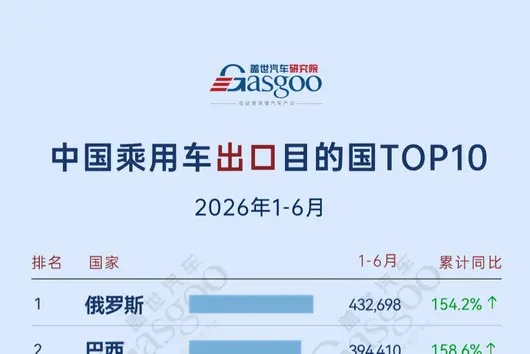
Top 10 Destination Countries for China's Passenger Car Exports (January-June 2026)
NO.1 Russia, January-June 2026, exports of passenger cars to Russia were 432,698 vehicles, cumulative year-on-year growth of 154.2%.
NO.2 Brazil, January-June 2026, exports of passenger cars to Brazil were 394,410 vehicles, cumulative year-on-year growth of 158.6%.
NO.3 United Kingdom, January-June 2026, exports of passenger cars to the United Kingdom were 251,290 vehicles, cumulative year-on-year growth of 91.4%.
NO.4 Belgium, January-June 2026, exports of passenger cars to Belgium were 215,184 vehicles, cumulative year-on-year growth of 46.2%.
NO.5 Australia, January-June 2026, exports of passenger cars to Australia were 211,965 vehicles, cumulative year-on-year growth of 84.2%.
NO.6 Mexico, January-June 2026, exports of passenger cars to Mexico were 148,154 vehicles, cumulative year-on-year decline of 33.7%.
NO.7 Italy, January-June 2026, exports of passenger cars to Italy were 146,769 vehicles, cumulative year-on-year growth of 141.9%.
NO.8 United Arab Emirates, January-June 2026, exports of passenger cars to the United Arab Emirates were 135,713 vehicles, cumulative year-on-year decline of 36.4%.
NO.9 Spain, January-June 2026, exports of passenger cars to Spain were 115,264 vehicles, cumulative year-on-year growth of 55.0%.
NO.10 Malaysia, January-June 2026, exports of passenger cars to Malaysia were 103,745 vehicles, cumulative year-on-year growth of 38.7%.

According to Gasgoo Automotive Research Institute data, in the first half of 2026, the landscape of destination countries for China's passenger car exports adjusted further. Russia returned to the top export market with 432,698 vehicles, a year-on-year growth of 154.2%, surpassing Brazil to take the top spot, showing that the strong demand for Chinese cars in the local market is being continuously released. Brazil ranked second with 394,410 vehicles, a year-on-year growth of 158.6%. Driven by inventory buildup prior to the increase in complete vehicle import tariffs in July, it maintained high-speed growth in the first half, but with the implementation of policy adjustments, the subsequent export model may gradually transform towards KD (knock-down assembly) and local production.
From a regional distribution perspective, Europe remains the core growth pole for China's passenger car exports. The United Kingdom ranked third with 251,290 vehicles firmly, Belgium (215,184 vehicles), Italy (146,769 vehicles) and Spain (115,264 vehicles) all entered the top ten, of which Italy grew by 141.9% year-on-year, continuing the high-speed growth trend. However, the European market still faces challenges such as trade policies, anti-subsidy investigations, and intensified local competition. Future growth will rely more on brand power and local operation capabilities.
Latin American market differentiation intensified further. Brazil continued to maintain strong growth, while Mexico's export volume was 148,154 vehicles, a year-on-year decline of 33.7%, affected by tariff policy adjustments and tightening North American trade environment factors, market demand continues to be under pressure. The Middle East market also entered an adjustment phase, with United Arab Emirates exports of 135,713 vehicles, a year-on-year decline of 36.4%, high-speed growth momentum slowed down somewhat. In contrast, Asia-Pacific market maintained steady expansion, with Australia ranking fifth with 211,965 vehicles, a year-on-year growth of 84.2%, and Malaysia with 103,745 vehicles, a year-on-year growth of 38.7% first broke through 100,000 vehicles, showing Southeast Asia and Oceania markets still have considerable growth potential.
Overall, in the first half of 2026, China's passenger car exports continued to maintain high growth, but growth momentum is shifting from single market driven to multi-regional coordinated development. With changes in global trade environment and continuous promotion of local policies in various countries, Chinese automakers' overseas competition is also gradually shifting from export scale competition to comprehensive competition in brand building, channel operations and local system capabilities.
Top 10 Destination Countries for China's "New Energy" Passenger Car Exports (January-June 2026)
NO.1 Brazil, January-June 2026, exports of new energy passenger cars to Brazil were 293,032 vehicles, cumulative year-on-year growth of 158.8%.
NO.2 Belgium, January-June 2026, exports of new energy passenger cars to Belgium were 207,174 vehicles, cumulative year-on-year growth of 45.3%.
NO.3 United Kingdom, January-June 2026, exports of new energy passenger cars to the United Kingdom were 181,880 vehicles, cumulative year-on-year growth of 101.8%.
NO.4 Australia, January-June 2026, exports of new energy passenger cars to Australia were 154,305 vehicles, cumulative year-on-year growth of 199.7%.
NO.5 Germany, January-June 2026, exports of new energy passenger cars to Germany were 83,085 vehicles, cumulative year-on-year growth of 219.5%.
NO.6 Thailand, January-June 2026, exports of new energy passenger cars to Thailand were 80,914 vehicles, cumulative year-on-year growth of 84.0%.
NO.7 Italy, January-June 2026, exports of new energy passenger cars to Italy were 77,773 vehicles, cumulative year-on-year growth of 298.8%.
NO.8 South Korea, January-June 2026, exports of new energy passenger cars to South Korea were 73,940 vehicles, cumulative year-on-year growth of 161.5%.
NO.9 Spain, January-June 2026, exports of new energy passenger cars to Spain were 71,872 vehicles, cumulative year-on-year growth of 69.3%.
NO.10 United Arab Emirates, January-June 2026, exports of new energy passenger cars to the United Arab Emirates were 59,739 vehicles, cumulative year-on-year growth of 34.7%.

According to Gasgoo Automotive Research Institute data, in the first half of 2026, China's new energy passenger car exports continued to maintain high growth, and the landscape of destination countries further concentrated on European and Asia-Pacific markets. Brazil ranked first with 293,032 vehicles, a year-on-year growth of 158.8%, new energy models have become the absolute main force for Chinese car exports to the Brazilian market. Belgium and the United Kingdom ranked second and third with 207,174 vehicles and 181,880 vehicles respectively, exports to the United Kingdom exceeded 180,000 vehicles for the first time, year-on-year growth of 101.8%, while Belgium continued to play an important role as a European logistics and transshipment hub.
From a regional distribution perspective, the European market remains the core growth engine for China's new energy passenger car exports. Belgium, the United Kingdom, Germany, Italy and Spain entered the top ten, of which Germany grew by 219.5% year-on-year, Italy grew by 298.8%, and the United Kingdom also achieved double-digit growth, reflecting that Chinese new energy vehicles are continuously improving competitiveness in mainstream European markets. At the same time, European market competition will gradually shift from product introduction stage to comprehensive competition in brand, channel and local operation capabilities.
Asia-Pacific market continued rapid expansion. Australia ranked fourth with 154,305 vehicles, a year-on-year growth of 199.7%, becoming the largest new energy export market outside Europe; Thailand and South Korea exported 80,914 vehicles and 73,940 vehicles respectively, year-on-year growth of 84.0% and 161.5%, showing that Chinese new energy vehicles' penetration rate in Southeast Asian and Northeast Asian markets continues to improve. In the Middle East market, United Arab Emirates exported 59,739 vehicles, year-on-year growth of 34.7%, maintaining steady growth, but growth rate slowed somewhat compared to before.
Overall, in the first half of 2026, China's new energy passenger car exports continued to maintain high momentum, and market coverage extended from emerging economies to traditional automotive powerhouses. With continuous improvement of product competitiveness and global channels, local systems continuously improving, Chinese new energy vehicles are accelerating from scale expansion to high-quality globalization development.

According to Gasgoo Automotive Research Institute data, from Jan-May 2026, exports of Chinese passenger cars and new energy passenger cars continued to show high growth, but regional differentiation intensified further. Regarding passenger car exports, Brazil continued to hold the top spot, with Russia following closely, the two countries accounting for more than 40% of the total in the top ten; the European market performed steadily, achieving high growth; while the Latin America and Middle East markets entered a period of deep adjustment.
New energy passenger car exports performed even more strongly. Brazil led by a large margin, Belgium jumped to second place, highlighting its status as a European transit hub; the European market occupied five seats in the top ten. Among them, Italy and Germany achieved explosive breakthroughs with growth rates of 365.3% and 211.2% respectively, showing that Chinese new energy vehicles have successfully penetrated the heartland of traditional automotive powerhouse countries; additionally, Australia ranked fourth on the list and South Korea eighth, fully demonstrating the core competitiveness and diversified layout capabilities of Chinese new energy vehicles in both traditional automotive powerhouse countries and emerging markets.
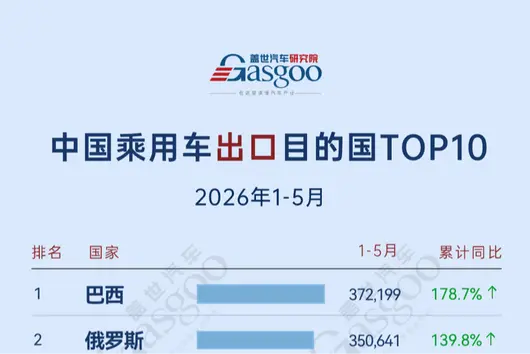
TOP 10 Export Destination Countries for Chinese Passenger Cars (Jan-May 2026)
No. 1 Brazil, Jan-May 2026, exported 372,199 passenger cars to Brazil, cumulative year-on-year growth of 178.7%.
No. 2 Russia, Jan-May 2026, exported 350,641 passenger cars to Russia, cumulative year-on-year growth of 139.8%.
No. 3 United Kingdom, Jan-May 2026, exported 188,935 passenger cars to the UK, cumulative year-on-year growth of 82.0%.
No. 4 Australia, Jan-May 2026, exported 158,230 passenger cars to Australia, cumulative year-on-year growth of 59.2%.
No. 5 Belgium, Jan-May 2026, exported 156,364 passenger cars to Belgium, cumulative year-on-year growth of 26.6%.
No. 6 Italy, Jan-May 2026, exported 123,214 passenger cars to Italy, cumulative year-on-year growth of 140.7%.
No. 7 United Arab Emirates, Jan-May 2026, exported 119,179 passenger cars to UAE, cumulative year-on-year decline of 32.6%.
No. 8 Mexico, Jan-May 2026, exported 113,642 passenger cars to Mexico, cumulative year-on-year decline of 40.0%.
No. 9 Spain, Jan-May 2026, exported 94,452 passenger cars to Spain, cumulative year-on-year growth of 56.0%.
No. 10 Malaysia, Jan-May 2026, exported 78,599 passenger cars to Malaysia, cumulative year-on-year growth of 26.9%.

From Jan-May 2026, the landscape of Chinese passenger car export destinations continued to evolve. Brazil maintained the top spot with 372,199 units and a 178.7% year-on-year growth, further consolidating its status as the No. 1 export market. Russia ranked second with 350,641 units and a 139.8% year-on-year growth, showing strong demand for Chinese vehicles.
In terms of regional distribution, the European market showed overall growth. The United Kingdom firmly ranked third with 188,935 units and 82.0% year-on-year growth. Belgium (156,364 units), Italy (123,214 units), and Spain (94,452 units) all achieved year-on-year growth, with Italy's growth reaching as high as 140.7%, reflecting the continuous breakthroughs of Chinese brands in new energy product import and channel construction in Europe. If Russia is included in the European regional consideration, the proportion of the European market in Chinese passenger car exports exceeds half, becoming the absolute core. However, the European market still faces uncertainties in policy environment, trade barriers, and local competition; future growth leans more towards structural opportunities.
The Latin American market showed obvious polarization. Brazil ranked at the top with over 370,000 units and 178.7% year-on-year growth, benefiting from early volume increase before tariff hikes in July. In contrast, Mexican exports declined by 40.0% year-on-year, related to tariff increases effective from Jan 2026, compounded by tightening North American trade policies and adjustments in market expectations, leading to significant demand contraction. This differentiation indicates that the performance of Chinese car companies in the Latin American region is influenced by tariff, trade policy cycles, and local market environments of each country, making operating fluctuations caused by country differences very prominent.
The Middle East market entered an adjustment phase. UAE (119,179 units) declined by 32.6% year-on-year, leaving behind the previous high-speed growth. Regarding the Asia-Pacific market, Australia (158,230 units) grew by 59.2% year-on-year, ranking fourth; Malaysia (78,599 units) grew by 26.9% year-on-year, ranking tenth, showing that the potential of Southeast Asian and Oceania markets is continuously being released. Overall, Chinese passenger car exports are transitioning from relying on a few hotspot markets to a new stage where multiple regions bear pressure together and the structure is becoming increasingly diverse; growth drivers are shifting from quantity expansion to a deeper contest of product strength and brand recognition.
TOP 10 Export Destination Countries for Chinese "New Energy" Passenger Cars (Jan-May 2026)
No. 1 Brazil, Jan-May 2026, exported 283,182 new energy passenger cars to Brazil, cumulative year-on-year growth of 175.6%.
No. 2 Belgium, Jan-May 2026, exported 150,110 new energy passenger cars to Belgium, cumulative year-on-year growth of 25.8%.
No. 3 United Kingdom, Jan-May 2026, exported 129,807 new energy passenger cars to the UK, cumulative year-on-year growth of 81.4%.
No. 4 Australia, Jan-May 2026, exported 111,406 new energy passenger cars to Australia, cumulative year-on-year growth of 168.2%.
No. 5 Italy, Jan-May 2026, exported 67,043 new energy passenger cars to Italy, cumulative year-on-year growth of 365.3%.
No. 6 Germany, Jan-May 2026, exported 65,235 new energy passenger cars to Germany, cumulative year-on-year growth of 211.2%.
No. 7 Thailand, Jan-May 2026, exported 62,316 new energy passenger cars to Thailand, cumulative year-on-year growth of 62.8%.
No. 8 South Korea, Jan-May 2026, exported 60,488 new energy passenger cars to South Korea, cumulative year-on-year growth of 170.3%.
No. 9 Spain, Jan-May 2026, exported 56,953 new energy passenger cars to Spain, cumulative year-on-year growth of 74.9%.
No. 10 United Arab Emirates, Jan-May 2026, exported 53,135 new energy passenger cars to UAE, cumulative year-on-year growth of 45.7%.

From Jan-May 2026, the landscape of Chinese new energy passenger car export destinations changed significantly. Brazil maintained the top spot with 283,182 units and a 175.6% year-on-year growth, further expanding its lead, with new energy becoming the absolute main force for Chinese car exports to Brazil. Belgium leaped to second place with 150,110 units and 25.8% year-on-year growth, highlighting its strategic value as a European new energy transit hub. The United Kingdom ranked third with 129,807 units and 81.4% year-on-year growth, followed closely by Australia with 111,406 units and a 168.2% surge year-on-year, showing that electrification demand in the Oceania market is accelerating.
In terms of regional distribution, the European market showed an overall explosive trend. Including Belgium and the UK, Italy (67,043 units) grew by 365.3% year-on-year, Germany (65,235 units) grew by 211.2% year-on-year, and Spain (56,953 units) grew by 74.9% year-on-year, with growth rates far exceeding the average. Among them, the amazing increases in Italy and Germany show that Chinese new energy vehicles have successfully penetrated the heartland of traditional automotive powerhouse countries, with product strength and brand recognition achieving substantial breakthroughs. However, the European market still faces policy uncertainties such as carbon tariffs and anti-subsidy investigations; future growth relies more on deep integration into local supply chains.
The Asian market is blossoming in multiple points. Thailand (62,316 units) grew by 62.8% year-on-year. As a stronghold of Southeast Asian EV industry, Chinese brands continue to deepen their efforts through localized production layouts. South Korea (60,488 units) grew by 170.3% year-on-year, entering the top ten for the first time, reflecting significantly improved competitiveness of Chinese new energy vehicles in East Asian neighboring countries. Regarding the Middle East market, UAE (53,135 units) grew by 45.7% year-on-year, with new energy becoming a new growth point in this region.
Overall, Chinese new energy passenger car exports have entered a new stage, with market coverage extending from emerging economies to traditional automotive powerhouse countries. Growth dynamics have shifted from price advantages to a deeper contest of technical strength and brand premium. In the future, how to maintain sustainable growth under the intensification of trade barriers and requirements for local production will be a common challenge facing Chinese new energy vehicle companies.