首頁Detailed Explanation

搜尋歷史
熱門搜尋
經銷商登入 / 註冊


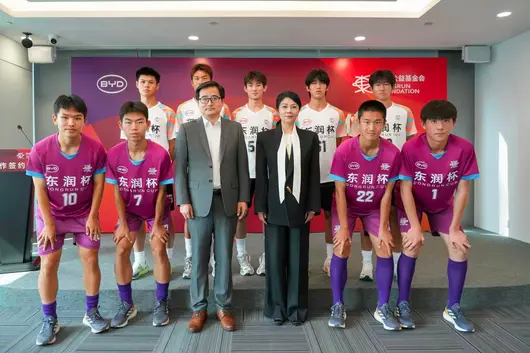
On September 17, in Beijing, at the scene of the cooperation signing ceremony between BYD and Dongrun Public Welfare Foundation. Li Yunfei, General Manager of BYD's Brand and Public Relations Department, said one sentence: "We cannot play on the field for them, but we can bring them to the field." This sentence summarizes BYD's path in youth football philanthropy — from taking teenagers abroad to see the world, to building their own stadiums for them domestically.
The signing ceremony itself was not complex. BYD will support the Dongrun Cup National Youth High School Football Tournament, deepening the field of campus football. The Dongrun Cup was initiated by the Dongrun Public Welfare Foundation in 2022, officially launched in 2023, covering more than 20 provinces nationwide, cumulatively attracting over 1,000 campus teams and over 10,000 players and coaches to participate. The third tournament in 2026 covered 352 schools, benefiting 4,864 players and coaches, with the finals gathering 20 teams from 20 provinces to compete together.
What deserves attention is the positioning of this tournament. Unlike the spotlight on international fields, the Dongrun Cup leaves the stage for ordinary high school students in county-level high schools such as Xinjiang, Yunnan, Shaanxi, Jiangxi, etc. Dongrun Public Welfare Foundation Chairman Kong Dongmei stated at the ceremony: "The Dongrun Cup not only selects football talents but also shapes character, nourishes the soul, and empowers long-term growth for youth."
This positioning hits a structural shortcoming in China's youth football. For a long time, the domestic youth football tournament system has presented a 'spindle-shaped' structure: professional club tiers and a few elite football schools possess relatively complete competition platforms, while campus teams of most ordinary high schools lack high-level tournament opportunities. Talented county-level youths are often buried due to a lack of display stages. The Dongrun Cup attempts to fill this very blank.
BYD's addition injected corporate strength into this tournament. The Dongrun Public Welfare Foundation is a national 5A-level non-public fundraising foundation under the supervision of the Ministry of Civil Affairs, deeply cultivating rural education for over ten years, covering 31 provinces and 324 counties nationwide, possessing a mature county-level implementation network. Since 2024, BYD has continued to organize football youths to go to Germany, Japan, Spain, Thailand, Italy, Brazil, Mexico, with over 200 person-times exchanging and playing with overseas top clubs. The logic of cooperation between the two parties is clear: the public welfare platform is responsible for county-level implementation, corporate strength is responsible for resource injection.
But what is worth questioning is: why does a car company engage in youth football philanthropy? From a business perspective, the association between football and car brands is not direct. BYD's explanation is 'Long-termism'. As early as 2010, BYD established a charitable foundation; on the 30th anniversary, established a 3 billion yuan education charity fund, covering 127 universities nationwide, inspiring over 6,000 students. Football philanthropy is a branch of its education support system.
The deeper logic might be the parallel execution of brand globalization and local responsibility. BYD cooperates with giants like Manchester City, Inter Milan, Paris Saint-Germain overseas, appearing in international tournaments like the European Championship and Copa America, using football to promote brand globalization. While domestically, by supporting county-level campus tournaments like Dongrun Cup, fulfilling corporate social responsibility while establishing brand recognition among young groups. This is a dual-track strategy of 'global resource linking, local soil deepening'.
However, the core of youth football philanthropy lies not in how much resources the enterprise invests, but in whether a sustainable training mechanism can be formed. The model of Dongrun Cup is worth attention: outside the tournament, simultaneously carrying out equipment donations, grassroots coach philanthropy training, tournament incentive funds are all used for school team construction. This 'Tournament + Equipment + Faculty' integrated empowerment system aims to make up for the infrastructure shortcoming of grassroots football, rather than selecting a few top players.
The revitalization of Chinese football ultimately relies on the thickness of the pyramid base. When ordinary youths in county high schools can also have professional tournaments, qualified coaches, and basic equipment, when 'playing football' is no longer a privilege of the few but an accessible campus lifestyle, the base of the football population can truly expand. This cooperation between Dongrun Cup and BYD may not immediately produce the next Wu Lei, but what it is doing now -- letting more ordinary children have the opportunity to stand on their own stages -- is exactly the soil that Chinese football needs most.