首頁Delivery

搜尋歷史
熱門搜尋
經銷商登入 / 註冊

[First Commercial Vehicle Network Original]
When "We Deliver" (We Deliver) becomes the theme of the 2026 Hannover International Transport Exhibition, Geely Farizon's answer is: Deliver Trust, Deliver Quality, Deliver Promise.
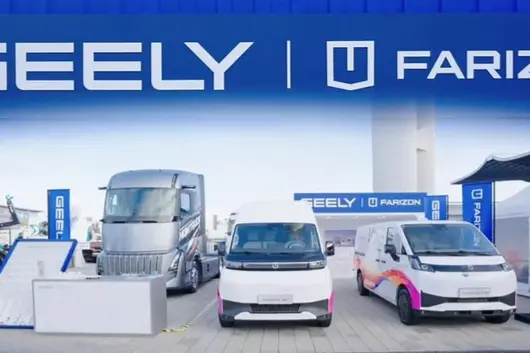
On September 14, the 2027 International Van of the Year Award (IVOTY), known in the industry as the "Oscar" for VANs, was unveiled in Hannover. As the Chinese force highly anticipated at this exhibition, the Geely Farizon New Energy Commercial Vehicle Group showcased three star products: the Xinghan H, Super VAN, and Xingxiang V7E, and held the "Geely Farizon Afternoon Tea" themed event to present plaques to partners in the European supply chain, finance, service, and modification fields.
After multi-stage, multi-dimensional professional evaluations by the judging panel, the Geely Farizon Xingxiang V7E successfully qualified for the 2027 IVOTY Final Round. Following the Super VAN qualifying for the 2026 IVOTY, Geely Farizon became the first and only Chinese brand to qualify for the IVOTY final selection for two consecutive years. This breakthrough is not just the honor of a single product, but marks the beginning of Chinese New Energy Commercial Vehicle Brands moving from "sporadic intrusion" to "systematic qualification" on the world's most rigorous VAN competition stage.

Delivering Trust: Qualifying for IVOTY for Two Consecutive Years, Chinese VANs Stand on the Global Standard Summit
IVOTY is regarded as the "Oscar" for VANs because its evaluation is not a single performance comparison, but a multi-dimensional professional assessment covering vehicle design, loading efficiency, electrification performance, intelligent configuration, safety standards, and operational economics. Qualifying for the final selection means the product must withstand systematic testing in real European usage scenarios and regulatory systems.

The Super VAN previously won the 2026 IVOTY International Van of the Year Runner-up, becoming the first Chinese model to reach the final selection since the award was established; it also won the What Van? Awards 2026 Zero-Emission Van Award, passed the Euro NCAP 5-Star Rating with a score of 85, creating the highest score in the history of the Chinese light commercial vehicle category, with AEB, Lane Assist, and Driver Monitoring receiving multiple full marks. Now, the Xingxiang V7E has again qualified for the 2027 IVOTY Final Round and advanced to the top three, making Farizon the first and only Chinese brand to qualify for the IVOTY final selection for two consecutive years.
Farizon's qualification for the IVOTY final selection for two consecutive years indicates that it does not rely on the accidental boom of a single car, but on R&D, Manufacturing, Validation, Compliance, Service, and other full-system capabilities, beginning to establish stable trust in the European high-standard market. This trust is the core of "We Deliver Trust".
Delivering Quality: Three Models Cover Mainstream European Scenarios, GXA Architecture Backs Core Strength
Products are the first language of brand globalization. The three models Farizon exhibited correspond to European multi-functional commercial scenarios, urban distribution, and long-haul logistics, forming a complete matrix from light commercial vehicles to heavy-duty trucks.
The Xingxiang V7E is designed for large-volume, last-mile logistics. As a 3rd generation global VAN product built on the GXA Digital Intelligence Architecture, it is equipped with a 6.95 cubic meter ultra-large loading space, a WLTP combined cycle range of 328 kilometers, and an excellent load capacity of 1,373 kg. At the same time, the flexibility of the body dimensions and turning radius can easily pass through height restriction facilities, underground garages, and historic districts, precisely matching the real-world scenario needs of European urban logistics. The entire line is equipped with 14+ ADAS Intelligent Driving Assistance, 360° Panoramic Imaging, etc., making safety and intelligence standard for city distribution operations.

The Super VAN demonstrates versatile van application capabilities. Its maximum interior space can reach 13 cubic meters, easily accommodating 5 standard European pallets, meeting European logistics loading specifications; the innovative concealed B-pillar design balances convenience and safety. Relying on the Euro NCAP 5-Star Rating, IVOTY Runner-up, What Van? 2026 Zero-Emission Van Award, and GREENFLEET 2026 Light Commercial Vehicle Manufacturer Award, the Super VAN has become an important business card for Chinese VAN products in the European market.
The Xinghan H is a new energy heavy-duty truck built by Farizon for the European long-haul transport market and is the technical foundation of Farizon New Energy Commercial Vehicles. The European version of the Xinghan H is equipped with a 600kWh capacity battery, with a combined cycle range of over 500 km, supporting dual-gun fast charging; the vehicle B10 design life reaches 1.5 million km, adaptable to high-intensity, long-cycle operation scenarios of long-haul logistics. The model was developed to meet local EU regulations and end-user needs, complying with EU access requirements in three dimensions: range, operational economics, and safety standards.

Behind the three products is Farizon's committed forward engineering R&D technical foundation. Relying on the "One Geely" strategic synergy, Farizon adheres to fully in-house development, forming two core technical roadmaps: "Methanol Electric + Pure Electric", and created the exclusive GXA Digital Intelligence Architecture for New Energy Commercial Vehicles. Methanol Electric uses methanol as liquid hydrogen to directly replace traditional hydrogen fuel cell systems for power generation and supply, achieving upgrades that are more convenient, more economical, and more sustainable for energy replenishment; Pure Electric relies on ZhiCore Technology, fully in-house development of core three-electric technologies, forming two technical advantages: Intelligent Cloud Control and Core Integration.
Relying on the Geely Holding Group Central Research Institute, Farizon established China's largest New Energy Commercial Vehicle Research Institute, gathering over 2,000 R&D engineers globally. This "Shared Passenger-Commercial Heritage" technical synergy gives Farizon systematic competitiveness in dimensions such as safety, lightweighting, comfort, and intelligence, which is also the confidence behind "We Deliver Quality".
Delivering Promise: From Product Going Global to Ecosystem Going Global, Taking Root in Pioneer Zone
Europe is a highland of the global automotive industry and the pioneer zone of Farizon's overseas strategy. Farizon insists on "prioritizing difficult markets first", proactively choosing Europe, the overseas market with the highest access standards and most severe competition, as the overseas pioneer zone to refine the entire product and service system with high-standard markets, then replicating it to various places globally.
This year, Farizon has entered core European markets such as Germany and France, with the European Headquarters Farizon Mobility Europe B.V. putting into operation, and German and French subsidiaries established in succession. In markets like the UK, Denmark, and Portugal, Farizon New Energy Commercial Vehicle export scale ranks first among Chinese brands. From January to July 2026, Geely Farizon ranked first in Chinese New Energy Commercial Vehicle exports, with a year-over-year significant growth of 152.5%, and topped the industry in 33 countries and regions including the UK, Australia, UAE, and Switzerland.

More importantly, Farizon's globalization is not simply selling cars overseas, but taking value root globally. In April, Farizon's first European spare parts warehouse officially landed in Gaggenau, Germany. Relying on the "Crossroads of Europe" location advantage, it provides one-stop support for European dealers including warehousing, logistics distribution, and after-sales service, covering Europe within 1-6 working days for regular orders, and spare parts OTD to central dealer warehouse shortened by 40-60 days.
In July, the Ningbo Global International Parts Distribution Center was launched, adhering to "Passenger-Commercial Collaboration, Co-building and Shared Ownership", forming a "Domestic Hub + European Local" dual-warehouse linkage global service system with Gaggenau. Currently, Farizon's overseas business covers 70 countries globally, forming over 150 sales outlets and over 200 overseas service outlets. On August 13, the first V8E rolled off the line at the Indonesia KD Factory, and the first overseas KD factory project officially entered a new stage of scaled operations.
From product going global to ecosystem going global, Farizon is gradually applying its mature full lifecycle service system to global markets, truly making global users "able to buy, use well, and repair fast". This is both "We Deliver Promise" and a key leap for Chinese commercial vehicle brands from trade exports to localized operations.
Facing Global Zero-carbon Future: Long-termism Globalization of Chinese Commercial Vehicles
Currently, Chinese commercial vehicle exports have bid farewell to the era of purely low price and volume, forming a pattern of "Volume Expansion in Asia, Africa, Latin America; Quality Improvement in Europe". Data from the China Association of Automobile Manufacturers shows that domestic commercial vehicle exports exceeded 1 million vehicles in 2025, with new energy commercial vehicle exports of 83,000 vehicles, up 86.8% year-on-year; industry consensus believes: in the future overseas markets, the competition is no longer just vehicle parameters, but the comprehensive system capability of localized operations, technology iteration, and service ecosystem.
Standing on the global stage of the Hannover Motor Show, Geely Farizon delivered its answer sheet for Chinese New Energy Commercial Vehicles: Building a global product matrix with the GXA Architecture, solidifying the technical foundation with Shared Passenger-Commercial Heritage, constructing a service ecosystem with localized manufacturing + dual-warehouse spare parts network, and gaining global professional review recognition through IVOTY International Awards.
In the future, Geely Farizon will continue to deepen its European market layout, continue to refine green mobility solutions conforming to local scenarios, and accelerate the advancement from product going global to localized operations of brand, channel, service, and ecosystem synergy. In the wave of land transport zero-carbon transition, with systematic hard power, it will continue to convey the technical confidence of Chinese commercial vehicle brands to the world, leading the global green commercial upward growth.

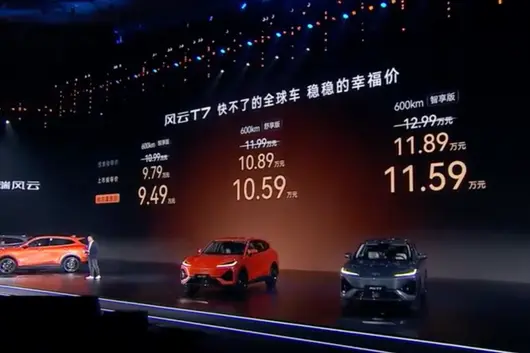
August 26, 2026, global quality pure electric SUV Fengyun T7 officially launched. New car offers three 600km range versions, launch guide price 97,900-118,900 Yuan, limited time early exchange price starting at 94,900. Relying on Chery's 23-year accumulation as the No.1 in passenger vehicle exports and globalization, 20 million global user reviews and 130+ overseas market operation experience, Fengyun T7 with native global car strength, six major redundant product confidence, full-range configuration sincerity, breaks the chaos of reduction and involution in the 100k level pure electric SUV. At the press conference venue, famous musician Wu Kequn served as "Happiness Experience Officer", deeply interpreted the "Steady Happiness" travel concept, joined hands with Chery to launch the "Happiness Co-creation Plan", letting global standard hard quality land as a peace-of-mind travel experience perceptible to the public.

Unparalleled Pricing Sincerity, Multiple Launch Benefits for All Users
Fengyun T7 persists in range equity, configuration equity, three versions all equipped with 600km long range as standard, no shrinking tricks for entry-level versions, affordable pricing, transparent value. Among them, 600km Enjoyment Edition launch guide price 97,900 Yuan, early exchange price 94,900 Yuan, 600km Comfort Edition launch guide price 108,900 Yuan, early exchange price 105,900 Yuan, 600km Smart Edition launch guide price 118,900 Yuan, early exchange price 115,900 Yuan.

From now until September 30, users purchasing cars can enjoy eight major benefits: Blaze Orange, Mountain Smoke Purple luxury-exclusive color schemes free for limited time; select 2 years 60k 0 interest or 5 years 100k 3 years interest-free financial plans; full brand exchange enjoys 3,000 Yuan subsidy; equipped with power battery thermal runaway new car compensation, intelligent driving up to 5 million compensation double bottom-line guarantee; 666 Yuan can purchase lifetime basic maintenance package, enjoy whole vehicle and three-electric system lifetime warranty; first owner lifetime basic traffic free, 3 years 5G entertainment traffic free. Meanwhile, 1,000 Yuan deposit offsets 2,000 Yuan pre-sale inflation benefit extended to August 31 deadline.

Native Global Quality, Tempered to Build a Reliable Foundation
As a native global car that tests overseas first, then launches domestically, Fengyun T7 since project initiation benchmarked against 2026 version E-NCAP five-star safety standards, relying on global 1+7+N R&D system, polished by 10 major global design centers, cumulatively completed 6 million kilometers vehicle testing, 1.45 million kilometers special durability verification. New car adapted to -40°C to 55°C ultra-wide temperature range environment, covering 95% of global road types, experienced seven major extreme scene trials including extreme cold, high temperature, high humidity, salt-alkali, water crossing, etc. Passed strict tests like 10,000 times braking, high-frequency chassis impact, etc., closed-loop optimization of problems throughout the process.

Its overseas homologous model Lepas L6 has landed in South Africa, Thailand, successively layout Indonesia, EU, Aus-NZ, UK and other global markets, overseas and domestic models share the same R&D, quality control, verification system. Relying on extreme quality, new car received authoritative endorsements from overseas engineers, foreign owners, delivery simultaneously upon launch, truly verifies global-level reliable strength.
Four Core Strengths, Full Specification Reshapes Same-Class Value Benchmark
Super Running, Say Goodbye to Range Anxiety. Fengyun T7 all series standard equipped with 65.05kWh Rhino Battery, CLTC range 600km, actual test up to 681.6km achieves reverse false labeling, 30%-80% fast charge only needs 20 minutes, battery cycle life over 2500 times, usable for 15 years. Standard dual-source heat pump air conditioning and AGS intelligent front grille, below zero 10°C range improved by 30%, 0.286Cd ultra-low wind resistance matched with 12-in-1 Kunpeng Electric Drive, comprehensive efficiency 90.8%, 178kW peak power balances energy saving and strong performance.
Beautiful Global, Appearance and Texture Both Online. New car gathers global users co-created aesthetics, 6 Oriental Elegant Color schemes adapted for diverse preferences, Blaze Orange equipped with same-class exclusive Tri-coat three-layer luxury-grade painting process. Interior 84% ultra-high space utilization rate, 2700mm wheelbase paired with pure flat floor, when folded down, can form 1955mm x 1310mm super large camping bed. 9-layer Cloud-feel seats support heating and ventilation, 38 storage spaces, max 1550L extended trunk, accommodating home use, camping full scene needs.

Safer, Six Major Redundancies Full-Angle Guard. Body uses nine horizontal five vertical cage structure, 80% high-strength steel ratio, equipped with same-class exclusive Shotgun structure, double frame subframe, and 9 airbags. Rhino Battery equipped with 31-layer 6D Lock Armor protection, IP68 waterproof, 2 times national standard anti-crush capability, passed strict fire burning, salt spray tests. Chassis tuned by international experts, Golden axle load ratio matched with wire-controlled braking, experienced global extreme road conditions verification, safety redundancy far exceeds same level.

Good Smart, Full-Scene Intelligent Easy to Use. All series debut 4nm 8775 Cockpit-Driving Integrated Chip, 80ms极速 response, equipped with Lingxi Smart Cockpit 2.0 and Doubao Large Model, supports full-scene intelligent voice interaction. Equipped with 15.6-inch 2.5K HD large screen, built-in six major custom scene modes. Full car 22 high-precision sensors, supports 300+ full-scene automatic parking, highway pilot assistance, novices and experts can easily drive.

Final Words:
Currently, the 100k level pure electric market generally exists range false labeling, safety reduction configuration, high-low configuration differentiation shrinking chaos, most models focus on marketing, light on verification, difficult to adapt to user long-term vehicle use needs. Fengyun T7 launch, completely reconstructed sub-market value bottom line, with global standards, full-series full-configuration, redundant safety, extreme cost-performance four major advantages, achieve "100k level price, 200k level quality" value breakthrough. Different from industry rapid iteration short-term tactics, Chery builds cars with long-termism, pre-place global million kilometers strict verification, use six major redundant strength to solve user range, safety, durability core pain points. At the same time, its domestic and overseas simultaneous launch, homologous same quality layout model, broke the inherent shortcoming of Chinese models "internal and external standards not consistent", not only consolidated Chery's globalization strategy foundation, also verified Chinese New Energy Vehicles transformation results from "low price volume" to "quality export, value export", established a new quality and value benchmark for the 100k level pure electric SUV market.

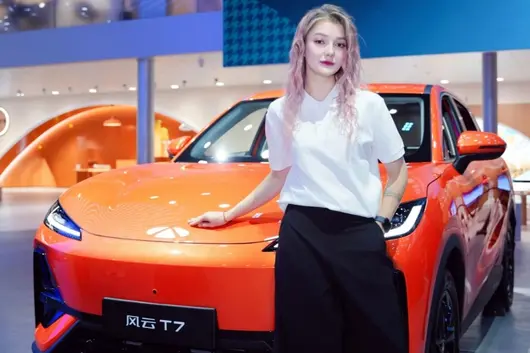

On August 26, Chery Fengyun T7 officially launched at Yanqi Lake. The new car offers 3 versions, with an early trade-in price ranging from 94,900 Yuan to 115,900 Yuan, and simultaneously launching 9 car-buying perks.


If looking only at the price, this is a standard 100,000-level home pure electric SUV. However, by penetrating the spec sheet, you will find that Fengyun T7's product logic has an essential difference from competitors in the same price range: it chooses to take "Global Validation" and "Full Series Long Range" as the foundation, instead of pouring all costs into marketing gimmicks. This approach seems somewhat "alternative" in the current price war.
Full Series 600km: Rejecting the "Downgraded Specs" Wordplay
The 100,000-level pure electric SUV market has an open secret: to lower the starting price, low-spec models often equip small batteries around 50kWh, with CLTC range stuck in the 400–500km range. If consumers want 600km, they usually have to pay extra to get the top-spec.

Fengyun T7's approach is that its 3 versions come standard with 65.05kWh Rhino batteries across the full series, with full series CLTC 600km.
This cannot be summarized by just the three words "Big Battery". The greater significance lies in — it allows 100,000-level users not to compromise between "affordable" and "goes far". City commuting charges once a week, cross-city round trips do not need mid-trip recharging, this sense of certainty is what family users truly need.
Recharging efficiency is also not graded: full series 30%—80% fast charge in 20 minutes, recharging 300km in a cup of coffee's time. With dual-source wide temperature range heat pump (standard on full series), range increases by 30% in -10℃ environment, -30℃—55℃ wide temperature range operation. Whether it is Northern winter or Southern heat, -40℃—60℃ working temperature makes the usage scenarios of this car unrestricted.
In terms of actual test, media actual test range reached as high as 681.6 km, achieving "Reverse Exaggerated Specs" with actual test performance exceeding 667km. For family users, displayed range is more credible than rated range, this works better than any marketing talk.
Global 210 Market Standards: Investing Validation Costs in What Users Cannot See
The most overlooked aspect of Fengyun T7 by spec sheet enthusiasts, but the most worth family users focusing on, is its global validation system.

As Chery's first intelligent-electric native global vehicle, Fengyun T7 relies on the global "1+7+N" R&D system, incorporating regulations and standards of 210 countries and regions worldwide along with vehicle usage needs into the product definition at the front end. The whole vehicle cumulative test mileage exceeds 6 million km, special durability verification 1.45 million km, traces covering over 100 global extreme road condition environments, spanning -40℃ to 55℃ ultra-wide temperature range.
From high speed bumps in Brazil, cobblestone roads in Mexico, to high-speed highway sharp curves in Germany, unpaved muddy roads in South Africa — these scenarios most domestic users may never encounter in a lifetime. But Chery's logic is: use the strictest environment globally for validation, when returning to domestic daily use, reliability redundancy is naturally maximized.
The direct result of this train of thought is that the homologous model LEPAS L6 has already launched successfully in South Africa and Thailand and joined the Milan Design Week. Markets such as Europe, Australia and New Zealand are also progressing. For domestic consumers, this means what you buy is not a car that "only runs in China", but a product built according to global standards.
Safety: No Downgrade in Full Series, Bottom Line Written into Contract
Another open secret of 100,000-level SUVs is: safety config grading. Reducing airbags, reducing active protection on low specs is a common tactic for high profit margins.

Fengyun T7 did not do this. High-strength steel accounts for 80%, hot-formed steel 18.84%, unique Shotgun structure + double-frame subframe + Pack bumper beam in the same class, front collision 6 paths/side collision 9 force transmission paths. The whole vehicle is equipped with the most 9 airbags in the same class — from the passive safety level, it has not made any subtraction on low specs.
Battery protection is also maximized: 6D Chainmail Armor 31-layer protection, IP68 waterproofing reaches 96 times the national standard, side anti-crush 200kN (2 times national standard), 1008 hours salt spray test, 1.5 times national standard fire test. Chassis refined by an international team led by former Maserati chassis tuning experts, equipped with 70mm large bushings, One-Box wire control braking 136ms build-up pressure, 50.8:49.2 golden axle load ratio (unique in same class), 560mm low center of gravity.

More critically, rights guarantee: damage caused by thermal runaway due to battery itself, compensation for same model or same configuration new car; within one year of car purchase, parking or highway navigation accidents caused by auxiliary/intelligent driving system reasons, maximum compensation 5 million Yuan; first non-commercial owner enjoys whole vehicle and three-electric system lifetime warranty, 666 Yuan purchase lifetime basic maintenance. Writing safety commitments into the contract is more persuasive than writing them on a PPT.
Intelligence: Full Series One-Stop, Not Using Intelligent Driving as a Premium Tool
Many competitors' tactics are: low spec gives a "able to connect CarPlay counts as intelligent", high-end chips and intelligent driving all packed into top-spec to raise profits.

Fengyun T7's approach is different, equipped with same-class first launch 4nm process 8775 cockpit-driving integrated chip, 72TOPS NPU computing power, system response latency 80ms. Equipped with 15.6-inch 2.5K high-definition anti-glare screen, supports CarPlay, HiCar, CarLink wireless connection. Lingxi Cockpit 2.0 x Doubao Large Model supports full-scenario fuzzy voice, six human-companionship modes, and one-click scenarios such as Power Nap/Alertness/Sentry/Baby.
Falcon 500 Driving Assistance System integrates 22 high-precision sensors (3 millimeter-wave radars, 7 cameras, 12 ultrasonic radars), supports 300+ full-scenario automatic parking, 100-meter trail reversing, highway navigation assist.
All three versions have complete capabilities in intelligence level — no need to "pay extra to get top-spec" for a good chip or a set of good intelligent driving. This in 100,000-level market is a real "not playing wordplay".
Space and Appearance: Family Car's "Hidden Essential Needs"
4570x1852x1694mm body, 2700mm wheelbase, space efficiency 84%. Rear 911mm legroom + pure flat floor, 4/6 folding forms pure flat bed mode — taking kids for lunch break, camping overnight can be used. 450L regular trunk + 99L sunken space + 32 storage spots, moving, self-driving, daily commuting loading needs fully covered.

Exterior, Oriental Wind-Driving aesthetics design, 6 Oriental Elegance paint colors, Crimson Orange adopts Tri-coat three-layer luxury car paint process. Cloud-Wing Embracing Cockpit + Diamond Quilting + Pebble Floating Speakers, interior texture belongs to the first echelon in 100,000-level. These configs will not appear in the C-position of parametric comparison, but are things family users use every day.

Fengyun T7 Launch: It Doesn't Involve Specs, It's Honest Full Series No-Downgrade
Competitors in the same price zone are used to using the logic of "low-spec traffic attraction, top-spec money making": entry version range shrunk to over 400 km, airbags reduced to 6, chips used previous generation — wait until you enter the store to tell you "add 20,000 to get mid-spec is enough".
Fengyun T7 chose a different path: range not graded, safety not graded, intelligence not graded. It uses "Full Series 600km + Full Series 9 Airbags + Full Series 8775 + Global Validation" combination, raising the bottom line of 100,000-level SUVs as a whole by a margin.

Hacken Lee said at the launch event: "Only after seeing the hustle and bustle can one understand the preciousness of stability." This sentence also holds for product logic — in today's 100,000-level pure electric SUV crazy involution, enterprises willing to slow down to do global validation and give full value to every configuration are more worthy of respect.
Whether Fengyun T7 can become a blockbuster ultimately depends on delivery quality and after-sales experience. But at least from product definition, it provided a thought-provoking sample for 100,000-level market, family users want not only the most explosive specs, but also trust that remains secure after three years.
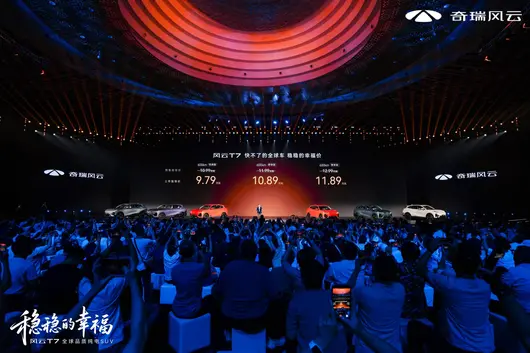

The more "involved" the industry becomes, the more people choose to "slow" down. On August 26, the globally quality pure electric SUV Fengyun T7 officially launched. The new car offers 3 trims. Launch guide price RMB 97,900 — 118,900. Early trade-in price RMB 94,900 — 115,900. While the 100,000-level pure electric SUV market competes to chase the rhythm of "launching new cars every 18 months", this pure electric SUV carrying a globally verified "ID card" chooses a slower path —— 2 years planning, 3 years R&D. Tempered by the global market first, then returning to the domestic.

At the press conference, famous musician Wu Kequn appeared in the role of "Happiness Experience Officer", having a dialogue with Chery Automobile Executive Vice President Li Xueyong on "Steady Happiness". Both parties agree to the concept of "making good cars with slow work", and jointly launched Fengyun T7 "Happiness Co-creation Plan". The uniqueness of this press conference lies in that it did not pile up gorgeous marketing speech, but spoke with solid data and actions.

In the industry's "invincible without speed" involution atmosphere, Fengyun T7 reversedly proposed the profound insight "The Global Car Can't Be Fast". The so-called "fast" is the shortcut of "domestic exclusive, fast overseas"; while Fengyun T7's "slow" is a long-termism car manufacturing persistence.
Slow in R&D: 3 years R&D cycle, plus 2 years product planning. Relying on Chery's global 1+7+N R&D system for repeated polishing. Not anxious to grab the window period, only to make the underlying architecture in place.
Slow in Design: Gathering 10 major design centers, 100+ designers to collaborate and create. Completed 5000+ global user research. Put aesthetic preferences and usage habits of different markets into the product definition.
Slow in Standards: Pre-researched global regulations 2 years in advance. Directly benchmarking 2026 version E-NCAP Five-Star Safety Standard design. Functional safety reaches ASIL-D highest level. Dare to face the highest global threshold.

Slow in Verification: 81 exclusive durable cars road tested simultaneously. Whole vehicle cumulative test mileage over 6 million km. Durability special test actual measurement 1.45 million km. Covering 95% global road types —— Brazil high-speed deceleration hump, Mexico cobblestone road, German high-speed large curvature bend, South Africa unpaved mud road; spanning -40°C~55°C extreme environment, Southeast Asia rainy season 500mm off-road grade water wading, Middle East high temperature sun exposure, Nordic extreme cold conditions. Every step is run out by the actual car.
These four "slows" exchanged for Fengyun T7's confidence to "simultaneously adapt to vehicle usage needs of 210 countries and regions globally". Homologous model Lepas L6 has been launched in South Africa and Thailand first. August Indonesia, September EU, October Aus/NZ, UK, Israel, Malaysia continuing to promote.
Fengyun T7 uses "Super Capable Running, Beautiful Globally, Safer, Smart Wisdom" four major values to put "Steady Happiness" into reality.
Super Capable Running, Range Equalization. All series standard equip 65.05kWh Rhino Battery. CLTC range 600km. Actual measurement "reverse false marking" reaches over 667km. 30%-80% fast charge only needs 20 minutes. One cup of coffee time recharge 300 km. Dual-source wide temperature range heat pump air conditioning all series standard equip. -10°C range increase 30%. 12-in-1 Kunpeng electric drive comprehensive efficiency 90.8%.

Beautiful Globally, Blend East-West Aesthetics. Global 10 design centers, 100+ designers collaborate. 5000+ users deep co-creation. Homologous model Lepas L6 appeared at Milan Design Week widely acclaimed. 6 Eastern elegance paint colors. Blazing Orange uses luxury car level Tri-coat three-layer craft. Co-created and developed with Axalta. Cloud Wing Wrap Cockpit. Occupancy rate as high as 84%. Rear row pure flat floor. Pure flat bed mode extendable to 1955mm×1310mm.
 Safer, Guarding Family Travel. High strength steel ratio 80%, Hot formed steel ratio 18.84%. Nine transverse five longitudinal cage-style body. Same level unique shotgun structure, First launch dual frame subframe + Pack anti-collision beam. Front collision 9 lines, Side collision 6 lines transmission paths. All series standard equip 9 airbags, containing 48L far-end airbags and rear row side airbags. 6D Locking Armor 31 layer battery protection. IP68 grade waterproof. Waterproof test duration is 96 times national standard requirement.
Smart Wisdom, Travel Easy and Worry-Free. Top version Smart Enjoy Edition equipped with same level first launch 8775 Cockpit Drive Integrated Chip. 4nm process. 72 TOPS computing power. System response 80ms. 15.6 inch 2.5K high definition large screen. Lingxi Smart Cockpit 2.0 equipped with Doubao Large Model. 22 high precision sensors. Support 300+ full scene automatic parking, Highway Pilot Assistance. Predict lane change 500 meters in advance.

Fengyun T7 three car models —— 600km Joy Enjoy Edition, 600km Comfort Enjoy Edition, 600km Smart Enjoy Edition —— core highlight is "Range Series Equalization". Price difference mainly reflected in comfort configuration and intelligent driving level.
Joy Enjoy Edition (97,900 RMB) —— Entry Level High Trim, Buy Powertrain Get Car. All series standard equip 65.05kWh Battery + 600km Range, 9 Airbags, 15.6 inch 2.5K Large Screen, 8 Speaker Sony Sound, L2 Level Basic Auxiliary Driving. Suitable for budget limited, pursuing long range core essential needs users.
Comfort Enjoy Edition (108,900 RMB) —— Add 10,000, Comfort Configuration Maxed Out. Compared to Joy Enjoy Edition, add Panoramic Sunroof + Electric Sunshade, Electric Trunk, 50W Phone Wireless Charging, Front Row Seat Heating / Ventilation, 360° Panoramic Image, L2 Auxiliary Driving Upgrade Rear Collision Warning, Lane Change Assist, etc. This is the most recommended version, daily use experience improvement most obvious.
Smart Enjoy Edition (118,900 RMB) —— Intelligent Driving Full Body Only Available at Top Trim. Compared to Comfort Enjoy Edition, upgrade 8775 Cockpit Drive Integrated Chip, 18-inch Wheels. Equipped with Falcon 500 Driving Assistance System. Support Highway Pilot, Full Scene Automatic Parking, Tracking Reverse, Remote Move Vehicle. Suitable for users with essential needs for intelligent driving.

From now until September 30 order, enjoy 8-layer gift bag: Value 6,000 RMB personal car color (Blazing Orange, Mountain Smoke Purple) Limited Time Free, 2 years 0 interest for 60,000 or 5 years 0 interest for 100,000. Non-brand enjoy 3,000 RMB trade-in subsidy. Whole vehicle lifetime warranty (including three-electric systems) etc. Pre-sale period inflation gift (1,000 RMB offsets 2,000 RMB) extended to August 31 deadline.
Chery continuous 23 years ranking Chinese Brand Passenger Car Export No.1, Global users breakthrough 20 million. This deep global accumulation is Fengyun T7's confidence to dare to "slow down". In the era where others fight desperately for speed, Fengyun T7 proves with "slow": True Global Quality, Cannot Be Fast.


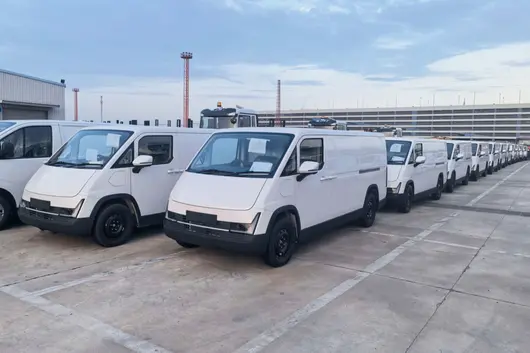
On July 23, the first batch of Foton Kavon LeFu overseas version CAVAN C1 right-hand drive vehicles destined for Thailand were fully prepared and officially set sail at Shanghai Port. This bulk delivery marks a substantial breakthrough in Foton Kavon Auto's global strategy implementation in the core Southeast Asian market after successfully delivering to European overseas market customers, further improving the brand's global market layout.

Layout Southeast Asian Market, Strengthen Regional Green Transformation Pivot
Along with the accelerating process of low-carbon development in the global transportation sector, the Southeast Asian market, with its strong market vitality and development potential, has become an important incremental track for Chinese new energy commercial vehicle exports. Foton Kavon Auto seized the trend of industry development, firmly promoted the global development strategy, listed Southeast Asia as an important sector of overseas strategic layout, and built an industrial hub for right-hand drive new energy vehicle landing.
This batch export of the Kavon LeFu overseas version — CAVAN C1 right-hand drive vehicle model is not a single phased product output, but a key step for Foton Kavon Auto to use Thailand as a strategic pivot, radiating to right-hand drive regional markets such as Malaysia and Indonesia, and building a complete three-dimensional Southeast Asian market system. This move not only landed the brand's long-term overseas layout plan, but also further promoted Chinese new energy commercial vehicle brands to go global.
Currently, Foton Kavon Auto products have been successfully sold to 25 countries and regions worldwide, forming a global market pattern with the European market as the core and coordinated development of multiple regions such as Southeast Asia, Australia and New Zealand. At the same time, the brand has successively won multiple international authoritative access qualifications such as EU WVTA, UK GB, and Australia VTA. With rigorous high-end market certification standards, it provides intelligent, efficient, and reliable new energy logistics solutions for global users.

Deep Cultivation of Quality R&D, Establish Global Commercial Vehicle Value Benchmark
Strategy landing, quality is the foundation. Aiming at Thailand's hot and humid tropical climate, complex road conditions, right-hand drive traffic regulations, and diversified application scenarios of urban last-mile delivery, Foton Kavon Auto abandoned the extensive development mode of simple vehicle model modification, strictly implemented the localized R&D strategy of "One Area One Policy, One Country One Policy", focused on local users' actual operation pain points to carry out special deep R&D, and with the hard overseas quality that can withstand long-term market inspection, continuously consolidate overseas market reputation and win global customer trust.

Since the brand's establishment, Foton Kavon Auto has always stood on the global development vision, focusing on "Brand New Platform Architecture, Extreme Energy Efficiency Management, High-Level Intelligence, Software Defined Car", achieving systematic breakthroughs in core fields such as energy architecture, intelligent architecture, trust architecture, reshaping commercial vehicle genes with three major architectures and six major technologies, building new energy exclusive vehicle platforms covering micro, light, and heavy types, and establishing global new energy commercial vehicle value benchmarks with excellent quality.
Upgrade Overseas Mode, Build Sustainable Eco-friendly Overseas System
Product overseas is the foundation, ecosystem overseas is the core. As an exclusive new energy commercial vehicle brand under BAIC Foton, Foton Kavon Auto has always upheld the brand mission of "Make Every Kilometer Better", with the development vision of "Committed to Becoming an Internationally Leading New Energy Technology Enterprise", continuously outputting high-quality intelligent products and full-cycle supporting services, helping the global logistics and transportation industry green and low-carbon transformation.
This bulk departure of CAVAN C1 right-hand drive vehicles to Thailand is an important verification of Foton Kavon Auto's "Comprehensive Internationalization" strategy moving from layout planning to landing harvest. Relying on Thailand's perfect industrial supporting and localized after-sales service system, the brand has realized the upgrade from single product output to "Product + Service + Brand + Ecosystem" systematic overseas mode, thoroughly completing the leapfrog development from "Product Overseas" to "Ecosystem Overseas".
The successful landing of the Thailand market fully verifies Foton Kavon Auto's core global competitiveness driven by "Forward R&D + Systematic Overseas" dual core. According to the overall development plan, the brand will continue to unfold the global marketing service network, steadily achieve each stage of overseas sales targets, and plans to land in the Hannover Motor Show in Germany in September 2026, comprehensively demonstrating the hard strength of Chinese Intelligence.
Facing long-term development, Foton Kavon will continue to deeply cultivate the global overseas market, relying on country-specific regulations and standards and user operation needs to continuously iterate and optimize the new energy product matrix, and continuously improve the global marketing service ecosystem network. Always practice the brand's original intention and commitment, continuously lead the global commercial vehicle green transformation, and output technology, efficient global logistics solutions.


29 years, 30 million vehicles, this is a dual achievement of scale and trust for GAC Group.
On July 16, the GAC Group 30 Million User Gratitude Event was held at the GAC Trumpchi factory. As a right-hand drive Trumpchi M8 PHEV rolled off the production line and was handed to Thai owner Tony Jaa, GAC officially crossed the 30 million user milestone.

From the first vehicle rolling off the line to now, GAC took 29 years to go from 0 to 10 million vehicles. Moreover, GAC is accelerating forward, taking only 9 years to go from 10 million to 30 million vehicles, achieving "GAC Speed". At the event site, multiple global production bases were connected simultaneously. GAC Honda P7, GAC Toyota BZ7, Qijing GT7, GAC AION N60, and GAC Hyper S600 rolled off the production line one after another as vehicles No. 29,999,995 to No. 29,999,999. The new energy matrix as a whole made a collective debut.

To repay 30 million users, GAC Group Chairman Feng Xingya announced the launch of the "Renewal Gratitude Season" on site. From today until August 31, GAC Honda, GAC Toyota, GAC Trumpchi, GAC AION, GAC Hyper, and Qijing Auto's six major brands will simultaneously launch new purchase, trade-in, and additional purchase triple benefits.
In the new purchase session, GAC Honda P7 launched a limited-time price; Accord and Breeze gasoline versions are eligible for "3 years, 80,000 yuan, 0 interest"; GAC Toyota, Trumpchi, AION, Hyper, and Qijing mainstream models offer purchase subsidies ranging from 5,000 to 50,000 yuan. Regarding trade-ins, GAC old owners trading in or upgrading to select Trumpchi, Hyper, and Qijing models receive additional subsidy boosts; families purchasing an additional Qijing GT7 can enjoy exclusive benefits, further lowering the upgrade threshold for users.

"Quality is the bottom line that GAC will never compromise." Feng Xingya stated in the summary. The trust of 30 million users is supported by quality control across the full chain from R&D to manufacturing. Before the vehicle goes on sale, it must undergo extreme environment tests of "Five Highs, One Mountain, One Dust" and at least "Two Winters, One Summer" validation, covering 12 major items and over 1,500 verification sub-items.

Mag Battery has been installed in 1.5 million vehicles, accumulating over 160 billion kilometers of safe driving; The Xingling Safety Guard system serves nearly 2 million users, cumulatively preventing 6.28 million potential accidents. GAC also pioneered the "Three Responsibilities" policy in the industry, actively backing the three-electric systems for self-ignition, battery power decay beyond limits, and intelligent parking accidents, extending the quality commitment throughout the entire vehicle usage cycle.

In technology and service, GAC accelerates the transformation from engineer thinking to user thinking. Relying on the "Panyu Action", the independent brand has been fully renewed. The high-end brand Qijing jointly created with Huawei Qunkun's first model GT7 has gone on sale. Xingyuan Power covers range extension, plug-in hybrid, and super hybrid; Quark Electric Drive mass-produced motors have broken 99% maximum efficiency, with cumulative R&D investment exceeding 62 billion yuan.

Service network is also expanding downwards, planning to add 1,000 county-level authorized stores this year; The "9 Vertical, 10 Horizontal" energy replenishment network covers 213 cities nationwide, with over 27,000 self-operated charging piles; Online "Super Butler" promises 5-second response and 2-hour completion.
At the event, a right-hand drive Trumpchi M8 PHEV rolled onto the stage as the 30 millionth vehicle. GAC Group Chairman Feng Xingya handed the keys to Thai owner Tony Jaa. The 30 million vehicle milestone, highlighted by a right-hand drive vehicle and one overseas user, is not a coincidence. Overseas markets are becoming a new engine for growth.

In the first half of this year, GAC Group sales reached 773,100 vehicles, up 2.35% year-on-year, of which new energy vehicle sales increased significantly by 68.8% year-on-year; Independent brand exports reached 121,500 vehicles, up 132% year-on-year, approaching the full year of last year. Taking the Thai market segment as an example, June sales increased by 207% month-on-month.

Currently, GAC has entered 110 countries and regions, built 746 sales outlets, 7 overseas factories, and 9 parts warehouses, moving from product export to a full value-chain system export. The scene of the right-hand drive M8 PHEV delivery is a microcosm of GAC's accelerated globalization.
The author of this article is Sun Xiaoshu of Tichebang
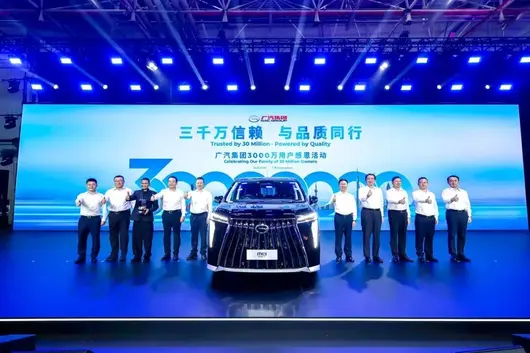

On July 16, GAC Group's 30 Million User Gratitude Celebration was held at the GAC Trumpchi Factory. Government and enterprise leaders, industry partners, domestic and international car owners, and media jointly witnessed this key milestone of the Group's 30 millionth vehicle coming off the production line. After 29 years of development, the delivery of 30 million vehicles is not only a testament to the trust of tens of millions of users but also a microcosm of the Chinese automotive industry shifting from scale expansion to high-quality development.

The event featured a connection to global bases on-site. Multiple new energy models from GAC Honda, Toyota, AION, Hyper, and Qijing sequentially completed production of the 29,999,995th to 29,999,999th units. The finale, the 30 millionth vehicle, was a Right-Hand Drive Trumpchi M8 PHEV. New car keys were delivered to a Thai owner on-site, intuitively showcasing GAC's dual achievements in new energy transformation and global expansion.
Market data confirms transformation results. In the first half of this year, GAC cumulative sales reached 773,100 units, up 2.35% year-on-year; new energy sales surged 68.8%, overseas exports reached 120,000 units, an increase of 132%, maintaining steady growth during the industry adjustment cycle.
Quality is the core bottom line of GAC's development. The group integrated the mature management system of Japanese brands to create an exclusive quality management model. New cars undergo unified testing in extreme environments of "Five Highs, One Mountain, One Dust" and two winters and one summer long-cycle tests. Relying on AION's global new energy lighthouse factory, digital quality control is achieved. In terms of safety, the StarGuard protection system and Cassette Battery are applied, cumulatively avoiding millions of driving risks. The industry's first "Three Responsibilities" policy proactively covers issues related to batteries and intelligent driving, eliminating user concerns about vehicle usage.

According to reports, GAC regularly carries out face-to-face communication with users, adhering to a user-centric orientation and building a full closed-loop complaint handling mechanism. Channels continue to deepen, adding 1,000 county-level stores this year and launching a 5-second response ultra-fast butler service. A "9 Verticals, 10 Horizontals" charging network covering the country has been built, with over 20,000 self-operated super-charging piles, perfecting supporting facilities for new energy vehicles. On-site, the full-brand renewal gratitude season was simultaneously launched, with six passenger car brands offering multiple return policies for purchasing and trading in.
With 30 million as a new starting point, GAC continues to increase investment in independent research and innovation, with cumulative R&D investment exceeding 62 billion yuan and an R&D team of over 6,800 people. The Xingyuan Power series power solutions, Quark efficient electric drive, all-solid-state battery pilot line, and evolved StarGuard electronic architecture are landing successively. They are jointly building an AI intelligent ecosystem with companies such as Huawei and CATL, continuously tackling industry pain points such as fast charging and low-temperature range.
In the future, GAC will adhere to the four main lines of Quality, User, Technology, and Globalization, accelerate the transition to an ecosystem-based tech enterprise, continuously output green intelligent products, and expand the global market.
Editor's Summary: Whole vehicle production and sales breakthrough 30 million is a concentrated embodiment of nearly 30 years of GAC's manufacturing, channel, and technology accumulation. At the same time, the enterprise did not only focus on product iteration. From extreme condition testing and battery safety backing, to county-level channels, national charging networks, and ultra-fast user services, a complete user guarantee system is formed. It is worthy of learning and reference by other car companies.

In the domestic automotive market, achieving a production and sales scale of 30 million is by no means an easy task for a car company. Links such as brand building, reputation accumulation, quality control, and product polishing are all indispensable.

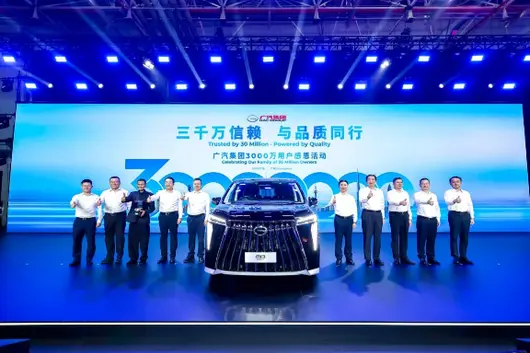
On July 16, the GAC Group 30 Million User Gratitude Ceremony kicked off grandly at the GAC Trumpchi factory. From the first complete vehicle officially rolling off the line to the smooth delivery of the 30 millionth car, GAC has moved forward steadily in 29 years of hard work and struggle. This milestone number not only highlights GAC's excellent product strength, but also embodies the group's bold courage to face the transformation of the automotive market, as well as the firm trust and support of the vast majority of users for the brand.

From the 29,999,995th to the 29,999,999th vehicle, the full brand lineup under GAC appeared on the scene. GAC Honda P7, GAC Toyota bZ7, Qijing GT7, GAC AION N60, and GAC Hyper S600 gathered on site, fully presenting the bright answers given by GAC on the new energy track.


This milestone 30 millionth complete vehicle is the right-hand drive version of GAC Trumpchi M8 PHEV, and its owner is the well-known Thai kung fu star Tony Jaa. This fact fully shows that the models under GAC are not only favored by users domestically, but even when sold far overseas, the excellent strength of Made in China has also won the heartfelt praise of overseas users.


Quality is the core bottom line that GAC adheres to and never retreats. In the summary speech session, Feng Xingya emphasized that GAC Group has always firmly practiced the development creed of 'Quality First' for a long time. On the production front line, workshop colleagues carve every detail with an attitude of striving for perfection; at the same time, the GAC powertrain independent R&D team, which has won the title of 'National Excellent Engineering Team', closely fits the diverse needs of consumers at different stages, and makes full efforts to break through technical barriers to present excellent powertrain solutions for users. In addition, the GAC styling design team also put in all efforts, created classic models such as Trumpchi GS8, Trumpchi M8, and Hyper SSR, which continue to receive widespread praise for their outstanding image. These are all vivid footnotes to GAC quality.

In the whole process of R&D and manufacturing, GAC has carefully built a strict and complete quality control system: every new car must undergo strict extreme environmental tests such as high cold, high temperature, high altitude, high humidity, high corrosion, and mountainous areas, sand and dust, etc., known as 'Five Highs, One Mountain, One Dust' before being officially launched to the market, and successfully complete the 'Two Winters One Summer' on-site road test; relying on test grounds and laboratories, the whole vehicle undergoes comprehensive systematic quality verification covering 12 major items and over 1500 verification sub-items; GAC AION Smart Ecosystem Factory has won the title of 'Global First New Energy Vehicle Lighthouse Factory', and relies on a digital intelligent manufacturing system to build a solid foundation for the stability of mass production quality.

Regarding automotive products, safety is undoubtedly the top priority. The Xingling Security Guardian System carefully built four protection barriers, and eight core systems all adopt dual redundant architecture. It has provided solid protection for nearly 2 million users so far, successfully resolving 6.28 million potential travel hazards; The Prism Battery has achieved installation on 1.5 million vehicles, and the safe driving mileage has broken through the 160 billion kilometer milestone; on the service guarantee level, GAC has also continued to exert efforts, becoming the first in the industry to launch the 'Three Responsibilities' measure for independent brands, proactively taking responsibility for battery and intelligent driving assistance problems that users are concerned about, effectively eliminating users' concerns about using vehicles.

It is indeed the case that consumers have firmly chosen GAC models with real financial investment: In the first half of this year, GAC Group's overall sales reached 773,100 vehicles, achieving a 2.35% growth compared to the same period last year, and the new energy vehicle sector sales soared 68.8% year-on-year; meanwhile, the export volume of overseas markets successfully broke through 120,000 vehicles, with a year-on-year increase as high as 132%.

At this key node where GAC Group reached the milestone of 30 million vehicle deliveries, from July 16 to August 31, GAC Group coordinated with its six sub-brands to heavily launch refreshed exclusive rights. From diverse car purchase benefits, thoughtful financial services, convenient trade-in policies to thoughtful after-sales treatment, all-roundly repaying the vast number of users. GAC products holding the quality original intention will surely win more users' trust and support, gathering an increasingly solid user group.

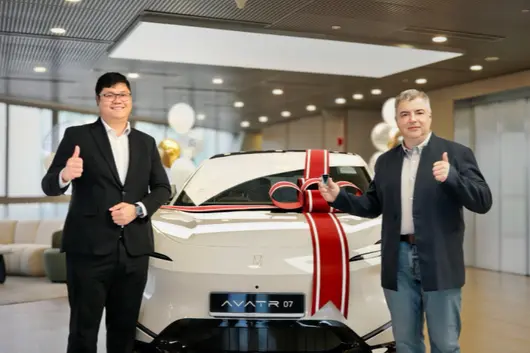
Gasgoo News Recently, Avatr Technology completed a delivery ceremony at its Singapore store, and Konstantin Novoselov, Nobel Prize laureate in Physics and discoverer of graphene, officially became the 100,000th Avatr 07 owner. This landing of high-end overseas users is another example of Avatr products gaining recognition from the global top circle, and also intuitively reflects the continuous improvement in the recognition of domestic high-end intelligent electric vehicles going global.
According to Novoselov himself, his first contact with Avatr models was during his trip to Chongqing in May this year. The vehicle's exterior design, cockpit layout, and smart interaction experience were the core reasons for his choice to purchase. This is also his first Chinese brand car to be purchased, and his public evaluation verifies the advanced results of domestic new energy models in terms of design, intelligence, and quality.

Image Source: Avatr
Public data shows that Avatr 07 is positioned as an urban luxury smart SUV, relying on original design, cockpit configuration, smart technology, and safety systems to build comprehensive product competitiveness. As of now, the global delivery volume of this model has surpassed 100,000 units. It is the brand's core volume-selling model, pulling Avatr's global cumulative sales to surpass 260,000 units, providing a sales basic support for the brand's overseas expansion.
In the overseas high-end market, Avatr's pricing strategy benchmarks against international luxury models, with its Singapore market starting price exceeding one million yuan, entering the local mainstream luxury car price track. Since entering the Singapore market in July 2025, Avatr has cooperated with the local high-end automotive group DPL Premium Automobiles, landing offline channels and a localized service system. Previously, multiple overseas politicians and royal family members have purchased this brand's models, and the brand's coverage in the global high-end circle continues to expand.
Channel data shows that Avatr's current business covers 43 countries and regions globally, focusing on deepening key overseas core markets such as Southeast Asia, the Middle East, and Europe. According to the brand's plan, by 2030, it will complete market layout in over 110 countries and regions, continuously improving localized product and service systems. This Nobel laureate scholar becoming an owner is a landmark event for Chinese high-end smart electric vehicle technology and product strength gaining global authoritative recognition, and will further help the brand promote its globalization high-end market layout.

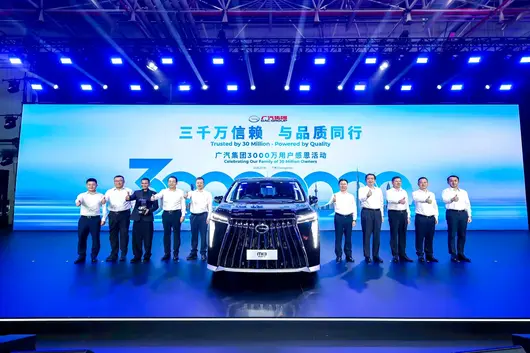
On July 16, GAC Group's 30 million user gratitude event was held at the GAC Trumpchi factory. From the first complete vehicle off-line to the 30 millionth delivery, GAC has undergone a 29-year development history. Behind this number 30 million is the choice and trust of millions of users, GAC's steadfastness in upholding quality and safety, its determination to transform towards electrification and intelligence, and also a microcosm of the Chinese automotive industry growing from large to strong, from scale expansion to value leap.

All New Energy Off-line Vehicle Matrix Debuts Together
On-site, GAC's multi-site production bases were connected synchronously. GAC Honda P7, GAC Toyota Platinum Wisdom 7, Qijing GT7, GAC Aion N60, and GAC Hyper S600 went off-line one by one as GAC's 29,999,995th to 29,999,999th vehicles. Finally, the Right-Hand Drive version of GAC Trumpchi M8 PHEV made a bright debut on the on-site stage as the 30 millionth complete vehicle. The collective debut of the all-line new energy off-line vehicle matrix became direct evidence of GAC's full-speed promotion of electrification and intelligence transformation.

[GAC 30 Millionth Vehicle — GAC Trumpchi M8 PHEV Right-Hand Drive Version Rolls Off Production Line]

[GAC Intelligent New Energy Matrix Makes a Bright Debut]
Subsequently, Feng Xingya handed the key of the 30 millionth vehicle into the hands of Thai owner Mr. Tony Jaa. The moment captured was not just a number, but a touching witness of the mutual dedication between GAC and global users.

[Feng Xingya (Left) Delivers New Car Keys to Thai Owner Tony Jaa (Right)]

[Ge Xianqing (Far Left) Awards GAC Group All-Brand Honorary Owners]
This trust spanning mountains and seas is precisely the confidence GAC has for breakthrough amidst industry changes. In the first half of this year, GAC Group sales reached 773,100 vehicles, a year-on-year increase of 2.35%, among which new energy vehicle sales increased by 68.8% year-on-year; overseas exports exceeded 120,000 vehicles, a year-on-year surge of 132%, running a steady rhythm during the industry's deep restructuring period.
Quality is the bottom line GAC will never compromise on
Quality is the bottom line GAC will never compromise on. Feng Xingya stated in the concluding speech. In GAC's development, scale growth has always been based on quality. For many years, GAC Group has always upheld the philosophy of Quality First, integrating Honda Total Quality Management (TQM), Toyota Production System (TPS), and Lingnan Culture to build a quality management mode centered on Integrated Innovation. The final destination of everything is to build good cars that allow users to drive with peace of mind, use with ease of mind, and sit with comfort.

[Witnesses of Key Nodes in GAC's Development History Tell the Story of GAC Walking with Quality]

[National Excellent Engineer Team GAC Powertrain Independent R&D Team Tells the R&D Innovation Journey]

[GAC Styling Design Team Tells the Design Innovation Journey]

[GAC Aion Intelligent Eco Factory]
From the R&D end to the manufacturing end, GAC established a full-chain rigorous quality control system: before each new car launches, it must undergo extreme environment tests including high cold, high heat, high altitude, high humidity, high corrosion, mountainous, and sandy conditions, completing two winters and one summer of on-site road testing; relying on test fields and laboratories covering 12 major categories and over 1,500 verification sub-items of the complete vehicle, achieving systematic quality verification; GAC Aion Intelligent Eco Factory, as the world's first New Energy Vehicle Lighthouse Factory, guarantees the stable quality of mass-produced vehicles with a digital intelligent manufacturing system.

[GAC Xingling Safety Protection System]
In terms of core safety technology, the Xingling Safety Protection System constructs four dimensions of protection, eight key systems adopt dual redundancy design, have guarded nearly 2 million users, and averted 6.28 million potential travel risks; Magazine Batteries cumulatively installed on 1.5 million vehicles, safe driving mileage exceeding 160 billion kilometers; Service side also adds support, GAC launched the self-owned brand Three Responsibilities policy in the industry first, actively covering issues users care about like batteries and intelligent driving assistance to eliminate user concerns about vehicle use. It is precisely these security lines and service promises that support the brand confidence behind GAC's 30 million sales.
People-based, Trust-based, Innovation-first
What users care about, we keep in our hearts; what users expect, we go all out. Feng Xingya stated that this user-centric philosophy has long been deeply integrated into the development DNA of GAC Group. For many years, GAC Group has always upheld the corporate philosophy of People-based, Trust-based, Innovation-first, among which the core meaning of People-based is precisely being people-oriented.

[GAC User Open Mic Event Site]
On one hand, to face problems directly and listen to users' voices, GAC normally holds User Open Mic events, inviting users to the home, communicating face to face. At the same time, establish a full-process closed-loop management mechanism to ensure every suggestion can be properly handled, common issues optimized for all users immediately.
In addition, GAC also established an exclusive user insight department, promoted full-process reform from problem discovery to resolution, guaranteeing user demands are responded to and everything has a result from the organizational mechanism.
On the other hand, service network penetrates in sync. At the channel end, promoting service network sinking to county levels, planning to add 1,000 county authorized stores within the year; at the response end, launching Super Butler service, achieving 5-second response and 2-hour claim completion, guaranteeing user demands reach and are handled quickly. At the energy replenishment end, building a 9 Vertical 10 Horizontal energy replenishment network, already covering 31 provinces and 213 cities nationwide, core urban areas achieving 1 kilometer in a straight line must have a station, self-operated charging pile quantity exceeding 27,000 units, among which super charging piles exceed 20,000 units, providing convenient energy replenishment services for new energy vehicle owners.
The core theme of this gratitude event is to express sincere returns and gratitude to 30 million users' long-term support. On-site, Feng Xingya announced that starting from today, GAC officially launches GAC Group 30 Millionth Vehicle Off-line · Renewal Gratitude Season. GAC Honda, GAC Toyota, GAC Trumpchi, GAC Aion, GAC Hyper, and Qijing Automobile six passenger car brands will launch characteristic policies around new purchase, trade-in, to add-on purchase respectively, returning for every company and support.

[GAC Group 30 Millionth Vehicle Off-line · Renewal Gratitude Season Officially Launched]
Finally: With 30 million as a new starting point, GAC will drive innovation and move towards a new journey of electrification and intelligence, allowing frontier technology to truly translate into peace of mind and convenience perceptible by users. In the Three Electrics field, GAC continues to attack battery super-fast charging, low temperature range and other industry pain points, has built an all-solid-state battery pilot production line, launched ultimate energy consumption technology, the mass-produced Quark Electric Drive Motor highest efficiency breaks through 99%, reaching the highest level in the industry. Facing the future, GAC will continue to anchor user needs as the anchor point, quality as the foundation, technological innovation as the core driver, global layout as the development path, accelerating towards the advancement of eco-technology GAC, walking side by side with more users, achieving each other, jointly rushing towards a smarter, greener, and broader future.
GAC's brilliance will continue!

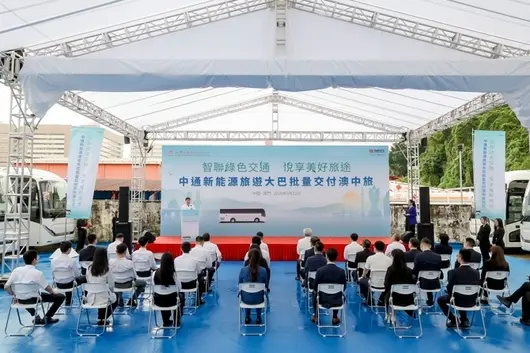
Connecting smart green transportation, enjoying a wonderful journey! On May 22, the ceremony for the batch delivery of Zhongtong New Energy Tourist Coaches to Macao China Travel Service Co., Ltd. under the Southlight Group (hereinafter referred to as "Southlight Macao Travel") was successfully held in Macao. Wang Zhijian, Party Secretary and Chairman of Shandong Heavy Industry Group, and Fu Jianguo, Chairman of Southlight Group, attended the event and cut the ribbon.

The delivery of this batch of range-extended new energy coaches is a landmark achievement of the deep collaboration between Zhongtong Bus and Macao's culture, tourism, and transportation sectors to jointly build a green and low-carbon Greater Bay Area. It is also a vivid practice of Zhongtong Bus using core technologies to create green application cases for the global high-end market and promoting the high-quality development of global green transportation.

Deeply Cultivating Core New Energy Technologies
Empowering Macao's Low-Carbon Transportation Development
As a high-end window for China's opening up and an important node city of the Greater Bay Area, Macao sets strict standards for the safety, stability, comfort, and regional environmental adaptability of passenger vehicles. It is a "high-end trial field" to test the smart manufacturing strength of new energy coaches.

Southlight Macao Travel is Macao's largest land passenger transport service provider. As a leading enterprise in Macao's tourism industry and a core operating entity for transportation, culture, and tourism, it has deeply cultivated Macao's entire industry chain of "eating, living, traveling, entertainment, sightseeing, and shopping". It is the backbone force of Macao's public transportation and cultural tourism passenger transport services.
To actively respond to the Macao Special Administrative Government's "Macau Long-term Decarbonization Strategy" and "Green Transition of Land Transportation" deployment, and implement the national "Dual Carbon" goals, in recent years, Southlight Macao Travel has comprehensively launched the new energy upgrade of its passenger fleet, accelerating the construction of a green, smart, and efficient modern passenger transport system. Zhongtong Bus has become its core partner for new energy development.

Zhongtong Bus has deepened its focus on new energy technology R&D and possesses the capability for full-series new energy coach product solutions, including pure electric, hybrid, and range-extended technologies. At the same time, with deep exploration of the global market, Zhongtong Bus has accumulated a massive amount of complex road conditions and multi-scenario operation data. Technology iterations continue to lead the industry.
Relying on hardcore technology and extreme adaptability, Zhongtong Bus's cooperation with Southlight Group covers cross-border, urban, and tourist passenger transport fields. The total cooperation scale reached 600 units, effectively boosting the quality improvement and upgrade of the local transportation industry.
Deeply Adapting to Macao Scenarios
Customizing to Build Green Travel Benchmarks
Macao has a special regional environment, complex road conditions, congested traffic, and limited charging resources, facing challenges in new energy transition. Based on a deep understanding of Macao's local operation scenarios, Zhongtong Bus has tailored a range-extended product solution for the local area.

Zhongtong range-extended coaches combine the dual advantages of pure electric models (quiet and comfortable, zero idling pollution) and fuel vehicle models (worry-free range, convenient refueling/recharging), precisely solving Macao's pain points of insufficient charging infrastructure, limited long-distance range, and high operating costs.
At the same time, the vehicle has undergone comprehensive upgrades in comfort details and intelligent safety. High-end configurations such as ergonomic seats and healthy environmental interior decoration improve the quality standards of cultural tourism passenger transport. Deeply optimized vehicle passability and turning radius make the vehicle better adapt to Macao's street conditions, improving operational flexibility and safety. At the same time, the vehicle integrates intelligent systems such as collision warning, automatic emergency braking, tire pressure monitoring, and driving assistance, achieving a dual upgrade in safety and intelligence.

Relying on refined customization and all-dimensional comfort experiences, Zhongtong range-extended coaches have now become the main model for Macao tourism transfer and commuter services. Delivered in three batches to the Macao market, it has won high recognition from passengers and users.
Leading the Global Green Track
Zhongtong Manufacturing Empowers Global High-Quality Development
Currently, the global carbon neutrality process is accelerating, and the green public transportation system is iterating and upgrading. New energy coaches have become a winning track for China's automotive industry development.

As a representative enterprise in China's coach industry, Zhongtong Bus closely follows the national "Going Global" strategy and the "Belt and Road" Initiative deployment. It takes new energy going overseas as a core development strategy, continuously increasing investment in overseas markets. Against diverse global market needs, it adheres to localization strategies, tailoring solutions for the market and enhancing product adaptability.
In Chile, over 1,000 Zhongtong pure electric coaches have become the backbone of local green public transportation; in Denmark, Zhongtong coaches on Bornholm Island have become a green landscape for the local area; in Dubai, Zhongtong Bus pioneered the entry of Chinese coach brands into the Dubai public transportation system; in Singapore, Zhongtong new energy coaches continue to provide innovative solutions for public transportation in Singapore's high-density cities...

Currently, more than 100,000 Zhongtong new energy coaches are roaming around the world. They not only bring green, intelligent, and efficient travel experiences to the world but also demonstrate the quality standards and innovative strength of Chinese manufacturing to the globe. With high-quality, highly intelligent, and low-energy-consumption green coach product solutions, they contribute Chinese wisdom and Chinese solutions to the development of global green transportation.

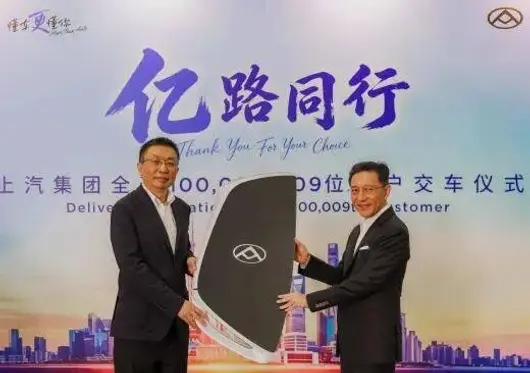
The first in China, SAIC Group's cumulative production and sales exceed 100 million vehicles! On May 28, at the Shanghai North Bund World Living Room, SAIC Group took this place as the origin to launch a global-reaching "First 100 Millionth User" vehicle delivery ceremony, becoming the first automotive group in Chinese automotive history to break 100 million cumulative production and sales. As a global leader in new energy commercial vehicles, SAIC Commercial Vehicles, with Maxus, Keya, IVECO, Hongyan, and Sunwin five brands, completed the global delivery relay from the 100,000,009th to the 100,000,013th vehicle, jointly creating a milestone in the Chinese automotive industry and engraving a historical coordinate for the Chinese commercial vehicle industry.
Behind the 100 million vehicles lies the long-term accumulation and explosive growth of SAIC's 70-plus years of deep cultivation, and it is also a vivid miniature of Chinese commercial vehicles moving from scale leadership to value leadership. Relying on the group's global resource empowerment, SAIC Commercial Vehicles has built the industry's most complete commercial vehicle matrix covering heavy trucks, buses, light trucks, light vans, pickups, MPVs, and RVs, continuously leading the Chinese commercial vehicle industry with a 35% new energy penetration rate and seizing opportunities in the global carbon neutrality wave. With reliable quality, cutting-edge technology, and a complete ecosystem, products are sold in over 100 countries and regions, winning deep trust from top global partners such as DHL, becoming the core force for Chinese commercial vehicles going global, moving in, and moving up.
Continuously leading Chinese brands to go global, Maxus drives global green logistics upgrade with benchmark strength. In Singapore, Maxus delivered eDeliver 5 (domestic Dana V1) to international logistics giant DHL, welcoming the group's 100,000,009th user. This is another milestone moment since both parties joined hands in 2017. Years of deep cultivation, Maxus not only won the largest procurement order of Chinese brands in DHL's European region, but also firmly stayed in its list of preferred partners for green transformation, with cooperation footprints covering Europe, America, Asia, and Oceania. Nowadays, relying on leading product strength and global strategy, Maxus light vans and high-end pickup export volumes firmly rank first in China, building five 10,000-unit level core markets; won C-NCAP, Euro NCAP, ANCAP global three major five-star safety certifications, continuously leading exports in high-end markets such as Singapore, Europe, Australia, and successfully joined the preferred cooperation camp of global top enterprises such as FedEx, DPD, JD.com, SF Express, Cainiao Logistics, with global strength to strongly expand the 100 million user map.


Based on the domestic market, the four brands deeply cultivate two major tracks of livelihood and infrastructure with green capacity. Keya delivered Dana T1 to Dizhantie in Yangzhou, Jiangsu, relying on high load-bearing, long range, and intelligent connectivity advantages to cover green urban distribution scenarios. In 2025, Keya delivered nearly 10,000 units cumulatively to Dizhantie, unblocking urban-rural logistics "capillaries". Sunwin delivered 10-series low-floor pure electric buses in Shanghai, empowering urban public transport smart upgrade with zero-carbon travel. Hongyan delivered i Jieshi dump trucks in Taiyuan, Shanxi, calmly mastering complex mountain operating conditions with military foundation and powerful performance, deeply protecting the construction of a strong country in infrastructure. IVECO delivered Juxing EV in Luoyang, Henan, 100-degree large capacity battery solved the mountain operation range problem, setting a new benchmark for green passenger transport. The four brands relay delivery, welcomed the group's 100,000,010 to 100,000,013th users, jointly casting a 100-million level milestone with hardcore strength.


From domestic core cities to key overseas markets, from logistics delivery and infrastructure engineering to public travel and tourist passenger transport, every delivery of the five brands is a vivid practice of SAIC Commercial Vehicles "Hand in Hand with Chinese Power, Driving the World's Pulse". 100 million users are not the end point, but a new starting point of trust. Facing the future, SAIC Commercial Vehicles will continue to take technological innovation as the core, user value as the guide, lead green transformation, deepen global layout, and write the brilliant chapter of the Chinese commercial vehicle industry on the new journey.

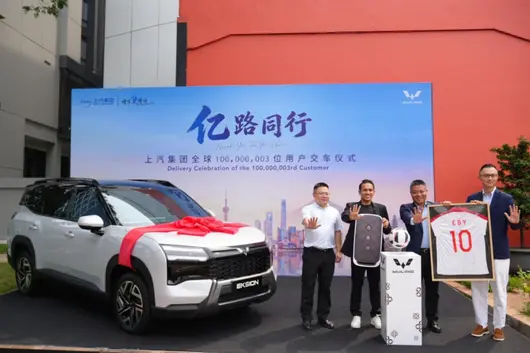
On May 28, SAIC Group welcomed the delivery of the first 100 millionth vehicle globally, becoming the first automotive group in China to cumulatively exceed 100 million units in production and sales. Among them, SAIC-GM-Wuling contributed more than 32 million units cumulatively. On that day, SAIC-GM-Wuling delivered its global car EKSION to the first batch of users in Jakarta, Indonesia.

[SAIC Group's 100,000,003rd vehicle delivered in Jakarta, Indonesia]
"What people need, Wuling builds." SAIC-GM-Wuling precisely grasped market trends, responding to user needs with hit products. Wuling Hongguang, with its versatile characteristics of "suitable for business and home, tough and durable", has become the preferred model for many entrepreneurs and families. As resident consumption gradually upgraded to quality life, Baojun 730 broke the monopoly of joint-venture brands in the household multi-purpose vehicle (MPV) market with its flexible space and high cost-performance ratio. In 2020, during the window period of new energy transformation in China's automotive industry, the launched Hongguang MINIEV became one of the pioneers in the domestic new energy commuting vehicle field. In May this year, the first technology flagship large six-seater SUV jointly created by SAIC-GM-Wuling and Huawei Qiankun, Huajing S, officially launched, breaking the technical premium barrier of high-end intelligent driving with innovative practices of cross-border synergy.
 [Equipped with Huawei Qiankun Technology Flagship Large Six-Seat Huajing S]
SAIC-GM-Wuling accelerated its layout for new energy and intelligence, and while promoting the electrification and intelligence upgrade of its products, deepened and solidified its global market layout. Currently, SAIC-GM-Wuling's cumulative overseas sales have exceeded 1.5 million units, with business covering more than 110 countries and regions globally.
The company has built a full-dimensional core competitiveness covering the intelligent manufacturing system, product matrix, and industrial ecosystem. First, the globally first intelligent island manufacturing system, using the flexible intelligent manufacturing mode of "cars finding workstations, materials finding cars", achieving full-dimensional breakthroughs in efficiency, quality, and cost; Second, a diversified product matrix adapted to the global market. Multiple models such as EKSION (Starlight 560), DARION (Starlight 730), BINGO (Wuling Bingo), BINGO S (Bingo S) have landed overseas successively, covering mainstream categories such as SUV, MPV, and sedans, meeting the differentiated travel needs of different countries and different consumer groups; Third, a unique "Moving Chains Overseas" globalization model, which, through the deep collaboration of the five chains: manufacturing chain, supply chain, sales chain, financial chain, and talent chain, broke the single path of traditional product trade going overseas and promoted the Chinese intelligent manufacturing system and standards to go global.
[Globally First Intelligent Island Manufacturing System (I²MS)]
The global car EKSION delivered in Indonesia this time is the latest footnote of the in-depth promotion of Wuling's globalization strategy. Relying on Indonesia as a core fulcrum, SAIC-GM-Wuling continues to deepen the "Indonesia-Malaysia-Thailand Integration" regional strategy, comprehensively covering Malaysia and Thailand with new energy products and localized supply chain systems, and gradually radiating to ASEAN countries such as Vietnam and the Philippines, forming a globalization pattern of regional synergy and linked development.

May 28, 2026, a date worth mentioning repeatedly in the history of China's automotive industry.
SAIC Group delivered an IM LS9 Hyper to the world's 100 millionth user—Momenta CEO Cao Xudong—at the North Bund World Welcome Hall in Shanghai. This is not an ordinary delivery. At the same time, more than a dozen brands under SAIC and 19 car models relayed deliveries in multiple locations around the world. From Shanghai to Nanjing, Liuzhou, and Taiyuan, from the UK to Indonesia and Singapore, a cross-continental "delivery relay" announced a fact: The first automotive group in China to exceed 100 million cumulative production and sales was born.

100 million vehicles. This number used to belong only to Toyota, Volkswagen, and GM. Today, it belongs to a Chinese enterprise.
Many might say: So what if it's 100 million vehicles? It's just "large volume". But I exactly think, the most worth savoring in these 100 million vehicles is not "quantity", but "change".
First Layer of Change: From "Hammering Cars" to "Building Cars", From "Trading Market for Technology" to "Technology Defining the Market"
In 1958, Shanghai workers hammered out the first "Phoenix" brand sedan with hammers. That was the infancy of China's automotive industry, clumsy and primitive, but full of longing.

In 1983, the Santana came off the line, China's auto industry entered the joint venture era. The logic of that stage was: trade market for technology. We provide the market, the foreign party provides technology. The biggest gain for SAIC in this process was not only learning to build cars, but constructing a full industry chain capability from components to whole vehicles, from R&D to manufacturing. Many people don't know that the Santana localization consortium was once China's automotive industry's most solid "Whampoa Military Academy".

In 2016, the Roewe RX5 was launched, claiming to be the "World's First Internet-connected Car". At that time, many people thought it was a gimmick. Looking back, that was actually SAIC's first signal: The initiative of intelligence should be ours.
In 2020, IM Motors was founded, leading up to today's 100 millionth vehicle—the IM LS9 Hyper, equipped with full-by-wire four-wheel steering, full-domain 800V high-voltage platform, Star Super Extended Range, L3-level intelligent driving redundancy capability, and even co-launched "Endogenous Security" technology with Zijinshan Laboratory, pulling safety from the physical world into the information world.

The evolutionary trajectory of these 100 million vehicles is very clear: From "I Can Build Cars", to "I Can Build Good Cars", to "I Can Define the Standards for the Next Generation of Cars".
Second Layer of Change: From "Product Going Global" to "Value Chain Going Global"
Among SAIC's 100 million vehicles, cumulative overseas sales have exceeded 7 million. MG won the European sales champion for Chinese brands for 11 consecutive years. In 2025, annual European sales exceeded 300,000 vehicles, becoming the first Chinese brand to exceed one million cumulative sales in Europe and the UK.
What is more worth noting is SAIC's released "Glocal Strategy" (Global + Local) last year. What does it mean? No longer simply shipping cars from domestic to foreign to sell, but building R&D centers and production bases locally, and even reverse-engineering technology for the local market. Semi-solid-state batteries, Hybrid+ hybrid technology, were all premiered first at overseas Tech Days, then fed back to the global market.
This is the true "Value Chain Going Global". Brands, technology, standards, ecosystems, all go out together.
Third Layer of Change: From "I Understand Cars" to "I Understand You"
The detail that moved me most about this SAIC delivery ceremony was not those cool technical parameters, but that they invited various real users: Luo Zhenyu, Yang Chen, Cao Kailiang, public welfare barber Liu Jia... Behind every user is a story of "Why This Car Suits Me".
SAIC proposed a concept called "Understand Cars, Understand You Even More". In the past, when car companies said "Understand Cars", it was boasting engineering capabilities; now saying "Understand You", it means translating technology into human language, turning it into the peace of mind, convenience, and fun you can feel when driving every day.
100 million vehicles is not a cold factory cumulative number. It is 100 million specific people, 100 million different travel lives. Enterprises that can reach this magnitude must not only have built cars well, but have taken good care of "people".

Finally, let me share a bit of my exclusive observation
Many view "100 million vehicles" as the coming-of-age ceremony of China's automotive industry. I don't see it that way. I believe this is the watershed where China's auto industry enters "ecosystem competition" from "scale competition".
In the past, we compared whose capacity was larger, who was cheaper, who sold more. In the future, it's about who can build a complete ecosystem including energy networks, intelligent driving systems, data closed-loops, and user communities on a global scale. SAIC's 100 million vehicles exactly proves it has sufficient user base, product breadth, and technical depth to support the establishment of this ecosystem.
The 100 millionth vehicle delivered to Momenta's CEO, this detail is very symbolic—the relationship between the OEM and the intelligent driving supplier has changed from "procurement" to "co-creation".
This is not a delivery, but a confirmation of an alliance.
From 1955 to 2026, 71 years, 100 million vehicles. The next 100 million vehicles will not need another 71 years. But the key to the next 100 million vehicles is not speed, but height.
China's automotive industry finally has a truly "100 million-level calling card". What is written on this card is not "World Factory", but "Global Co-creation".
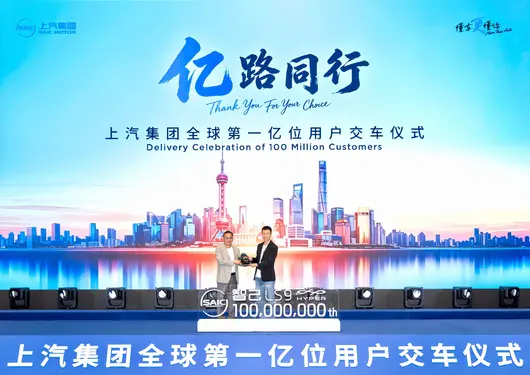

In Australia, the Philippines, and South Korea
after Thailand, Singapore, and New Zealand
The Model Y L produced at the Shanghai Super Factory
Malaysia 🇲🇾 has also kicked off its first batch of deliveries 👏
Why do people around the world choose it?
Safe, intelligent, easy to drive, easy to use, good-looking, and money-saving ⚡️


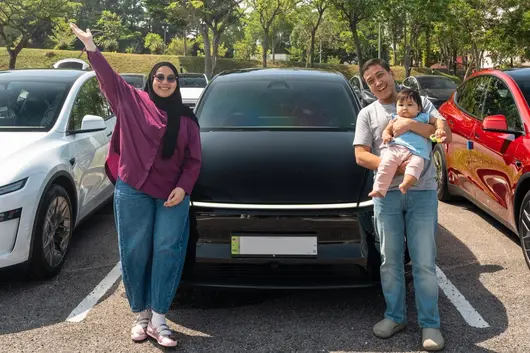
On November 15, 1977. A customized gas-powered Fairmont Futura rolled off the line at the New Jersey plant. This was Ford's 100 millionth vehicle produced in the US. Under the pressure of the CAFE mandate, the influx of Japanese cars, and controversies over excessive cost-cutting, Ford decided not to sell this car. Instead, it used it to kick off a cross-coast tour to celebrate.
When the Detroit Three and Toyota were staging a showdown of the century in the world's largest auto market, a bold idea appeared on the banks of the Huangpu River, 11,460 kilometers away. The accumulation of handmade Phoenix sedans became the momentum for Shanghai-brand sedans entering a steady development phase. Even with an annual output close to 3,000 units, this still could not meet the soaring demand. The concept of adopting Ford's assembly line operations for China's sedan production was brought back to the agenda.
Joint venture cooperation with transnational automakers became the most realistic option. Across the domestic automotive industry, there was only one place capable of mass-producing sedans and having an assembly line: Shanghai. Next, the story of China's auto industry entered the SAIC Volkswagen (now known as: SAIC Volkswagen) era. Amidst the acclaim of "driving a Santana anywhere is safe", transnational car companies rushed to China to seek fortune. The craze of sedans entering ordinary households caused the world's largest auto market to shift accordingly. After the fierce competition of the fuel vehicle era, the machine changing the world gradually switched to the smart-electric track.

On the afternoon of May 28, 2026. Inside the World Living Room of North Bund, Shanghai. SAIC Group Chairman Wang Xiaoqiu handed an IM LS9 Hyper exclusive custom model to Momenta CEO Cao Xudong. Applause erupted, they shook hands, and SAIC Group's 100 millionth vehicle delivery was frozen in time. Over 70 years of vehicle building journey converged in the giant waves of Shanghai's new era, making SAIC the first Chinese vehicle group to enter the global 100 million-level auto camp: Leading the charge at the forefront of the tide.
In January 1997. Toyota welcomed its 100 millionth car after 50 years. Cross Ford's assembly line operations, Toyota used its unique lean production method to pull the efficiency of the fuel vehicle era to the peak. In the shadow of the Heisei recession and the Asian financial crisis, Japanese cars completed the disassembly of the Euro-American auto myths. Amidst a chorus of praise, Toyota did not indulge in the steel dividends piled by 100 million fuel vehicles. Less than 10 months later, Toyota shocked the world again. The Economist wrote at the turn of the century: When Detroit was still obsessed with the roar of large-displacement SUVs, this Eastern automaker knocked on the door of green and low-carbon early with the Prius.
Now, SAIC IM LS9 Hyper is accelerating the transformation of the auto world with a Chinese way. This car is equipped with the next-generation Star Super Extended-Range Power System, the next-generation Full-Line-by-Wire Four-Wheel Steering System, and the next-generation Intelligent Driving Technology. Every item points to the highest standards of the next generation of electric vehicles. It is both the culmination of SAIC's 70 years of vehicle building foundation and technology, and more importantly, a declaration of China's new energy to the auto world. If the Prius was a gentle reform of the fuel vehicle order, then SAIC IM LS9 Hyper is a breakthrough reshaping of the global automotive gravitational field. Chinese Academy of Engineering academician Wu Wangxing said that LS9 Hyper implants China's original endogenous safety system into the car, which is a very important highlight moment for the whole world: it is the flagship benchmark for the Chinese automotive industry entering the "Fourth Generation Electric Vehicle" era.

Looking back, from a golden phoenix hatched from a grassy nest, to SAIC Volkswagen taking root in Anting, to SAIC GM rising in Pudong, MG, Roewe, IM, Wuling, Baojun, Maxus, etc. have become the backbone of independent brands, Shangjie and Huajing are forging new roads for vehicle building; from fuel vehicles to pure electric; from passenger cars to commercial vehicles; Shanghai's open-mindedness that accepts hundreds of rivers has made SAIC Group different: no technical walls, no ecological islands.
In May 2005. With a silver Touran rolling off the production line, Wolfsburg's 100 millionth car pushed the Volkswagen brand to the 100 million automobile brand club. It is the highest harvest of human mechanical manufacturing system on hardware replication consistency. The golden age of China's automobiles provided even richer dividends for Volkswagen. Crossing the threshold of 100 million automobile scale has never been in the soil of coincidence. In the slice of auto history, it corresponds to three hardcore indicators: anti-risk ability in the face of external changes, industrial consistency under a modern manufacturing system, and strategic agility.
20 years later, these three hardcore indicators welcome a redefinition of smart electrification. Entering 2026, the new energy penetration rate of China's auto market continues to climb. Among them, the penetration rate of passenger cars in April broke through 60 percent for the first time. Standing at the new starting point of cumulative 100 million vehicles, SAIC Group has demonstrated strategic agility in capability output to the global auto market.

This May, SAIC Group's vehicle sales reached 349,000 units, continuing to hold the top position in the industry. In the first five months, independent brand cumulative sales reached 1.173 million units, up 8.6% year-on-year; new energy vehicle sales reached 595,000 units, up 13.2% year-on-year; overseas market sales reached 589,000 units, up 45.9% year-on-year. Independent joint ventures, passenger and commercial vehicles, domestic and overseas working in the same direction, promoting SAIC to continue upward while navigating the cycle.
It is worth mentioning that SAIC's joint venture new energy sector also welcomed new growth points. Joint venture new energy made a strong comeback in May. SAIC GM's new energy vehicle sales in May reached 13,000 units, up 75% year-on-year, with Zhijing E7 deliveries breaking 10,000 in its first month after launch. SAIC Volkswagen's new energy vehicle sales in May reached nearly 10,000 units, up 34.3% year-on-year; the newly launched ID.ERA 9X cumulative deliveries exceeded 7,000 units.
SAIC GM Buick's Series 7 models adopt the locally self-researched Xiaoyao Super Architecture, with the Zhenlong Hybrid Power System. From the three-electric system to high-level intelligent driving with LiDAR redundancy, the underlying R&D logic is realized through localization. SAIC's technology output allowed the Buick brand to be reborn. SAIC Volkswagen's flagship SUV model for the Volkswagen brand, ID.ERA 9X, and Audi's AUDI E7X, are all aggregating global resources and precisely customizing for Chinese users' smart-electric needs.
At this year's Greater Bay Area Auto Show, the AUDI E7X officially launched with a starting price of 269,800 RMB, becoming a new answer for BBA solving the China puzzle. With the dense landing of these models, the cooperation between SAIC Group and General Motors and Volkswagen has completed a transgenerational transition from introducing technology to joint development, to the current "Joint Venture 2.0". Volkswagen's 100 million units in 2005 was built on the fuel dividends of 23 million Golfs and 13 million Passats, erecting the peak of hardware replication consistency.
SAIC Group's 100 million units in 2026, one of its most core contents, is through its own technology and architecture output, restructuring the cooperative division of labor of joint venture brands. This has become the optimal solution for transnational automakers to establish themselves in the Chinese market. This round of new energy transformation in the global auto industry is stormy with uncertainties. Holding the trump cards of technology, SAIC has gradually established a position as a rule maker in the future smart-electric era: Ignore the sound of wind and rain through the woods; why not chant aloud and walk leisurely?
In September 2024. After 57 years of building the factory, a Hyundai IONIQ 5 produced at the Ulsan plant pushed its production record to 100 million. This is the Han River Miracle, a new narrative in the history of the world auto business. The Hyundai Motor Group, therefore, became one of the most globalized automakers. After the export volume of Chinese automakers climbed to the scale of 8 million units, Korea and Japan's auto export records were rewritten. The example of Hyundai and Toyota advancing globally has a new protagonist.

On May 30, 2026. After SAIC Group stood on the first 9-digit delivery volume, the first user of the next 100 million appeared in the UK. London doctor Natalia exchanged her grandfather's MGB from memory for the new generation MG4 EV Urban. The ticking pointer brings a new story. In Shanghai Pudong, in Jakarta, Indonesia, in Lantian, Shaanxi, in Singapore DHL Supply Chain Advanced Regional Center, in Taiyuan, Shanxi, in Hechi, Guangxi, the delivery of 15 brands under SAIC Group is laid out by the second.
Along with the alternating pictures on the screen, SAIC Group's Glocal strategy extends a new outline. It is no longer traditional commodity foreign trade and one-way export of products, but using the whole value chain's Chinese smart-electric core to comprehensively fit the specific lives of different global time zones: Every car of SAIC must turn China's best intelligent technology into steady happiness within reach for every family in the world.
In Oceania, MG's small cars rank at the head of the niche market; in Thailand, MG has become the most stable growing Chinese brand; in 7 countries of South America, MG's sales are approaching the 10,000 unit mark; in Europe, MG has held the European sales champion of Chinese brands for 11 consecutive years, and is also the first Chinese automobile brand with sales breaking 1 million.
In the first five months of this year, cumulative sales exceeded 150,000 units, up 20% year-on-year, continuing to lead Chinese brands. The glory of 100 million+, rushes forward along the Huangpu River. In London's rain, in Bangkok's sunset, in the waves of the Suez Canal, in every corner where Chinese smart-electric solutions take root, it is a new answer sheet of a more international SAIC Group: Stars hang low over the vast plains; the moon surges with the flow of the great river.


On May 28, SAIC Group held the "Global 100 Millionth User Delivery Ceremony" at the North Bund World Living Room in Shanghai. How grand was this event? More than ten vehicle brands and nineteen car models under SAIC Group relayed from Shanghai all the way to Nanjing, Liuzhou, Taiyuan, and even crossed national borders to the UK, Indonesia, and Singapore – all live globally. But upon closer inspection, the "starting whistle" for all this was blown by two Shangjie units.
The 999,999,996th and 999,999,997th units cumulatively delivered by SAIC Group were both Shangjie brand vehicles.

Two cars, an electric purple-pink Shangjie Z7 and an amber gold-green Z7T, were personally handed to two young owners by SAIC Group Chairman Jia Jianxu. The numbers themselves are worth mulling over – falling short of 100 million units, just three or four steps away. In other words, the moment all eyes focused on Shangjie, the milestone of 100 million units was just behind a sheet of paper.
This is obviously no coincidence.

SAIC leaving such an important "pre-billion night" to Shangjie sends a very clear signal: This brand is not just a casual endeavor. It is a true "deep interlock" between SAIC and Huawei – not a brand sticker or shell fitting cooperation, but a collaboration where both teams worked together from underlying R&D to production line planning, from three-electric architecture to intelligent driving solutions.
Now, all of these assets are bet on Shangjie. SAIC Group's attitude is very clear, the most mature production lines, the best technology, the best talent, "All in Shangjie".

Why the effort? Because with new energy penetration rates already reaching 60%, SAIC needs a brand capable of tearing open a gap in the mainstream market. Zhiji targets the high-end, Roewe and MG have their own positions, but the biggest and most competitive cake between 150,000 and 250,000 lacks a truly capable role. Shangjie is that role.
And Huawei's addition completes the final piece of the puzzle. Huawei Qiankun Intelligent Driving, HarmonyOS Cockpit, Smart Mobility Solutions – placing these tags into the mainstream price range makes a different impact. Not to mention, just look at the expressions of those two young people receiving keys at the delivery site, and you know this combination punch hit the right spot for someone.

Before delivery of the Shangjie Z7 and Z7T, 1,300 vehicles participated in testing, cumulatively driving 11 million kilometers, from the freeze of Mohe to the roast of Turpan, from the Tibetan Plateau into the Hainan rainforest, leaving tire marks in 75% of the province within the country. The body uses 91% high-strength steel and aluminum alloy, 14 places of 2,000 MPa hot-formed steel – at this level, few dare to compare the numbers on the table. Even the car paint was not sloppy, collaborating with the WGSN Color Institute to create 10 trending colors, not decided on a whim, but finalized after truly pondering what tone young people want.
More critically, it's the pace. After the Z7 series opened large pre-orders, relying on SAIC Group's manufacturing strength, production capacity is already ramping up, and bulk delivery can begin by the end of May. From order to delivery, there were no delays. This speed relies not on slogans, but on the entire manufacturing system supporting it from behind.

Back to the number of 100 million units. It is certainly huge, huge enough to be abstract. But if you break it down – the 999,999,996th and 999,999,997th units were Shangjie,
SAIC handed over the "last kick" of 100 million units to Shangjie. Delivered were not two cars, but an attitude: On the road to the next 100 million units, Shangjie must lead the way.
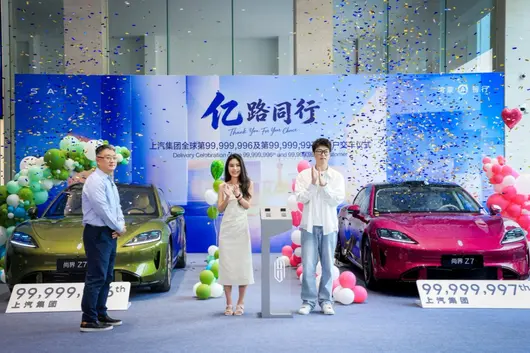


Another historic moment in the Chinese automotive industry was frozen in Shanghai! — But the real highlight of this ceremony was not the numbers themselves, but how SAIC handed the "stage" over to users.
On May 28, 2026, at the World Living Room, Shanghai North Bund. When the IM LS9 Hyper drove onto the stage as the 100 millionth vehicle produced by SAIC Motor, this constantly running Chinese automotive group achieved an unprecedented accomplishment in the history of the Chinese automotive industry: cumulative production and sales officially exceeded 100 million units.
Undoubtedly, this is a number worth recording in industry history. But what deserves more attention from the outside world is the presentation method of this delivery ceremony.As the "pioneer" among Chinese car companies to first achieve this accomplishment, SAIC left a sample for all subsequent car companies that have not yet "crossed the line" with a creative delivery ceremony.
Ten-plus complete vehicle brands, nineteen car models, fifteen delivery nodes, relayed live across Asia and Europe, constitute a phenomenon-level roadshow centered around the "full value chain". In the current situation where the Chinese automotive industry is generally trapped in anxiety over single product blockbusters, SAIC instead turned this ceremony into the best expression of systemic capabilities.
And the ultimate direction of systemic capabilities has never been about how strong the enterprise itself is, but what the user feels. The true innovation of this delivery ceremony lies precisely in transforming "systemic confidence" into a narrative experiment led by the user.
From Single Product Explosion to System Stability: SAIC's "Long Road of Struggle"
In the past few years, the most familiar successful model in the Chinese automotive industry has been "blockbuster driven": a certain car selling over 10,000 units, a certain technology debuting first, a certain press conference dominating the feeds, almost constituting the KPI for all car companies' communication work. Admittedly, this narrative logic was extremely effective during the window period of new forces rising; it amplified the dramatic nature of single-point breakthroughs and allowed consumers to quickly establish cognitive recognition of new brands.
However, entering 2026, the industry rules have quietly changed. The new force dividend period is nearing its end, the marginal effect of single-point breakthroughs is diminishing, and more and more car companies are finding that having blockbusters alone cannot save the overall downward slide of the sales curve, and talking only about technical parameters is hard to move increasingly calm consumers anymore.

SAIC's delivery ceremony at this juncture happened to land exactly at this node. It did not focus the spotlight on a certain new car, nor did it explode topics by relying on a single celebrity endorser, but used a "family portrait" of nineteen car models, ten-plus brands, covering price tiers from 50,000 to 500,000, covering passenger and commercial, covering domestic and overseas, presenting a complete industrial cross-section to the outside world.
When the IM LS9 Hyper appeared at the main venue, Huajing S was delivered in Liuzhou, MG4 EV Urban was delivered in London, Maxus eDeliver 5 was delivered in Singapore, Hongyan i Jieshi was delivered in Taiyuan, Yuejin Danna T1 was delivered in Yangzhou. The strong signal SAIC wanted to convey to the outside world — delivering 100 million units based on strength was already very clear.
A car company capable of mobilizing so many brands, so many categories, and so many overseas nodes to complete relay delivery today, and able to let the industry see actual results landing, there is only one in China — SAIC Motor.


Behind this, in addition to the rising independent brands, SAIC's joint venture brands that were painstakingly cultivated also played a key role in this ceremony.
Volkswagen ID.ERA 9X, AUDI E7X, Cadillac Kaiwei De, Buick Zhijing E7, Buick Zhijing Shijia appeared collectively. When joint venture models and independent models shared discourse power on the same delivery stage, the outside world saw a more diverse SAIC.It is both the initiator of joint venture cooperation in the fuel vehicle era, the output provider of new energy intelligence technology at present, and the integrator of global technical platforms.
For all Chinese joint venture car companies undergoing the transition of "Electrification + Intelligence" and currently seeking solutions, this is undoubtedly a timely and persuasive answer.
In fact, behind the breakthrough of 100 million new car deliveries of SAIC Motor, besides the main track of passenger vehicles, commercial vehicles are also a key "paving stone". This silent cornerstone filled the last piece of the puzzle in SAIC's layout of complete vehicles. Names of bulk users such as DHL, Jiading Bus, Henglong Sheng Industry and Trade, Di Shang Tie appearing at the main venue means SAIC is willing to leave a position for commercial business in the highest specification communication event, telling everyone that SAIC Group's comprehensive layout and system narrative focus on balance without bias.
Handing the stage back to users: What did this ceremony get right?
If defined in one sentence, this one hundred million vehicle delivery ceremony should be: it is not a press conference, but a "flowing history public class" with users as the protagonist and global relay as the form.
Traditional automotive industry milestone activities are often "enterprise shows" of leader speeches, product presentations, and data displays. But SAIC this time completely subverted this inherent mode. Starting from the main venue at the World Living Room, Shanghai North Bund, connected to domestic multi-cities and overseas delivery sites such as the UK, Indonesia, Singapore via Oriental TV global live broadcast, crossing the Asia-Eurasia continent, spanning multiple time zones, completing a truly meaningful "decentralized" relay delivery.
The core innovation of this ceremony lies in three "Firsts":
First, let users become the absolute protagonist. The 100 millionth user was Momenta CEO Cao Xudong — the setting of "Partner turns into Car Owner" expanded the concept of "User" from consumers to ecosystem partners; the "Ten-Year Trust Agreement" of two generations of Roewe owners, London intern doctor Natalia inheriting her grandfather's MG sentiment, post-85s Village Secretary Pang Fuqiang delivering food for left-behind elderly people using Wuling Rongguang... Behind every delivery action was a true life story. SAIC did not arrange any leader's long speech; all time was handed over to the "delivery" core action and user narrative behind the delivery.
Secondly, replace "centralized stage" with "global relay delivery". From 99,999,996th to 100,000,013th "relay delivery" created real-time suspense and participation; users of different skin colors, different languages, different models appearing successively under the same theme constituted a brand communication event with great impact. This "decentralized" ceremony design has no precedent in Chinese car brands.
Third, define the delivery ceremony itself as "content". Ceremony is news, is communication. SAIC did not rely on traditional press releases, but let the images of global relay, users' true emotional resonance, and the visual spectacle of full category stage presence become the most communicative content themselves. This pioneered a new narrative method of integration between Chinese car brands and media — from "What enterprise says, media writes", to "What media and users jointly witness, what moves them".
The underlying logic of this ceremony is the concentrated fulfillment of SAIC's "Knows Cars and Knows You Better" user concept: not the enterprise standing in the center of the stage telling users "how strong I am", but inviting users onto the stage, letting the world see "how far we have walked together".100 million vehicles is not a cold industrial number, but the total temperature of 100 million trusts. This activity creativity centered on users, with emotional resonance as the core, and global relay as the form, left a "SAIC Sample" with great reference value for how Chinese car brands should do milestone communication.
More Difficult than Delivering 100 Million Vehicles is the "Sustainability" of System Growth
Behind this grand new car delivery ceremony, the author believes that the truly scarce place in SAIC's "100 million milestone" lies in the "sustainability" of system growth.

In fact, SAIC's legendary car making story began with the breakthrough from zero to whole, and was formed through strategic maneuvering and open cooperation.
From the establishment of Shanghai Internal Combustion Engine Parts Manufacturing Company in 1955, to the successful trial production of Phoenix sedan in 1958, to the manual assembly and delivery of the first Santana in 1983, 23 months factory construction and vehicle production by Shanghai General Motors in 1997, 2006 Roewe birth, 2016 Roewe RX5 opened the internet car era, 2020 IM Motors establishment. Every node on SAIC's timeline corresponds to an industrial upgrade of the Chinese automotive industry.
Nowadays, this continuous "startup" already belongs to "rare assets" in the current Chinese automotive industry.
Most car companies either start from joint ventures, or start from new forces, or start from a certain major transformation. But there are few leading enterprises that can tell the complete development story of "from nothing to something, from weak to strong" in the independent and joint venture dual lines with technology, brand, products, and even more subdivided behind them.SAIC's 70-plus years of development history, condensed, is almost a development history of the Chinese automotive industry, and it is precisely this point that constitutes the heaviest historical footnote of the 100 million new vehicle delivery milestone.

Among them, the historical node that determined SAIC's big stride towards the "Electrification + Intelligence" transformation was the crucial year 2014. That year, when senior leaders investigated SAIC's development, they clearly proposed the general policy of "Developing new energy vehicles is the only way for China to move from an automotive giant to an automotive power". This general policy was deeply understood and put into action by SAIC senior leadership, and SAIC immediately launched a comprehensive new energy transformation. This thus opened the prelude to SAIC Group and even the national automotive industry "changing lanes to overtake".
12 years later in 2026, SAIC officially welcomed the user delivery of the 100 millionth new car globally. Behind this, the efforts SAIC made and the results achieved in the new energy sector can be said to be world-renowned.
Looking back 12 years ago, new energy transformation had not yet formed a consensus in the domestic industry circle. Disputes over technology routes, changes in subsidy policies, and shallow market acceptance made many companies hesitate on the transformation rhythm.SAIC decisively chose this path of early transformation. Its R&D investment, capacity layout, and the establishment of innovation systems have always been at the forefront of the industry.
Sprinting in the new energy track has achieved SAIC Group leading today in the intelligence and electrification new era.
Latest data shows that from January to May 2026, SAIC Motor achieved cumulative complete vehicle sales of 1.651 million, continuing to firmly stay at the industry head. Among them, independent brands January-May cumulative sales 1.173 million, year-on-year growth 8.6%, the proportion of group total sales broke 70% for the first time, reaching 71.1%; new energy vehicles January-May cumulative sales 595,000, year-on-year growth 13.2%; overseas market January-May cumulative sales 589,000, year-on-year surge 45.9%. Independent, new energy, and overseas working together simultaneously, pushing SAIC to continue upward during cycle crossing, and also writing a powerful footnote for the new journey after the 1st hundred million delivery. These numbers answer the question of whether long-termism can still run faster in the Chinese automotive industry.

In addition, another supporting point of SAIC's strategic determination comes from its deeply internalized global layout. Over 100 parts production bases overseas, over 3,000 dealer networks, 4 overseas production centers, and Anji Logistics with 42 own roll-on roll-off ships. Most of these assets were not formed suddenly in the past two or three years, but the result of continuous investment over the past ten years or even twenty years.
And from the brand side, MG won the Chinese brand sales champion in Europe continuously for 11 years. In 2025, annual sales in Europe broke 300,000 units. In March 2026, MG released SolidCore semi-solid-state battery and Hybrid+ hybrid technology at Frankfurt, marking that SAIC's globalization logic switched from "product going global" to "technology and value chain output". Without over ten years of local operation accumulation, this switch cannot be accomplished.
In addition, the 100 millionth user SAIC chose is just its current most dazzling supply chain partner Momenta CEO Cao Xudong. Giving the milestone user role to the founder of a intelligence driving technology company, the signal SAIC wants to convey is very clear, that is, SAIC does not understand "User" narrowly as consumers, but includes ecosystem partners together into the user ecosystem.
And this posture can also be seen as a continuation of the Shanghai-style cooperation culture foundation established by SAIC since the Santana localization community period: Open, Co-creation, Mutual Foundation.In the current industry more inclined to "Vertical Integration" and "Full-Stack Self-Research", SAIC chose to take down the technology walls, letting partners become part of the community. Alone you go fast, together you go far. The truth of this seems to become even more weighty on this 100 million milestone commemoration.
Final Thoughts:
In this milestone event that can be called a grand event of Chinese automotive industry, the 100 million new car delivery achieved by SAIC, although it is a specific number, but the meaning it possesses in the entire industry cannot be summarized by a specific measurement.
And behind the achievement of delivering 100 million new cars, SAIC, like other Chinese automotive enterprises, is also facing new questions. In new competition dimensions, whether able to mobilize full categories, whether able to cross passenger and commercial, whether able to integrate domestic and overseas, whether able to let joint venture and independent coordinate under the same roof, will become a new ruler to measure car companies' real strength.
For SAIC itself, delivering the 100 millionth new car is just a stage answer, and also a new starting line. The market after 2026 will not be exceptionally tolerant of it because of this number, but for SAIC itself, it also does not need "special treatment", but strives to prove through this ceremony, this Chinese automotive leading enterprise that has walked for over 70 years, still maintains the strategic determination of open cooperation, and still has the practical ability to transform strategic intent into industrial action.


On May 28, SAIC Motor completed the global 100 millionth new vehicle delivery ceremony, becoming the first automotive manufacturer in China to break 100 million in sales. From the establishment of the Shanghai Internal Combustion Engine Parts Manufacturing Company in 1955 to 1958, workers hammered out the first "Phoenix" brand sedan off the production line. Having gone through more than 71 years of development, SAIC Motor now possesses more than 10 whole vehicle brands, with products covering categories from sedans, SUVs, MPVs, to commercial vehicles.

From January to April 2026 alone, SAIC's cumulative sales reached 1.302 million units, ranking as the sales champion among Chinese automakers for four consecutive months. Among them, independent brand sales were 910,000, accounting for nearly 70%; new energy vehicle sales were 412,000; overseas market sales were 459,000, a surge of 50.2% year-on-year.

As a pioneer among Chinese automotive enterprises in "going global," SAIC Motor owns more than 100 parts production bases and more than 3,000 dealer networks overseas, having built 3 major R&D innovation centers including London, and 4 production and manufacturing centers in Thailand, Indonesia, India, and Pakistan. Today, SAIC's products and services are distributed in over 170 countries and regions, with cumulative overseas sales breaking 7 million units.

At the delivery ceremony site, the 100 millionth vehicle model delivered was the flagship SUV — IM Motors LS9 Hyper — which was delivered to the 100 millionth user, Momenta CEO Cao Xudong.

The new car is equipped with full line-by-wire four-wheel steering, a 520-line LiDAR + NVIDIA Thor chip, providing L3 level hardware capabilities. In addition, the new car is built with a whole-domain 800V architecture, adopts an extended-range electric system, and can achieve a 0-100 km/h acceleration in 3 seconds.

At the delivery ceremony site, all SAIC brands and the entire product matrix coordinated their efforts. Independent brands went all out: Shangjie Z7, Huajing S, Roewe M7, MG4 Semi-Solid State Battery Edition, Wuling Starlight 560, Maxus eDeliver5, Hongyan Heavy Truck, Yuejin Dana T1, Sunwin Pure Electric Bus, Iveco Juxing EV, etc., were delivered successively, covering multiple scenarios such as personal travel, family life, commercial operations, and logistics transportation.


Joint venture brands concentrated on displaying "Joint Venture 2.0" achievements: Volkswagen ID. ERA 9X will debut globally equipped with Momenta R7 Reinforcement Learning World Model, delivering over 7,000 units within one month of launch.

Audi E7X plans to become the first Audi model globally to implement L3 level autonomous driving; Buick Zhijing E7 is built based on the "Xiaoyao" Super Fusion Architecture, delivering over 10,000 units within one month of launch.

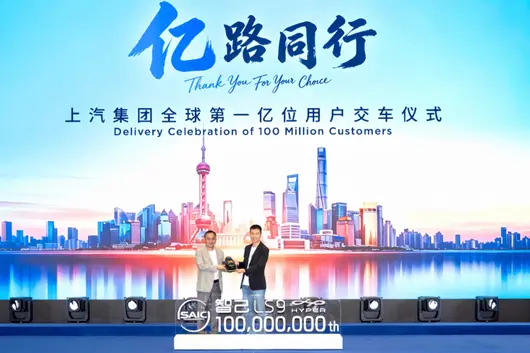

[June 13th], Beijing Off-road Honored Owners Collective Delivery and 618 Group Buying Event was grandly held at Beijing Off-road Changde Huashengda 4S Store. The center completed centralized vehicle delivery for Beijing Off-road owners on site, jointly starting the journey of glory. Owners left their exclusive marks on the sign-in wall, received keys symbolizing glory, with confidence and joy on their faces. Ms. Li, who participated in this centralized delivery, stated: Choosing Beijing Off-road means choosing a lifestyle. Today I received this special delivery ceremony, feeling the brand's dedication.

Owner Mr. Liu said on site: It is a great honor to become a Beijing Off-road owner, and I am more grateful for the delivery ceremony carefully prepared by Beijing Off-road. The product strength and trade-in policy of BJ30 moved me very much. The service in the store was also very professional and thoughtful. From entering the store to picking up the car, every link was smooth. Looking forward to exploring broader horizons with car friends in the future.

As the model that fastest reached 150,000 units in China's light off-road SUV category. BJ30 Traveler relies on Beijing Off-road's more than 60 years of professional accumulation, with hardcore strength of super off-road, super large, and super fuel-saving, making the world see China. To further promote off-road equity and allow more families to enjoy light off-road life, the BJ30 Traveler series launched a 30,000 yuan trade-in policy, with super trade-in price starting from 69,900 yuan.

"Super Off-road" is the confidence to start. Beijing Off-road built an industry-leading "Three-Engine Four-Wheel Drive Six-Mode HEV Hybrid Architecture" and applied it first to BJ30 Traveler, becoming the first HEV hybrid model in the Chinese Box-style SUV category. Three-engine power consists of a 41% thermal efficiency hybrid dedicated engine, front drive motor and rear drive motor, each good at long-distance energy saving, real-time replenishment and instant burst; Intelligent four-wheel drive response speed reaches 30 milliseconds, 0.5 seconds to explode peak torque. Six modes can automatically select the optimal working method, power is always in the best state. Coupled with energy center lock, four-wheel electronic limited slip and smart electric ATS all-terrain control system, easily cope with mud, sand and other scenes.

"Super Large" is the calmness of travel. BJ30 Traveler has three-row seven-seat layout, with 2820mm super long wheelbase, 66% super high space utilization rate, and 1496 liters super large trunk, rear row pure flat fold down seconds into 1.92 meters big bed. B-class Box-style super wide third-row space, let 1.8 meters adult sitting still spacious. Whole car 38 storage spaces, personal items have exclusive positions. Whole family travel freedom, everyone does not compromise.

"Super Save" is long-term companionship. BJ30 Traveler achieves saving money, saving time, saving worry. Recently, car bloggers from five countries including South Africa, Indonesia, UAE, Poland, Mexico, tested the fuel consumption of domestic SUVs, BJ30 Traveler ran a result of not exceeding 5 liters per 100 kilometers in every country, one tank of fuel range more than 1,000 kilometers. No need to find charging piles, refueling and go, saving dozens of hours of energy replenishment time every year. At the same time, the first owner enjoys whole vehicle lifetime warranty, no high-voltage battery pack safety hazards, maintenance is simple and parts are sufficient, making every departure worry-free.

BJ30 Traveler is both a Box-style that can take you to the mountains and a city commute SUV that can let you enjoy life comfortably. Light off-road SUVs are all alike, BJ30 Traveler is one in ten thousand!