首頁Chase

搜尋歷史
熱門搜尋
經銷商登入 / 註冊

Recently, JPMorgan released a 58-page "China Auto Industry 2027" report, which was recently circulated wildly in the automotive community. It didn't offer positive vibes to the China car market, but instead poured cold water: domestic passenger car retail sales in 2027 might continue to decline, the price war isn't over, and European tariffs and non-tariff barriers are lining up at the door. More heart-wrenching is that the report downgraded ratings for BYD, Geely, Xpeng, and Leapmotor, yet still said BYD is the toughest fighter. Contradictory? No—the second half of the car market competition isn't about who sells more, but who can still make money and retain cash flow. This article only deconstructs the report logic and does not constitute investment advice.

1. A Drop in Sales Isn't the Worst Pain
First, look at demand. In the report model, passenger car retail sales will be about 24 million units in 2025, possibly dropping 21% to 18.96 million units in 2026, and dropping another 5% to 18.01 million units in 2027. The wholesale side, supported by exports, will drop 5% in 2026 and only 1% in 2027. These numbers act like a knife, slicing open "hot production" and "cold consumption": factories can support wholesale via exports, but if domestic consumers don't spend, terminals will continue to squeeze water. JPMorgan provided two scenarios: if the government continues stimulus, sales remain roughly flat; if subsidies phase out, sales drop about 5%. The base forecast assumes policy support, but analysts remain cautious. My judgment is that in 2027, what to watch most isn't "new models launched", but the speed of capacity clearance. If capacity doesn't decrease and demand doesn't rise, inventory will become stones pressing on dealers and automakers. Sales decline is just a symptom; overcapacity is the root cause.

2. Price Wars Thin Profits
The profit picture looks even worse. The report estimates that actual transaction prices still average a 15%-16% discount relative to guide prices, though slightly lower than the 17% high point in the first half of 2025, it is still "hard discounts trading price for volume". More troubling is that new models, smart driving, and cabin chips require continuous burning of cash. As selling prices go down, R&D and marketing go up, revenue growth and profit growth decouple. JPMorgan added another blow: DRAM and NAND prices might rise over 20% in 2027; the deeper the intelligence, the more sensitive automakers are to memory chips. As of the report release, market profit forecasts for China's auto industry have been adjusted down over 40% this year, but JPMorgan's profit forecasts for 2026-2027 are still 10%-11% lower than consensus. Translation: Everyone has already cut once, but it thinks another cut is needed. Dealers shouldn't hide either; inventory turnover relies on short-term loans. Slow sales, falling prices mean a double blow to cash flow and inventory value. Price wars today aren't about who is cowardly who loses, but who collapses the income statement first.

3. European Tariffs Are Just Appetizers
Overseas markets are the growth engine and also a new minefield. China brands' market share outside China surged from 1.5% in 2020 to 8.2% in the first seven months of 2026; overseas PHEV share is about 44%, pure electric 23%, and HEV about 5%. This achievement is fierce, but Europe has started to ramp up pressure: countervailing taxes on China-made pure electric vehicles started in October 2024, and JPMorgan expects trade defense might expand to PHEV by the end of 2027. After mid-2027, relevant entry requirements for the "Industrial Accelerator Act" will gradually take effect; localization production, procurement, minimum selling price, and quotas might all be put on the table. Export VAT refund adjustment adjustments were also listed as risks, but the report explicitly stated they were not officially announced at that time. The solution isn't continuing hard exports, but localization: BYD bets on Thailand, Brazil, Hungary; Geely leverages partners; Leapmotor uses the Stellantis network; Chery deploys Malaysia, Spain, Brazil. My view: Going overseas moves from "selling cars phase" to "building factories phase". Whoever can land supply chain, compliance, and costs together will have a second growth curve.
Conclusion: The harshest part of this report isn't forecasting another 5% drop in sales for 2027, but dragging the industry valuation anchor from the "sales list" to the "income statement". If anti-involution only targets low prices without solving overcapacity, price wars will return in disguise. 2027 is worth watching for four things: whether terminal prices can stabilize, whether capacity can truly clear, whether Europe localization can be delivered, and whether automakers' cash flow can withstand. Don't rush to pop champagne; first see who can still keep their pants on when the tide recedes.

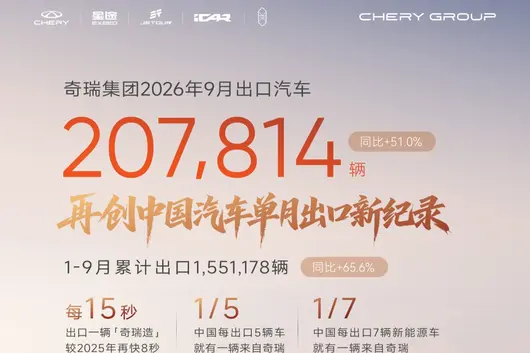
When the domestic car market is deeply stuck in stock competition, the incremental logic of Chinese car companies is being rewritten. Chery Group's "double breakthrough" report card for September, not only refreshes the single-month export record of China's automotive industry, but also unusually received capital endorsement from international investment banks.
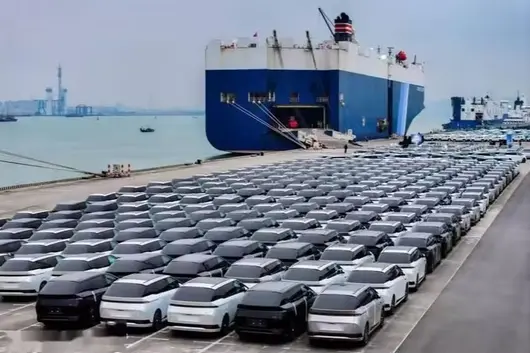
 Data shows, Chery Group's single-month export volume reached 207,814 vehicles in September, a year-on-year increase of 51%. This means, in the just passed month, on average every 15 seconds, a car bearing a Chery badge drives overseas. What is more worth noting is, cumulative exports from January to September reached 1,551,178 vehicles, this figure has surpassed its total export volume for the whole year of 2025, a cumulative growth rate of 65.6% appears particularly noticeable in the current macro environment.
At the end of September, JPMorgan released a research report, covered Chery Automobile for the first time and issued an overweight rating, listing it as the preferred target for Chinese passenger cars. In the capital market, ratings backed by real money are often more persuasive than companies talking to themselves. The core reason given by JPMorgan is, Chery's overseas business has evolved from pure trade exports to the local operation stage, and formed a scale-based profitability platform.
 A qualitative leap from going out to rooting down
For a long period in the past, the outside world's impression of Chinese car going overseas often stayed at cost-effectiveness and Asia-Africa-Latin America markets. But Chery's September report card is breaking this stereotype.
A representative one is the UK market. In September, Chery's single-month sales volume in the UK reached 32,823 vehicles, taking the UK monthly brand sales champion for the second consecutive month. In such a strict regulation, traditional automotive industry extremely mature European core market, JAECOO 7 topped the sales list of all models, JAECOO 5, OMODA 5 also made it into the top 10. In other words, for every 10 new cars sold in the UK, 1 comes from Chery.
This breakthrough is not an isolated case. Jan-Aug, Chery cumulative sales in 24 European countries reached 234,000 vehicles, year-on-year growth of 193%, among which new energy models account for nearly half and growth rate exceeded 3 times. Being able to achieve scale breakthrough in a high regulatory threshold market like Europe, indicates China car's competitiveness is no longer limited to price dimension, but truly touches the comprehensive competition of product power, brand power, and compliance capability.
 New Energy: From Overflow to Engine
Another change worth deep thought for the industry is the role conversion of new energy going overseas. Data shows, Jan-Sept Chery exports new energy vehicles 529,337 vehicles, year-on-year increase 136%. Currently, for every 7 new energy vehicles exported by China, 1 comes from Chery. Behind this proportion, is the collaborative overseas expansion of multiple new energy brand matrices such as OMODA & JAECOO, iCAR, Zhongheng. From Thailand, Malaysia to Saudi Arabia, UAE, Chery's new energy products are establishing segment advantages in markets at different levels.
JPMorgan specifically mentioned in the report, it is expected that Chery's new energy penetration rate and gross margin will increase significantly. This actually points out a breakthrough trend in the industry, new energy going overseas is turning from a channel for domestic capacity overflow, into the core engine for Chinese car brands to achieve high-end and intelligent image output.
 Industry Implications Behind Capital Favoritism
Looking at Chery's recent global actions, whether it is brand topping in the UK market, or 3 car models winning the Turin Design Award, or the investment in global top 10 styling centers and thousands of design teams, all point to the same direction: Chinese car overseas logic is upgrading from selling products to outputting brands and systems.
The positive ratings given by JPMorgan and other institutions, are essentially pricing this systematic overseas capability. When overseas business can contribute continuously growing revenue and profit, the valuation model of Chinese car enterprises needs to be re-examined.
From cumulative export volume first breaking 7 million vehicles, to single-month exports reaching a new high again, to obtaining preferred target certification from international capital, Chery's globalization path provides a new sample. In the big exam of globalization, the real moat is not a certain hit model, but the depth of local operations, the breadth of product matrices, and the adaptability to cross different market cycles.