首頁Changan CS55PLUS PHEV

搜尋歷史
熱門搜尋
經銷商登入 / 註冊

In four years, it has nearly multiplied tenfold. HEVs guard a market that doesn't "plug in".
New energy vehicles have taken center stage: In 2025, China's new energy vehicle sales reached 16.49 million units, penetration rose to 47.9%, becoming the absolute mainstay of the new car market.
Among them, the spotlight on hybrid technology is almost entirely on plug-in hybrids—According to the China Association of Automobile Manufacturers, PHEV (including extended-range) sales increased from 603,000 units in 2021 to 1.518 million in 2022, 2.804 million in 2023, 5.141 million in 2024, reaching 5.861 million units in 2025, nearly tenfold in four years.

Figure 1 Change in Annual Sales of China PHEV (Including Extended-Range) (10,000 Units)
Ordinary HEVs without charging ports are much quieter, yet they have not fallen behind. Without a charging port, people still vote with their feet—Behind this market is a group of users with quite clear needs: those without fixed charging conditions who want to save fuel but are unwilling to change their refueling habit.
HEV market potential is evident globally. According to a PW Consulting market research report 'Global HEV Market 2026', the global HEV market size is expected to increase from approximately 148.6 billion US dollars in 2025 to approximately 308 billion US dollars in 2032, with a compound annual growth rate of about 11%—In the global market where pure electric pace is slowing and energy infrastructure is uneven, HEV is turning from a 'transition solution' into a long-term route actively chosen by more automakers and users.

Global HEV Market Size and Forecast (2020-2032) | Source: PW Consulting 'Worldwide Hybrid Electric Vehicle (HEV) Market 2026'
For HEVs, without a charging gun as a 'backstop', every coordination between the engine, motor, and battery must be reliable. The most direct way to test this coordination is not to keep the car in the test track, but to drive it into real complex road conditions to show users.
Departing from Yudu: A Long-Term Test Leaving Issues in the Verification Phase
July 31, Yudu, Jiangxi, eve of August 1st Army Day. Sunwoda Power and Changan Automobile jointly participated in the 'Retracing the Long March' event initiated by People's Daily New Media. The 'New Hybrid, New Long March' domestic hybrid HEV reliability long-term test officially started, with the Changan Blue Whale Super Engine hybrid team equipped with Sunwoda Power HEV batteries setting off from here. The full distance is nearly 8,000 km. The route crosses high-temperature and humid river valleys, continuous steep slope canyons, high-altitude mountainous areas, plateau snow mountain grasslands, and plain intercity sections, completely covering the vast majority of complex scenarios users might encounter on long-distance travel.
Yudu is the gathering and departure point of the Central Red Army for the Long March—More than 90 years ago, 80,000 Red Army soldiers crossed the Yudu River from here and embarked on a 12,500-kilometer journey; Today, a hybrid team departs from the same county, to deliver another answer sheet.

In front of the Memorial Monument of the Central Red Army Departure for the Long March, the 'Retracing the Long March' team is ready to depart
The departure ceremony itself was not long, lasting about 90 minutes: After guest sign-in, speeches from both parties, and technical interpretation, it was the highlight of the event—Representatives from both parties presented the flag to the team, and all guests and media took photos in front of the cars; Horns honked to start, and the Changan Blue Whale Super Engine hybrid team equipped with Sunwoda Power HEV batteries drove out of the departure venue one by one, accompanied by invited media, technical experts, and KOL photography teams to witness. At the same moment the team left Yudu, real-time data recording for the entire journey began synchronously.

Sunwoda Power Brand Marketing Director Yang Jing
This is the second time both parties have publicly verified the reliability of hybrid products across all working conditions nationwide, following the previous 1,504 km single-tank fuel-saving limit test. At the beginning of the interview, Changan Automobile Brand Director Li Pan did not expect the team to have zero problems throughout, but hoped to fully verify problems during the process and solve them on the spot, so that in the future when they reach users, they would produce fewer problems.

On-site: Changan Automobile Brand Director Li Pan (Left) and Sunwoda Power Key Account Department General Manager Long Zhenjun (Right)
For the industry, this long-term test has another layer of significance—it is the first near-8,000 km level full-working-condition public verification carried out by the domestic hybrid industry targeting 'HEV Battery + Complete Vehicle', with the standard of 'Full Scenario, Full Working Condition, Full-Chain Traceable': Driving mileage, energy consumption, fault alarm and other data are recorded in real-time and retained throughout the journey.
For Sunwoda Power Key Account Department General Manager Long Zhenjun, the purpose is equally direct: Previously, various working condition tests were more professional data within the industry, and ordinary consumers find it hard to perceive intuitively; This long-term test is to turn laboratory data into real vehicle performance that users can see and are willing to believe. After the entire route test reached the end, both parties relied on the accumulated real driving data over the entire journey to intuitively present the long-term reliability performance of the hybrid system after driving through nearly 8,000 km of complex road conditions.
Why are Small Batteries Harder to Make than Large Batteries?

Changan Golden Bell Shield Blue Whale Super Engine Hybrid Special Battery
HEV batteries are easily underestimated because of their 'smallness'. The battery capacity installed this time is only 1.7 kWh, composed of 90 cells, and the PACK overall volume is only slightly larger than the traditional on-board 12V battery. But small does not mean easy.
General Manager Long Zhenjun repeatedly mentioned the working intensity of this battery: When starting and overtaking, discharge quickly; when releasing the accelerator, braking, or going downhill, recover the energy again. Small capacity, but the rhythm of energy ingestion and egestion is very fast, such cycles happen many times a day.

Battery Module High-Temperature Working Condition Test
A qualified HEV battery must pass at least three checks: First, high instantaneous power output—Matching cells can continuously output 60 kW power, power level is approximately equal to a 1.5-liter naturally aspirated engine, starting and overtaking are instantly available; Second, ultra-long service life—Cells must complete tens of thousands of charge-discharge cycle tests in the lab, keeping up with the vehicle's 15 to 20-year usage cycle; Third, full-domain wide temperature range—Extreme cold in the north, high temperature and high humidity in the south, must stably release rated power without compromising power.

Power Battery Safety Test: Bottom Impact, Nail Puncture Thermal Runaway, Bottom Irregular Scratch, Battery Pack Dynamic Soaking
Safety cannot be answered by a single parameter alone. Sunwoda Power starts from the cell, Changan stacked three layers of design at the complete vehicle level: Cells are arranged in a modular manner inside the car body skeleton, physically isolated from the passenger compartment; The battery area reserves 41% buffer redundancy to deal with bottoming and chassis impacts; The BMS system monitors the voltage and temperature of every cell in real-time, uploads to the cloud to complete an 'online checkup', automatically executes cell isolation and fault pre-processing after identifying abnormalities. Owners only ask one sentence 'Is it safe?', behind which two teams need to answer with many lines of defense.
Director Li Pan summarized Changan's requirements for the Blue Whale Super Engine Hybrid with 'Save, Power, Quiet, Stable': Saving fuel makes users willing to buy, power and quietness affect whether they are willing to drive every day, stability is being gradually certified.
The foundation of this system is Changan's self-developed hybrid architecture: The Blue Whale Super Engine Hybrid engine achieves an average thermal efficiency of 40.9% under comprehensive working conditions in user daily driving, with a multi-in-one electric drive comprehensive efficiency of 92.8%, paired with Sunwoda power battery supporting 50C high-rate charge-discharge, instantaneously releasing 80 kW peak power, reducing city fuel consumption to 2L class, 0-60 km/h acceleration is only 3.59 seconds; AI Cloud Intelligent Control System continuously learns combined with navigation road conditions and driving habits, making fuel consumption more and more saving whoever drives.
This battery is not 'new to the world'. Sunwoda Power HEV batteries have maintained the number one domestic installation volume for 5 consecutive years, ranked first in global installation volume in Q2 2026, global cumulative installed vehicle volume broke through one million units, and matched the China Automotive Technology and Research Center HEV High-Quality Battery Certification Standard. What does one million units mean? It means the 'Small Battery Large Power' scheme has been repeatedly verified under different climates and road conditions globally.

Battery Pack Low-Temperature Short Circuit Test (-20°C ±5°C)
Battery capacity also follows the logic of 'suitable' rather than 'larger'. HEVs do not have external charging ports, after power is used up, only the engine and energy recovery can recharge it; if the battery is larger, how to recharge quickly, how to avoid fuel consumption rebound, must be recalculated. 1.7 kWh is the specification determined after both parties jointly surveyed a large number of user needs. Sunwoda Power has simultaneously reserved 3 kWh, 5 kWh, 8 kWh multiple schemes, implemented in batches according to different sub-user usage scenarios.
A good-driving car requires the battery factory to enter from the definition stage
In Changan's HEV project, Sunwoda Power's work does not start from a purchase order and end with battery delivery. According to General Manager Long Zhenjun's introduction, both parties adopted joint development from the project initiation stage: Cell selection, module structure design, battery system overall plan, BMS control strategy, complete vehicle energy recovery logic, full-chain technical parameters open communication.
Whether a hybrid car is good to drive is rarely decided by a single component alone. When the engine intervenes, when the motor supplements power, in which SoC interval the battery works, how much energy is recovered when decelerating, all must be adjusted together. In the 1,504 km single-tank limit test previously jointly completed by both parties, the CS75 Blue Whale Super Engine Hybrid was 'people rest vehicle not rest' throughout, tested fuel consumption was only just over 3 liters per 100 km, cost per kilometer was just over 30 cents—this performance is the result of collaborative calibration.
During this long-term test, energy consumption, battery temperature, State of Charge, and power request of the vehicle under different road conditions were continuously recorded, 24-hour cloud synchronization, abnormal feedback returned to both parties' laboratories immediately, waiting for the next round of tests to give answers. The auto industry often says 'Co-creation', in the engineering link, this is mostly this kind of non-dramatic repetition.

Changan CS55 Blue Whale Super Engine Hybrid Urban Travel Scenario
Loss Narrowing, Scale Doubling: Where did the 'Quiet' Sunwoda Spend Its Money?
In the impression of automotive industry workers, Sunwoda Power engineers have a strong engineer temperament, many customers and projects, but do not like to say much externally. General Manager Long Zhenjun said new energy is a rising industry, but doing it is very hard, growth, price competition, capacity construction and quality pressure always come together. Sunwoda Power Brand Marketing Director Yang Jing summarized the 'unwilling to talk' seen externally as low-key and pragmatic: Money and people are more invested in technology, facing customers, first get the project done.
The numbers of the past three years supplemented this statement. According to Sunwoda listed company electric vehicle battery business criteria, relevant revenue increased from about 10.8 billion RMB in 2023 to 15.139 billion RMB in 2024, reaching 18.908 billion RMB in 2025; In the first half of 2026, revenue from this business was 14.134 billion RMB, year-on-year increase of 85.87%, accounting for about 37% of total listed company revenue. Automotive batteries are no longer a new business waiting to grow in Sunwoda's financial reports.

Figure 2 Sunwoda Listed Company Automotive Battery Business Revenue (Billion RMB)
These two sets of numbers have different criteria and time spans, cannot be directly added, and conclusions of 'break-even is imminent' cannot be drawn from this. But revenue continues to expand, half-year loss significantly narrowed, net assets rebounded, at least let the financial curve have an improving direction. Power battery is a capital-intensive industry, early factory construction, R&D and customer introduction all cost money, the faster the scale is spread, the earlier the pressure on the statement often appears. Sunwoda Power has already passed the 'whether there is scale' hurdle, what needs to be answered next is: Can growth precipitate into sustained profitability.
From Supplier to Front of Owners: Making 'Is it Safe' Have an Answer
Yang Jing mentioned in the answer 'Make every battery with heart' multiple times. If this sentence stays only on the brochure, the weight is limited; put on Changan's cars, it must be broken down into cell safety, power output, thermal management, BMS strategy and long-term durability, then verified by complete vehicle. When it reaches the owners' hands, these technical terms finally leave only two feelings: Is it easy to drive, is it stable after long use.

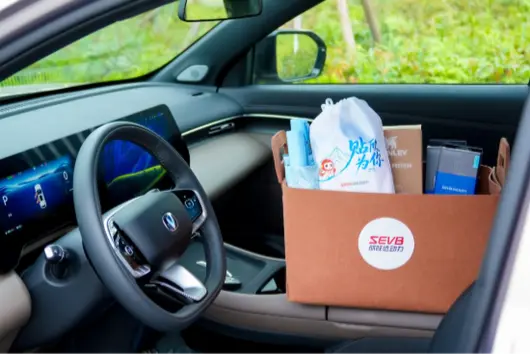
Sunwoda Power 'Sunwoda Cares for You' Care Package
A nearly 8,000 km long test will not immediately change consumers' perception of suppliers, but it brings the battery enterprise originally hidden behind the complete vehicle to the forefront. This kind of 'forefront' happens on this Long March route—Changan incorporates 'Save, Power, Quiet, Stable' into every test drive experience, Sunwoda Power puts the safety and durability of the battery on public routes for verification. Batteries are turning from invisible parts inside the car into selling points that automakers are willing to bring to the table; For consumers, it has become a variable that can be openly compared when buying a car for the first time. For Sunwoda Power, this means it has to start getting used to being scrutinized: Like a complete vehicle enterprise, accepting media questions, user inspections and peer comparisons.
Goes global layout is also advancing in sync—Sunwoda Power Thailand base phase 1 has mass production, phase 2 topping out soon, only dozens of kilometers from Changan Thailand complete vehicle factory, Morocco, Hungary base cover European market; Global market fuel models still occupy about 90% share, HEV transformation space is huge.
Ten years ago, industry eyes were almost all on pure electric and plug-in hybrids, HEVs were once viewed as 'transition technology'; Sunwoda Power chose to deepen its plowing on this track, relying precisely on the judgment that '90% of fuel vehicles remain globally'. Now, this window has opened on schedule—Standing in front of it is not just Sunwoda Power, but also a batch of Chinese automakers willing to put technology on public routes for verification.
More than 90 years ago, the Red Army set out from this county, relying on faith and willpower; Today, a battery factory and an automaker set out from the same county, relying on data and every verified cell.
For Sunwoda Power, the question has changed: It no longer only needs to prove that the automotive battery business can be made big, but also to prove that it can do every small battery well in the long run. The final answer is hidden in the driving in the coming many years.