


首頁Boxy SUV

搜尋歷史
熱門搜尋
經銷商登入 / 註冊


These past few days, I have been closely watching a major move by Beijing Off-road, the BJ30 Traveller's "5 Countries Fuel Saving Challenge". To be honest, we have seen many fuel saving competitions, but stretching the line of battle to 5 countries globally, and then back domestically for a live on-site broadcast, this scale is indeed rare. This live broadcast lasting more than three hours has concluded. How was the result? One sentence summary: The 70,000 RMB big boxy SUV, the 100km fuel consumption really went into within 5L!

Don't scroll away in a hurry, I know someone will say "it is another optimistic gauge under ideal conditions". But this time, we have to accept the data.
Five countries actual test endorsement, not just pure luck
Before this live broadcast at Yanqi Lake, Beijing Off-road had already sent the car to South Africa, Poland, Indonesia, UAE and Mexico. What concept do these 5 places represent? Dry deserts, humid rainforests, high altitude, urban congestion, unpaved rough roads... basically ran through all the extreme driving environments encountered on Earth.

Those local car bloggers are no pushovers, directly using local real driving scenarios to stress test the BJ30 Traveller. What was the result? The whole vehicle structure, 3-motor HEV hybrid system, chassis hardware, all held up. Cross-country full-domain road test, the 100km fuel consumption was also firmly around 5L.
With this foundation, only then could the domestic live broadcast dare to play for real.
Three major road condition actual tests, congestion generates low fuel consumption
This live broadcast I paid special attention to the urban congestion segment, this is our daily commuting most headache place. BJ30 Traveller in Beijing business district + residential areas stop and go, frequent idle, low speed creeping, in general fuel boxy SUVs, fuel consumption would have already soared to 8, 9 liters.

But its set hybrid + 3-motor 6-mode + electric 4WD architecture is indeed smart. Motor priority drive, engine only intervenes when needed. During traffic jams, it is almost like an electric car running, idle consumption? Non-existent.

Finally actual test, 2WD version official comprehensive fuel consumption 5.85L/100km, 4WD 6.45L/100km, but in this on-site challenge, directly broke the 5L barrier. I calculated a bill, according to driving 20,000 km a year, gas price 8 yuan, compared to the same level fuel boxy SUV can save 3,000 to 4,000 yuan in gas money. Three years down the line, saving a flagship mobile phone is not a dream.

Highway segments are also no slouch. 2820mm wheelbase, back row folded directly becomes 1.92 meters big bed room, Polish blogger even can lie sideways into the trunk filled with equipment. Fuel saving and can carry, this is the way a home SUV should be.

Country road gravel, unpaved roads more verify its passability: 215mm ground clearance, ATS all-terrain system, millisecond electric 4WD, light off-road conditions easily handled. 5 countries experts collectively praise, not without reason.
Comparison reveals differences, is HEV the best solution for boxy SUVs?
To be honest, now there are many boxy SUVs on the market, but BJ30 Traveller this set of HEV hybrid road, I think more and more feel it is right.

Compared to traditional 2.0T fuel cars, it has stronger power, lower fuel consumption; compared to PHEV plug-in hybrid, it doesn't need to find charging piles, body is lighter, off-road battery layout safer. 70,000 RMB level price point, has both boxy SUV's tough look, and sedan fuel consumption performance, this is its continuous 23 months domestic light hybrid SUV sales first real reason.

Live broadcast finally also threw a surprise egg. June 12, BJ30 Traveller Highlight Edition officially launched. Configuration upgrade, power optimization, new exclusive colors, reportedly also has special edition exclusive colors. Current model has achieved all-road fuel consumption break 5L, all-around capable, new model plus mark, this wave indeed worth looking forward to.
Final Thoughts:
One city mountain water test fuel consumption, 5 realms trial prove strength. From South Africa gravel road to Beijing city evening peak, BJ30 Traveller with solid actual live broadcast told us, 70,000 RMB level big boxy SUV, can also make fuel saving into basic skill.

Frankly, boxy SUVs have been a bit too hot these years.
Show one at the auto show, square body, bold eyebrows, black wheel arches, add a few camping chairs, sky canopy, coffee pot, and the vibe is instantly there. But the issue is, when consumers actually spend money, they aren't thinking only of poetry and distant dreams. They calculate: Is the commute stuck in traffic daily? Is fuel consumption high? Is it cramped for the whole family? Going to the mountains on weekends, do you regret the fuel cost coming back?

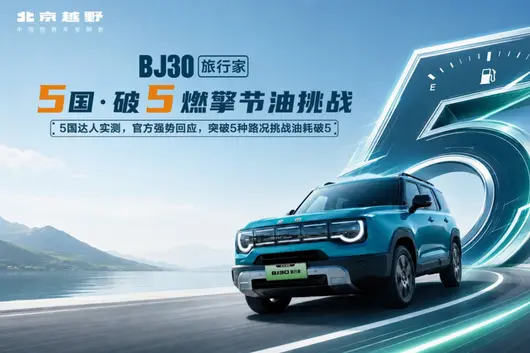
So, for this "5 Nations · Break 5L Fuel Challenge" of the BJ30 Traveler, it looks like a live streaming event, but in reality, it is poking the most sensitive nerve of the boxy SUV market: rugged capability is acceptable, but don't ask me to pay for sentiment daily.
On June 5th, Beijing Off-Road pulled the BJ30 Traveler into a live stream of a 3+ hour field test. Before the event, it had collaborated with local automotive bloggers from South Africa, Poland, Indonesia, UAE, and Mexico for cross-border road tests, covering different climates, urban roads, and unpaved composite road conditions; in the domestic live stream, this 70,000 yuan range boxy SUV finally delivered a result of less than 5L fuel consumption per 100km across multiple road conditions.
This number is very striking. It's even so glaring that it makes people instinctively suspicious.
After all, the phrase "fuel consumption breaks 5" has been worn out in today's automotive communications. Everyone knows fuel consumption tests are most susceptible to route, speed, temperature, and driving style. Claiming all users can consistently achieve 5L is neither rigorous nor responsible. However, what's noteworthy this time is that Beijing Off-Road didn't just use a lab report to fool people; it placed the car in real-world scenarios: urban commuting, highway cruising, rural gravel roads, unpaved surfaces, and light inclines. It at least didn't dodge the scrutiny.
More critically, it targeted not a niche pain point, but the most realistic anxiety of ordinary families.
Imagine a scenario: 8:30 AM, major city arteries clogged in red, traffic inching forward. Traditional fuel-powered boxy SUVs idle there, crawling, fuel gauge dropping slowly, the driver's heart grows impatient. By the weekend, the whole family wants to camp in the suburbs; tents, folding tables, cookers, and children's toys fill the trunk, road conditions shift from asphalt to gravel. At this moment, you hope the car is big, stable, and rugged, yet you don't want it to behave like a fuel-guzzling machine.
The truly smart part of the BJ30 Traveler lies right here.

It didn't package itself as an extreme off-road machine, but targeted the broader market of "Urban Daily Use + Light Off-Road". 3-Motor HEV hybrid, 3-Motor 6 modes, electric AWD, sounds like tech jargon, but in plain language it means: use electric drive more at low speeds, save fuel in traffic jams, and engage the engine when power is needed. For most people, this is more persuasive than chanting "Hardcore Gene" a hundred times.
Consider the space. 2820mm wheelbase, 1.92m large bed with rear seats folded, full set of camping gear can be stored, these numbers are not mere show. Chinese families buying SUVs rarely do so just for the driver's pleasure. Can children stretch their legs in the rear? Does the elderly get tired sitting for long? Can the trunk fit camping gear? These details are more telling than a single line about "segment-leaping space". Not feeling cramped when sitting inside, and not struggling when packing, is true family value.
Of course, the BJ30 Traveler also didn't completely give up on "Wildness".
215mm ground clearance, ATS All-Terrain System, millisecond-level electric AWD. Facing country roads, gravel, unpaved surfaces, and light inclines, these configurations are sufficient. Note, sufficient, not mythical. It's not asking you to take it to uninhabited areas to face challenges head-on, nor replacing traditional hardcore off-roaders. It serves more authentic Chinese mobility: county roads, mountain paths, muddy roads at farmhouses, and the last two kilometers before the campground.
This is where it's most worth talking about.
In the past, many boxy SUV models sold posture; they looked good driving out and stylish parked in front of coffee shops. But posture can't fill your stomach. Fuel costs, maintenance, space, comfort, and drivability ultimately end up on a family budget. The BJ30 Traveler's strength lies not in any single parameter being exaggerated, but in forcibly combining "Boxy Sentiment" with "Family Economics".

The "70,000 yuan price range, scarce boxy HEV at the same price point", this sentence is where the real impact lies.
Because it lowered the threshold for things that previously seemed exclusive. Previously, if you wanted a boxy SUV, you often had to accept higher prices, higher fuel consumption, and stronger usage compromises. Now the BJ30 Traveler tells you: I give you the boxy look, hybrid low fuel consumption, plus large space and light off-road capability. It may not top every category in the industry, but the combination is powerful, especially for fuel-powered SUVs in the same price range.
However, I still reserve a little hesitation.
A single live stream cannot prove everything. Whether the 5-nation road test or domestic field test, the true test remains in the users' hands. How is the real fuel consumption after a year of driving? How is the stability of the electric AWD under high-frequency complex road conditions? Is the long-term maintenance cost truly as worry-free as advertised? These questions cannot be stamped with a single event. The market lacks no noise; it lacks a reputation that can stand the test of three years.
But conversely, the BJ30 Traveler has already thrown the problem to peers.

If a 70,000 yuan boxy SUV can press fuel consumption within 5L, can offer a 2820mm wheelbase, 1.92m large bed, 215mm ground clearance, and cover city, highway, rural, gravel, and light off-road scenarios, then those products that only stack styling, stack emotions, and stack slogans should be nervous.
On June 12th, the BJ30 Traveler Highlight Edition will also be launched. Official information shows the new car will have configuration upgrades, power optimization, and new exclusive colors. Simply put, Beijing Off-Road has no intention to stop there; it wants to keep stoking this fire. As for whether it will become a blockbuster, it depends on the final price, configuration sincerity, and the real reputation after delivery.
But at least for now, the BJ30 Traveler has put a question on the table: Boxy SUVs, why must they always be expensive and fuel-guzzling?
This question is sharp and very realistic.

If the past boxy SUV market sold distance, sentiment, and posture, then the BJ30 Traveler this time sells something else: a sense of freedom that ordinary people can afford. It is not high and mighty, not pretending to be mysterious, nor pretending to be omnipotent. It just tells you: you can save on fuel during the workweek, drive boldly on the weekend, the whole family can fit inside, and the fuel costs won't make you wince.
This is far more ruthless than empty calls for "hardcore".

Frankly, boxy SUVs have been a bit too hot these years.
Show one at the auto show, square body, bold eyebrows, black wheel arches, add a few camping chairs, sky canopy, coffee pot, and the vibe is instantly there. But the issue is, when consumers actually spend money, they aren't thinking only of poetry and distant dreams. They calculate: Is the commute stuck in traffic daily? Is fuel consumption high? Is it cramped for the whole family? Going to the mountains on weekends, do you regret the fuel cost coming back?
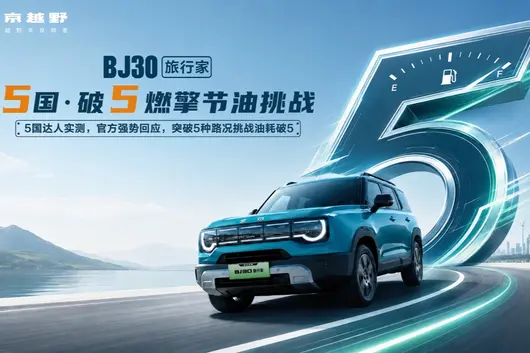
So, for this "5 Nations · Break 5L Fuel Challenge" of the BJ30 Traveler, it looks like a live streaming event, but in reality, it is poking the most sensitive nerve of the boxy SUV market: rugged capability is acceptable, but don't ask me to pay for sentiment daily.
On June 5th, Beijing Off-Road pulled the BJ30 Traveler into a live stream of a 3+ hour field test. Before the event, it had collaborated with local automotive bloggers from South Africa, Poland, Indonesia, UAE, and Mexico for cross-border road tests, covering different climates, urban roads, and unpaved composite road conditions; in the domestic live stream, this 70,000 yuan range boxy SUV finally delivered a result of less than 5L fuel consumption per 100km across multiple road conditions.
This number is very striking. It's even so glaring that it makes people instinctively suspicious.
After all, the phrase "fuel consumption breaks 5" has been worn out in today's automotive communications. Everyone knows fuel consumption tests are most susceptible to route, speed, temperature, and driving style. Claiming all users can consistently achieve 5L is neither rigorous nor responsible. However, what's noteworthy this time is that Beijing Off-Road didn't just use a lab report to fool people; it placed the car in real-world scenarios: urban commuting, highway cruising, rural gravel roads, unpaved surfaces, and light inclines. It at least didn't dodge the scrutiny.
More critically, it targeted not a niche pain point, but the most realistic anxiety of ordinary families.
Imagine a scenario: 8:30 AM, major city arteries clogged in red, traffic inching forward. Traditional fuel-powered boxy SUVs idle there, crawling, fuel gauge dropping slowly, the driver's heart grows impatient. By the weekend, the whole family wants to camp in the suburbs; tents, folding tables, cookers, and children's toys fill the trunk, road conditions shift from asphalt to gravel. At this moment, you hope the car is big, stable, and rugged, yet you don't want it to behave like a fuel-guzzling machine.
The truly smart part of the BJ30 Traveler lies right here.
It didn't package itself as an extreme off-road machine, but targeted the broader market of "Urban Daily Use + Light Off-Road". 3-Motor HEV hybrid, 3-Motor 6 modes, electric AWD, sounds like tech jargon, but in plain language it means: use electric drive more at low speeds, save fuel in traffic jams, and engage the engine when power is needed. For most people, this is more persuasive than chanting "Hardcore Gene" a hundred times.
Consider the space. 2820mm wheelbase, 1.92m large bed with rear seats folded, full set of camping gear can be stored, these numbers are not mere show. Chinese families buying SUVs rarely do so just for the driver's pleasure. Can children stretch their legs in the rear? Does the elderly get tired sitting for long? Can the trunk fit camping gear? These details are more telling than a single line about "segment-leaping space". Not feeling cramped when sitting inside, and not struggling when packing, is true family value.
Of course, the BJ30 Traveler also didn't completely give up on "Wildness".
215mm ground clearance, ATS All-Terrain System, millisecond-level electric AWD. Facing country roads, gravel, unpaved surfaces, and light inclines, these configurations are sufficient. Note, sufficient, not mythical. It's not asking you to take it to uninhabited areas to face challenges head-on, nor replacing traditional hardcore off-roaders. It serves more authentic Chinese mobility: county roads, mountain paths, muddy roads at farmhouses, and the last two kilometers before the campground.
This is where it's most worth talking about.
In the past, many boxy SUV models sold posture; they looked good driving out and stylish parked in front of coffee shops. But posture can't fill your stomach. Fuel costs, maintenance, space, comfort, and drivability ultimately end up on a family budget. The BJ30 Traveler's strength lies not in any single parameter being exaggerated, but in forcibly combining "Boxy Sentiment" with "Family Economics".
The "70,000 yuan price range, scarce boxy HEV at the same price point", this sentence is where the real impact lies.
Because it lowered the threshold for things that previously seemed exclusive. Previously, if you wanted a boxy SUV, you often had to accept higher prices, higher fuel consumption, and stronger usage compromises. Now the BJ30 Traveler tells you: I give you the boxy look, hybrid low fuel consumption, plus large space and light off-road capability. It may not top every category in the industry, but the combination is powerful, especially for fuel-powered SUVs in the same price range.
However, I still reserve a little hesitation.
A single live stream cannot prove everything. Whether the 5-nation road test or domestic field test, the true test remains in the users' hands. How is the real fuel consumption after a year of driving? How is the stability of the electric AWD under high-frequency complex road conditions? Is the long-term maintenance cost truly as worry-free as advertised? These questions cannot be stamped with a single event. The market lacks no noise; it lacks a reputation that can stand the test of three years.
But conversely, the BJ30 Traveler has already thrown the problem to peers.
If a 70,000 yuan boxy SUV can press fuel consumption within 5L, can offer a 2820mm wheelbase, 1.92m large bed, 215mm ground clearance, and cover city, highway, rural, gravel, and light off-road scenarios, then those products that only stack styling, stack emotions, and stack slogans should be nervous.
On June 12th, the BJ30 Traveler Highlight Edition will also be launched. Official information shows the new car will have configuration upgrades, power optimization, and new exclusive colors. Simply put, Beijing Off-Road has no intention to stop there; it wants to keep stoking this fire. As for whether it will become a blockbuster, it depends on the final price, configuration sincerity, and the real reputation after delivery.
But at least for now, the BJ30 Traveler has put a question on the table: Boxy SUVs, why must they always be expensive and fuel-guzzling?
This question is sharp and very realistic.
If the past boxy SUV market sold distance, sentiment, and posture, then the BJ30 Traveler this time sells something else: a sense of freedom that ordinary people can afford. It is not high and mighty, not pretending to be mysterious, nor pretending to be omnipotent. It just tells you: you can save on fuel during the workweek, drive boldly on the weekend, the whole family can fit inside, and the fuel costs won't make you wince.
This is far more ruthless than empty calls for "hardcore".


