首頁Automotive Going Global

搜尋歷史
熱門搜尋
經銷商登入 / 註冊

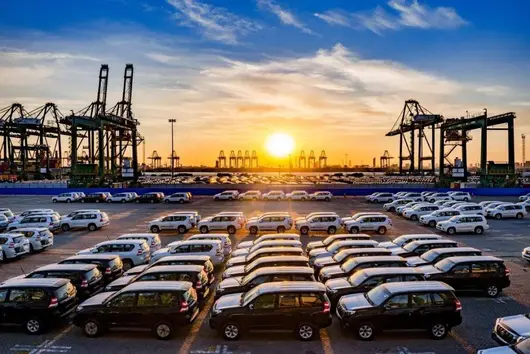
The first half of 2026 has passed, a time for summary, review, and reflection. Amidst fluctuations in the global economy, Chinese auto exports have not slowed down; growth is accelerating.
This year, the total volume of complete Chinese car exports approached 5 million units, an increase of more than 60% year-over-year.
According to the consulting firm AlixPartners, China's car exports in 2026 are expected to break 10 million units, setting a historical record for the highest annual car exports from a single country. However, this 10 million unit overseas journey is far from smooth; global regional markets are showing vastly different landscapes and policies.

The US is the world's largest consumer market, but for a long time to come, Chinese cars may be excluded from it.
Many people think Chinese cars cannot enter the US due to high tariffs, but the reality is more complex. The US has effectively constructed a three-tier blockade system, almost completely severing ties with the Chinese automotive industry.
The first layer is tariff barriers. The US levies a 25% general tariff on imported cars, plus a 100% Section 301 tariff on Chinese EVs previously imposed, resulting in a combined tax rate exceeding 125%. For example, assuming the Li Auto i8 is exported to the US with an FOB price of $40,000, the tariff at destination would be $50,000, making the cost of these two items at least $90,000. In the US market, this price is sufficient to purchase the top-spec Cybertruck.

Besides tariffs, there are technology bans. In January 2025, the US released 'Rules for Intelligent Connected Vehicles', requiring that starting from the 2027 model year, connected car software designed, developed, or supplied by entities 'owned, controlled, or subject to the jurisdiction of' China or Russia be prohibited. Starting from the 2030 model year, connected car hardware is further prohibited. This rule not only looks at where the vehicle is assembled but penetrates to the source of software and capital.
Recently, Polestar became the first automotive brand affected by this. The US Department of Commerce refused to grant Polestar sales authorization, citing that 'vehicles equipped with relevant Chinese connected technologies may collect sensitive owner information and pose national security risks'. Therefore, Polestar had to announce a complete stop on selling new cars in the US starting from the 2027 model year, which is almost equivalent to exiting the US market.
Finally, there are legislative restrictions. In May of this year, the US Congress was still pushing for a stricter 'Connected Vehicle Safety Act', planning to elevate this temporary ban to permanent law, while sealing off traditional routes to evade sanctions such as 'transshipment through Mexico or Canada or building factories in the US'.
Therefore, against the backdrop of the US-China power game, the US market is likely the market with the greatest challenge for Chinese auto companies going global.

The EU is the world's second largest new energy vehicle market, and a strategic high ground Chinese auto companies must secure.
Although the previous anti-subsidy investigation and tax increase bill drew wide attention, the EU's strategy did not take a 'one-stick-kill' approach, but adopted a relatively gentle gradual means, essentially a form of self-industry protection.
In early 2026, after more than two years of negotiations between China and the EU, the EU implemented a minimum price commitment mechanism for Chinese imported electric vehicles. This means Chinese pure electric cars do not need to pay extra high taxes to enter Europe, but must price according to EU rules and cannot enter the market at too low a price.

On the surface, it seems Chinese enterprises no longer need to pay high anti-subsidy taxes, keeping profits in their own hands; but in essence, the EU is using administrative means to level out the price advantage of Chinese EVs, limiting Chinese EVs from launching price wars in the European market. This means every model and every configuration must be separately calculated for the minimum price, greatly raising compliance costs.
Therefore, for Chinese auto companies to develop in Europe in the future, they can no longer rely solely on price advantages; they must promote deep localization.
In the future European market, the pure 'complete vehicle trade export' model will have little room to survive. Chery building a joint venture in Spain and BYD's Hungarian factory production are using real investment to exchange for entry tickets, which is actually consistent with China's earlier approach of introducing foreign enterprises.
Although the threshold is raised, as long as enterprises are willing to share value and create benefits locally, the market door remains open—just a door that is 'half-open'.

Southeast Asia is the regional market with the most intensive investment and most significant results for Chinese auto companies. Thailand is a typical weather vane.
In January 2026, the Thai auto market welcomed a historical turning point. According to the Federation of Thai Industries, brand pure electric car sales in January reached 31,860 units, a year-on-year increase of 354%, accounting for more than 75% of Thailand's pure electric market share. On the brand sales list, Toyota ranked first with 19,113 units, BYD stayed firmly second with 12,812 units, Chery entered the top three with 9,714 units, and six Chinese brands collectively entered the top ten. Chinese brands' combined market share in Thailand reached 47.34%, historically surpassing Japanese brands' 47.338% for the first time.

Indonesia is another key market. By the end of 2025, the market share of Chinese brands in Indonesia doubled year-on-year to 14%, and BYD sales jumped to third place. In January 2026, Indonesia's new car wholesale sales were 66,447 units, a year-on-year increase of 7%. In the electric vehicle sector, Chinese market share reached as high as 91.7%.
Looking at the whole of Southeast Asia, the market landscape dominated by Japanese cars for sixty years is facing attacks from all sides. In 2025, Japanese car sales in Indonesia, Thailand, Vietnam and other six major countries declined by 22% compared to 2019, dropping to 68% in Thailand alone. Meanwhile, Chinese auto company sales in Southeast Asia exceeded 800,000 units in 2025, a year-on-year increase of over 120%, with average market share breaking through 35%. By the end of 2025, 7 Chinese auto companies had invested in building factories in Thailand, with cumulative investment exceeding $3 billion.
However, China's supply chain in ASEAN still has about 80% imported from China. Japanese car companies have not withdrawn, but switched tracks—Toyota invested 55 billion Thai Baht to expand hybrid production, local policies are shifting from focusing on pure electricity to technology neutrality. How to build a moat in local supply chain and product diversification is the next hard battle for Chinese auto companies in Southeast Asia.

Chinese cars in the Middle East market are undergoing dramatic changes.
In the first two months of 2026, the UAE has jumped to the second position among Chinese car export destinations, with import volume reaching 103,900 units, a year-on-year increase of 53%. In 2025, China's car exports to the Middle East region reached 1.4 million units, of which the UAE's 570,000 and Saudi Arabia's 300,000 combined contributed more than 60% of the share. The economic report released by Saudi media in 2026 shows that Chinese car brand sales in the Saudi market are expected to exceed 120,000 units annually.
This way, the market share of Chinese brands in the Middle East has risen to above 20%, with proportions breaking through 25% in core markets such as Saudi Arabia and the UAE, among which Chery and BYD are the two largest Chinese enterprises.
The key variable promoting this growth is exactly the recent change in the situation in the Middle East region. The tense situation in the Strait of Hormuz made this traditional golden route nearly paralyzed, ship traffic volume plummeted from about 130 ships per day in February to only 6 ships in March. Toyota has already planned to cut export production to the Middle East by 24,000 units, Nissan continued production cut measures, and Mazda also confirmed that exports to the Middle East would be stopped before the end of May.
The delivery period of Japanese car companies has been greatly extended, while Chinese car companies quickly filled the market vacancy with stable supply chains and more competitive products. Another significant advantage of the Middle East market is ample funds, objective recognition of Chinese brands, and geographical location that can radiate to Africa and Europe. This is also a major unexpected pleasure of Chinese auto exports this year.
The Latin American market is becoming one of the fastest-growing regions for Chinese auto companies.
In the first half of 2026, the sales of Chinese brands in the 7 countries of South America were between 650,000 and 750,000 units, an increase of more than 80% year-on-year, and the market share also officially exceeded US and German brands, becoming the third largest car series in the market.
In March this year, the monthly sales of Chinese brand cars in Mexico reached 15,698 units, with a market share of 11.9%, surpassing German brands for the first time. MG sales surged 54.2% to 6,166 units, ranking rising to 7th place; Geely sales surged 245.3%. Brazil was the fastest growing single market. For the entire first quarter, China exported 166,787 passenger cars to Brazil, with a cumulative year-on-year increase of 242.8%. Brazil has become the country with the largest export volume of Chinese new energy vehicles.
But uncertainties facing the Latin American market are also rising. The US is pressuring Mexico to require it to limit the entry of Chinese cars into North America through the US-Mexico-Canada Trade Agreement. BYD has established sales networks in Brazil and Mexico and plans to build a factory in Mexico, but how long the 'Mexico stepping stone' can play a role largely depends on policy gaming between the US and Mexico.
Africa has 1.4 billion people, but the current car penetration rate is low, and most car companies did not fully pay attention due to consumption power limitations. But looking at the data from the first half of 2026, important trend changes are appearing in South Africa and North Africa.
The industrial orientation of core countries such as Egypt and South Africa is very clear; they vigorously encourage local assembly models, complete vehicle import tariffs are high, but imported parts can enjoy great tax incentives. So layout in Africa, similarly cannot expect to rely solely on complete vehicle exports to achieve profitability, the core logic is still 'industry exchanging for market'.

If enterprises can invest deeply to build factories locally and drive local employment with parts assembly, it is more promising to obtain long-term market entry tickets. Although there is limited premium space at present, there are still few Chinese auto companies willing to make long-term layouts here.
Who is the largest national market for Chinese auto exports? It is Russia.
In the first quarter of 2026, China exported 186,765 passenger cars to Russia, with a cumulative year-on-year increase of 97.1%. From January to May 2026, Russia ranked first among Chinese car export destinations with a monthly import volume of 94,301 units. In 2025, the market share of Chinese independent brands in Russia rebounded to 57.2%, accounting for more than half.

The speciality of the Russian market lies in the huge market vacancy left by the mass exit of Western car companies, and Chinese brands quickly filled this gap. However, objectively speaking, geopolitical risks remain the 'Sword of Damocles' in trade between China and Russia.
Final Thoughts
Some predict that Chinese auto exports in 2026 will cross the 10 million unit threshold, which is undoubtedly a milestone achievement in the entire history of human industry.
However, we believe this number is not the higher the better, because the higher the number, the more challenging the road ahead. Chinese auto exports need to formally move from the 1.0 stage of purely pursuing sales to the 2.0 era of system output and supply chain output. And in this more mature stage, the competitive fire between Chinese auto companies will also extend comprehensively to overseas markets.
Looking around at the current global landscape, the automotive industry is irrevocably dividing into two camps: 'China Ecosystem' and 'Non-China Ecosystem'. In overseas markets, our biggest opponent may no longer be Toyota or Tesla, but those Chinese peers who are going global together to compete.