


首頁301

搜尋歷史
熱門搜尋
經銷商登入 / 註冊

Recently, the U.S. Trade Representative Office issued a new Section 301 tariff announcement, categorizing 60 countries and regions into different tax brackets. This tariff package is not only levied in addition to the old Section 301 tariffs, but tire products are prominently included with no room for exemption. This policy adjustment marks a reconstruction of global trade rules and also forces China's tire industry, which relies heavily on external markets, to face a fundamental shift in its export environment.

Export Paths Blocked: Direct Export and Southeast Asia Transit Double-Pronged Restrictions
China's tire direct export and transshipment trade space is facing severe squeezing. On July 15, the U.S. Department of Commerce concluded the sunset review of Chinese passenger car and light truck tires, pushing the combined tax rate to a historical high of 190%, basically blocking the direct export path to North America. Meanwhile, the EU previously announced anti-dumping duties of 24.4%-45.3% on relevant Chinese tires, weakening the price competitiveness of Chinese products in Europe.
More severe is the synergy of U.S. and EU tariff policies. In the U.S. new Section 301 tariff list, Southeast Asian countries such as Vietnam and Thailand are in the same 12.5% tax bracket as China, which echoes the EU's recent anti-circumvention investigations initiated against Southeast Asia. When Chinese enterprises attempt to avoid tariffs by transiting through Southeast Asian capacity, the U.S. and Europe have set up an "Origin Trap." Combined with anti-dumping investigations by Brazil and Peru and environmental barriers of the Eurasian Economic Union, trade barriers globally targeting Chinese tires are continuously rising.

Profit Model Under Pressure: "False Globalization" Faces Compliance Challenges
As the world's largest tire producer, 80% of domestic capacity is concentrated in low-end products, and the long-term "trading price for volume" model has become a key focus of anti-dumping investigations by various countries. Data shows that in 2025, China's tire export volume was huge, but profit accounted for only 8%. In the face of tariff barriers exceeding 100%, this meager profit space is instantly squeezed away.
Under tariff pressure, domestic tire companies have sparked a boom in overseas factory construction. In the first half of 2026, more than a dozen projects announcing overseas expansion were declared, with total investment exceeding 20 billion yuan. However, simple capacity transfer is facing compliance challenges. A certain enterprise's Southeast Asia factory faced suspension due to EU anti-circumvention investigations immediately after production start; another enterprise was still levied high tariffs due to not meeting U.S. "content of origin" standards. Compared to the full-chain localization models of foreign giants like Michelin and Bridgestone, "False Globalization" staying at the "assembly workshop" stage with supply chains still bound to China appears weak in the face of tariff barriers.

Industry Accelerates Transformation: Deep Localization Becomes Consensus for Breaking the Deadlock
When low-price advantages are limited, China's tire industry is forced to face the reconstruction of the industry's underlying logic. Linglong Tire, in its Serbia factory, explored a "R&D + Production + Supply" three-in-one deep localization model by achieving European local procurement, forming an R&D team targeting EU regulations, and entering the OEM market. At the same time, Zhongce Rubber, Double Coin Tire, etc., are doubling down on local supply chains, and Sailun Group introduced Industry 4.0 standards at its Cambodia factory.
The tightening of new Section 301 tariffs and global trade barriers objectively accelerates industry reshuffling and transformation. When Southeast Asia transit paths are blocked and low-price models are unsustainable, this industry adjustment triggered by tariffs is pushing Chinese tires to move from "Global Factory" to "Global Brand". Future market competition will gradually shift from capacity scale contests to a comprehensive battle of technological innovation, brand value, and global operational capabilities.
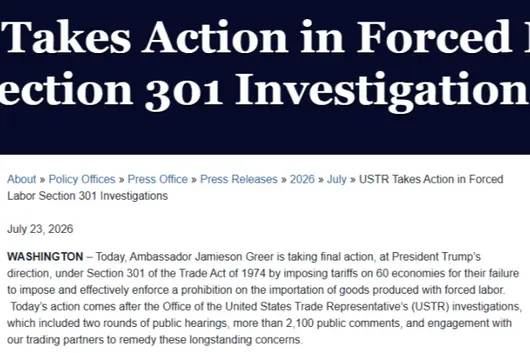

近日,美國貿易代表辦公室發布新 301 關稅公告,將 60 個國家和地區劃分至不同檔位稅率。這套關稅不僅與舊 301 關稅疊加徵收,且輪胎產品赫然在列,無任何豁免餘地。此一政策調整標誌著全球貿易規則的重構,亦令高度依賴外部市場之中國輪胎產業面臨出口環境之根本性轉變。
出口路線受阻:直接出口與東南亞中轉雙重受限
中國輪胎之直接出口及轉口貿易空間正遭遇嚴重擠壓。7 月 15 日,美國商務部對華乘用車及輕卡輪胎日落復審終裁落槌,疊加稅率推至 190% 之歷史高位,導致直接出口北美之路線基本封死。同時,歐盟此前宣佈對華相關輪胎徵收 24.4%-45.3% 之反傾銷稅,削弱中國產品在歐洲之價格競爭力。
更為嚴峻的是歐美關稅政策之協同性。在美國新 301 關稅清單中,越南、泰國等東南亞國家與中國同處 12.5% 稅率檔位,這與歐盟近期對東南亞發起之反規避調查形成呼應。當中國企業試圖通過東南亞產能中轉規避關稅時,歐美已布下「原產地陷阱」。疊加巴西、秘魯之反傾銷調查及歐亞經濟聯盟之環保壁壘,全球針對中國輪胎之貿易壁壘正持續高築。
盈利模式受壓:「假全球化」遭遇合規挑戰
作為全球最大輪胎生產國,國內 80% 產能集中於低端產品,長期之「以價換量」模式成為各國反傾銷調查重點。數據顯示,2025 年中國輪胎出口量巨大,但利潤額僅佔 8%。在超 100% 之關稅壁壘面前,此種微薄利潤空間瞬間被擠壓殆盡。
關稅壓力下,國內輪胎企業掀起海外建廠熱潮。2026 年上半年,宣佈海外擴產項目超十多個,總投資額超 200 億元。然而,單純產能轉移正面臨合規挑戰。某企業東南亞工廠投產即遭遇歐盟反規避調查停產;另有企業因未達美國「原產地含量」標準仍被徵收高額關稅。對比米其林、普利司通等外資巨頭全鏈路本地化模式,停留在「組裝車間」階段、供應鏈仍綁定國內之「假全球化」,在關稅壁壘前顯得不堪一擊。
產業加速轉型:深度本地化成破局共識
當低價優勢受限,中國輪胎業被迫直面產業底層邏輯之重構。玲瓏輪胎在塞爾維亞工廠通過實現歐洲本地採購、組建針對歐盟法規之研發團隊及進入主機廠原配市場,探索出「研發 + 生產 + 配套」三位一體之深度本地化模式。同時,中策橡膠、雙錢輪胎等加碼本地化產業鏈,賽輪集團在柬埔寨工廠引入工業 4.0 標準。
新 301 關稅及全球貿易壁壘之收緊,客觀上加速了行業之洗牌與蛻變。當東南亞中轉路線受阻、低價模式難以為繼,這場由關稅引發之產業調整,正促使中國輪胎從「全球工廠」向「全球品牌」邁進。未來之市場競爭,將逐漸從產能規模之較量,轉向技術創新、品牌價值與全球運營能力之綜合比拼。


