


首頁黃耆

搜尋歷史
熱門搜尋
經銷商登入 / 註冊

In Malaysia's SUV market, many buyers compare the Toyota Corolla Cross and Kia Sportage when choosing a car. Both vehicles are quite close in price and positioning. Today, we will make a detailed comparison from multiple aspects to help you save time on research.
The Toyota Corolla Cross OTR price in Malaysia is RM 133,800 - 148,800, with a total of 3 versions, including 2026 HEV 1.8L GR Sport (RM 148,800), 2026 HEV 1.8L Standard (RM 140,800), 2026 1.8L Standard (RM 133,800), etc.
The Kia Sportage OTR price in Malaysia is RM 129,639 - 179,320, with a total of 4 versions, including 2025 1.6T DCT 4WD High (RM 179,320), 2025 1.6T DCT 2WD High (RM 159,320), 2025 2.0L AT 2WD High (RM 139,639), etc.
From a price perspective, the Kia Sportage entry price is RM 4,161 cheaper than the Toyota Corolla Cross. Honestly, in this price range, a difference of a few thousand is actually not significant; the key is still looking at overall value for money and long-term usage costs.

The Toyota Corolla Cross safety rating is 5★ (ASEAN NCAP), active safety systems include TSS (PCS, LDA, ACC, LTA).
The Kia Sportage safety rating is 5★ (ASEAN NCAP), active safety systems include Drive Wise.
Both vehicles have the same safety rating. Safety features in this class are quite comprehensive. New cars today generally have good safety, so no need to worry too much about this point.

The Toyota Corolla Cross uses FWD drive configuration.
The Kia Sportage uses FWD drive configuration.
Both vehicles have the same drive configuration, both are FWD, so there won't be much difference in daily driving experience.

Toyota Corolla Cross warranty 5 years/unlimited mileage, maintenance interval every 10,000km or 6 months.
Kia Sportage warranty 5 years/300,000km, maintenance interval every 10,000km or 6 months.

Overall, both Toyota Corolla Cross and Kia Sportage are very good models in the Malaysian market. Which one to choose mainly depends on your personal needs and budget. We suggest you do your research, compare quotes from several dealerships, and then go for a test drive to make a final decision. Buying a car is a major matter; taking time to do research is never a mistake.


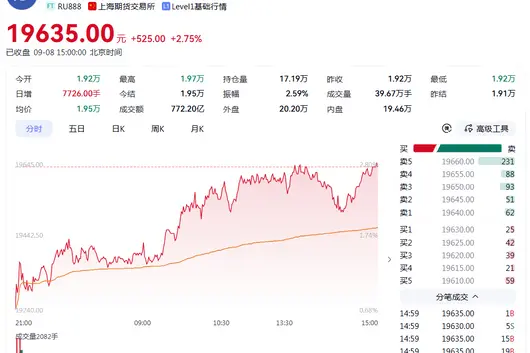
September 8, two "heavy bombs" landed simultaneously: Brent crude approached $100/barrel intraday, natural rubber main contract closed up 2.75%, quoted at 19,635 Yuan/ton, both hitting new phase highs. Under the surge of raw materials' "dual engines", two tire companies announced price hike letters on the same day. The third round of price hikes in the tire industry this year is now unstoppable.

Rubber Approaches 20,000 Yuan, Rubber Series "Three Brothers" Surge Together
September 8 closing, Shanghai Futures Exchange natural rubber main contract quoted at 19,635 Yuan/ton, up 2.75%, intraday high touched around 19,700 Yuan, one step away from the 20,000 Yuan threshold, single day turnover reached 77.22 billion Yuan.
The day before (September 7), the rubber series had already staged a collective surge: Natural rubber main contract closed at 19,180 Yuan/ton, up 2.18%; No. 20 Rubber main contract set a new record since listing, closed at 16,345 Yuan/ton; Synthetic rubber intraday approached 8%, closed at 15,605 Yuan/ton, up 4.59% for the day. Three varieties surged collectively and broke through the high-level oscillation zone within a day, which is rare in the past two years.

Guotai Junan Futures Analysts Point to Three Drivers:
First, synthetic rubber fundamentals are relatively strong. High oil prices pushed up the core raw material butadiene price, synthetic rubber processing profits continued to decline, some private enterprises operated at reduced capacity, supply side shrank, and market anxiety over spot liquidity intensified.
Second, natural rubber raw material side is firm. Hat Yai main producing areas had excessive rainfall and tapping was hindered, Hat Yai rubber glue prices rose from 75 Baht at the start of the month to 77.7 Baht; El Niño production cut expectations continued to ferment, impact intensity expected to peak in September-November, production cut logic difficult to disprove in the short term.
Third, the price hike atmosphere in the industrial chain is formed. Around September 1, over 25 tire enterprises such as Triangle, Double Star, Aeolus centrally adjusted prices by 2%-3%, strengthening bullish sentiment.
Different from the price hike wave in March-April, this time natural rubber and synthetic rubber resonated synchronously. According to Zhuochuang Information data, comparing September 3 with August 3, Shandong STR20# Blended Rubber rose 8.75%, Styrene Butadiene Rubber 1502 rose 16.67%, Polybutadiene Rubber rose 20.65%, Carbon Black N330 rose 16.89% — the four major core raw materials all surged heavily, none were "gentle".

Oil Price Nears $100, Goldman Sachs Forecasts $120
September 8, Brent crude intraday high touched $99.42/barrel, one step away from the $100 threshold, year-to-date gain nearly 100%; NY crude futures rose over 3%. On the same day, A-share oil and gas sector surged, Huajin Shares, Heshun Petroleum, Zhongman Petroleum hit limit up, Tongyuan Petroleum, Guanghui Energy and other stocks rose over 5%.
The direct trigger is the rapid escalation of the Middle East situation: Saudi energy facilities attacked by Houthis, partial facility operations interrupted, causing 73 injuries; meanwhile, US-Iran standoff over the Strait of Hormuz continued, US military required 94 commercial ships to alter course in blockade actions.
Goldman Sachs warned that if attacks escalate further, oil price may rise to $120/barrel; China Merchants Futures pointed out that if Yanbu Port exports continue to be hindered, supply reduction could expand to 3-4 million barrels/day. Plus OPEC+ announced October production halt — this is the first since production increase started in April this year, oil price upside risk is significant.

Price Hike Letters Land Again, Another "3% Hike"
Under cost pressure, two tire companies announced price hikes simultaneously on September 8:
Fangxing Rubber announced that due to continued rise in raw material prices such as rubber, carbon black, steel cord, starting from September 12, semi-steel, full-steel, and engineering tire series prices were adjusted upward by 3%;

Shandong Weihai Rubber announced that "Hongying", "OPALS", "HIMALAYA" brand full-steel radial tires increased by 3% starting from September 12.

This is the third centralized price hike in the tire industry since late August this year. But the gap between cost and selling price remains glaring: Zhuochuang Information calculates that on September 3, production cost of a single full-steel tire was about 984.97 Yuan, up 9.21% in one month, up 13.87% year-on-year. Cost rose nearly 10 points, selling price only rose 2-3 points, some economic tires already showed real losses like "losing 80 Yuan per tire sold". Some enterprises said frankly: Tire prices need to rise at least another 16% to cover costs, and 20% increase is needed to achieve profitability.
Industry insiders point out that raw materials are unlikely to fall in the short term, but weak demand constrains transmission, price hikes will show a pattern of "multiple batches, small amplitude" rotation, industry reshuffling accelerates. For dealers, the dense period of price hike letters is both opportunity and trap, reasonable stocking, cash flow is king, maintain flexibility to navigate the cycle.

In Malaysia's SUV market, many buyers compare the Proton X90 and Mitsubishi Xforce when choosing a car. These two vehicles are quite close in price and positioning. Today, we will make a detailed comparison from multiple aspects to help you save time doing research.
The OTR selling price of Proton X90 in Malaysia is RM 106,800 - 122,800, with a total of 4 versions, including 2026 1.5T Prime X (RM 122,800), 2026 1.5T Prime (RM 116,800), 2026 1.5T Lite (RM 106,800), etc.
The OTR selling price of Mitsubishi Xforce in Malaysia is RM 109,930 - 119,930, with a total of 2 versions, including 2026 1.5L Ultimate (RM 119,930), 2026 1.5L Urban (RM 109,930), etc.
From a price perspective, the starting price of Proton X90 is indeed RM 3,130 cheaper than Mitsubishi Xforce. If your budget is limited, Proton's entry-level version can already meet daily needs. However, be aware that that saving of a few thousand Ringgit might involve trade-offs in features, depending on your specific needs.

Proton X90 is equipped with a 1.5L Turbo, 140 hp. Official fuel consumption 7.0 L/100km.
Mitsubishi Xforce is equipped with a 1.5L Turbo, 140 hp. Official fuel consumption 7.0 L/100km.
Both cars use the same powertrain, and the driving experience is basically the same. Fuel consumption is also similar, so there is no need to worry too much about this.

Proton X90's safety rating is 5★ (ASEAN NCAP), active safety systems include ADAS (ACC, AEB, LKA, LDA, BSM, RCTA).
Mitsubishi Xforce's safety rating is 5★ (ASEAN NCAP), active safety systems include MI-PILOT.
Both cars have the same safety rating, and safety features in this class are quite comprehensive. Safety of new cars nowadays is generally good, so no need to worry too much about this.
Proton X90 warranty 5 years/150,000km, maintenance interval every 10,000km or 6 months.
Mitsubishi Xforce warranty 3 years/100,000km, maintenance interval every 10,000km or 6 months.

Proton X90 and Mitsubishi Xforce are both mainstream choices in the Malaysian market, suitable for family use and daily commuting. If you value brand reputation and resale value more, you can prioritize the one with better reputation; if you care more about cost-performance ratio and features, then choose the one with richer configurations. Ultimately, it is recommended to test drive both, as personal experience is the most important.
Overall, Proton X90 and Mitsubishi Xforce are both very good models in the Malaysian market. Which one to choose depends mainly on your personal needs and budget. It is recommended to do your homework, compare quotes from several car dealerships, and then test drive to make the final decision. Buying a car is a big matter, spending some time doing research will never go wrong.


