首頁邊度塞車邊度好玩

搜尋歷史
熱門搜尋
經銷商登入 / 註冊

Editor's Note: BYD sales achieved positive year-over-year growth for three consecutive months. The overall operation shows signs of recovery. Among them, the explosion in overseas markets has become the biggest highlight of BYD's development this year. However, at the same time, the situation where its domestic market sales declined by over 30% has not yet been reversed, and achieving comprehensive stability still faces multiple challenges.
Three Consecutive Sales Increases, Recovery Signals Emerge
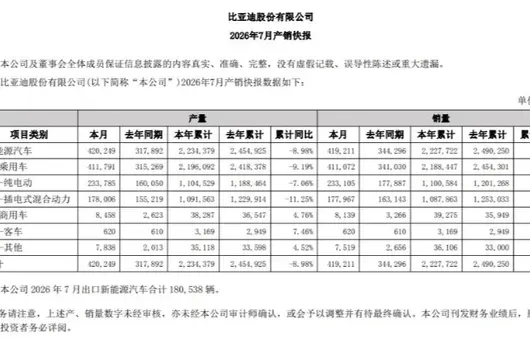
On August 1, BYD released the latest production and sales data. July sales reached 419,000 units, a year-over-year increase of 21.8%, achieving positive year-over-year growth for the third consecutive month.

In May, BYD sales were 383,000 units, a slight year-over-year increase of only 0.2%. June sales were 403,000 units, with the year-over-year increase expanding to 5.4%, and July's year-over-year growth rate increased to 21.8%. The significant expansion of single-month increments shows that the strength of BYD's recovery has strengthened month by month. Before this three-month consecutive year-over-year growth trend appeared, BYD experienced continuous year-over-year deep decline. The industry growth leader fell into a continuous period of deceleration.
From September 2025 to April 2026, BYD experienced an 8-month cycle of consecutive year-over-year declines in overall vehicle sales. In January, February, March, and April this year, BYD's overall vehicle sales dropped significantly with two-digit figures for four consecutive months. Among them, January sales dropped 30.67% year-over-year, February's year-over-year drop widened to 36%, March year-over-year declined 30.13%, and April's year-over-year drop narrowed but still remained in the two-digit decline range at 26.17%.
The eight consecutive year-over-year declines for BYD were caused by the resonance of multiple factors: The expiration of new energy vehicle purchase tax incentives at the end of 2025 caused a large amount of car buying demand to be prepaid into the fourth quarter; Since 2026, the policy of halving the purchase tax was implemented, causing market purchasing power to contract in phases at the beginning of the year; At the same time, the competition in the domestic new energy market has fully upgraded, and competitor hybrid and pure electric new products were launched centrally, eroding BYD's market share, and overseas local production capacity has not been fully released.
With the market performance recovery starting in May, BYD officially bid farewell to the low-level market trend of continuous multiple-month year-over-year decline. The repair effect of cumulative sales for the year also appeared synchronously. Data shows that from January to July 2026, BYD's cumulative overall vehicle sales reached 2.22 million units, with the year-over-year decline narrowing to 10.5%. Compared to the significant decline of around 30% in the first quarter, the overall operating pressure has been significantly alleviated.
However, looking at the sales structure, the growth momentum of this round of BYD recovery is not balanced. Its overseas markets contributed the main increments. The performance in the domestic market has not yet walked out of the downward channel. The overall recovery shows a differentiated pattern of 'strong abroad, weak domestically'. The recovery in growth rate is largely due to the explosive growth of overseas businesses supporting it. The domestic basic floor has not yet returned to the positive growth track. The foundation of recovery still needs to be further solidified.
Overseas Supports Growth, Domestic Still Faces Pressure
The overseas market is the core engine for this round of BYD sales recovery. Official data shows that in July alone, BYD's overseas market contributed about 180,000 units of sales, a year-over-year increase of 125%. From January to July this year, BYD's cumulative export sales reached 970,000 units, a significant year-over-year increase of 76.1%. The proportion of overseas sales in total sales continued to increase, rising from 22% year-on-year at the same period last year to the current 43%.
According to the current progress, BYD's original overseas target of 1.6 million units has completed 64%. The remaining 5 months with a monthly average overseas sales of 126,000 units can achieve the target. Under this trend, BYD has already given a higher expectation than 1.6 million units. Previously, BYD Chairman Wang Chuanfu stated, 'The overseas sales target set for 2026 at the beginning of the year was 1.5 million units. Now it is expected that it will exceed this target.'

The high-speed growth of BYD's overseas business is the concentrated realization of its long-term global layout over the past two years. In recent years, BYD has accelerated the implementation of global production capacity, successively building whole vehicle manufacturing bases in many places such as Thailand, Brazil, Hungary, etc. Localized production not only avoids tariff barriers but also better fits the consumption demands and policy rules of local markets. On the product level, BYD has also laid out dual technology routes for pure electric and plug-in hybrid. Vehicle models cover entry-level commuting, home commuting to multiple levels of mid-to-high-end, which can adapt to consumption levels of different markets such as Southeast Asia, Latin America, and Europe.
However, what needs to be paid attention to is that, in sharp contrast to the high growth overseas, the weak state of the domestic market has not been fundamentally reversed. Apart from BYD's overseas sector, from January to July this year, BYD's domestic cumulative sales were about 1.25 million units, a year-over-year decline of 35.5%. July domestic sales were 239,000 units, a year-over-year decline of 9.4%. Although the decline narrowed compared to before, it has not yet returned to the positive growth track.
The pressure in the domestic market mainly stems from the continuous intensification of industry competition. Over the past two years, independent car companies have fully turned to new energy. New products in the hybrid and pure electric tracks were launched intensively. Price wars ran through the full price range of 100,000 to 300,000. BYD's previously established cost and cost-performance advantages based on vertical integration were gradually diluted. At the same time, the main models of the Dynasty series entered the middle-to-late stage of the product lifecycle, and product attractiveness decreased;
Including the slow implementation pace in the field of intelligence compared to leading competitors. The insufficient popularity of high-level intelligent driving also affected the brand's competitiveness in the mid-to-high-end market to a certain extent.
Stabilization Still Awaits Breakthrough on Domestic and International Lines
For BYD, although the high growth in the overseas market is able to support the overall sales volume, the domestic market, as the core basic floor of the brand, still needs stable market performance. Currently, the domestic new energy market has entered the stage of stock competition. For BYD to hold the share of the mainstream home market, it faces dual squeezing from new forces and traditional car companies, and operating pressure remains significant.
Facing the challenges in the domestic market, BYD has launched multi-dimensional adjustments to break through the situation.

On the product end, the main models of the Dynasty series will usher in replacement modifications one after another. Including products such as 'Tang, Han' have been launched into the market or are waiting to be launched, reactivating terminal attraction; On the intelligence level, BYD is accelerating the implementation and popularity of high-level intelligent driving systems, making up for intelligence shortcomings, and narrowing the experience gap with leading competitors. On the brand matrix side, relying on the three high-end brands of Denza, Fang Cheng Bao, and Yang Wang to continue to exert force, covering the 200,000 to 1 million level market, pulling up brand premium ability, and getting rid of the low-end price involution.
Overall, the positive signals in BYD's adjustment process are the year-over-year growth for the past three consecutive months, marking that BYD has passed the previous downward cycle, but it does not mean that BYD has comprehensively stabilized.
Especially the overseas market it currently relies on, growth is not without risks either. Trade protectionism is rising in many places globally. Tariff policies and localized access rules may change. Global traditional car companies are also accelerating electrification transformation. Competition between local brands and other multinational car companies will gradually intensify. Superimposed with uncertainty factors such as exchange rate fluctuations, whether BYD's high growth rate in overseas sales can be maintained long-term still has many uncertainties.
This actually means that for BYD's true stabilization and recovery, it is inseparable from substantial recovery in the domestic sector as support. Subsequently, with the implementation of new product iterations and intelligent upgrades, whether BYD can re-activate domestic terminal demand and finally achieve balanced development of domestic and foreign markets will be the core indicator to observe whether BYD can continue to lead the market in the future after standing on the height of scale.

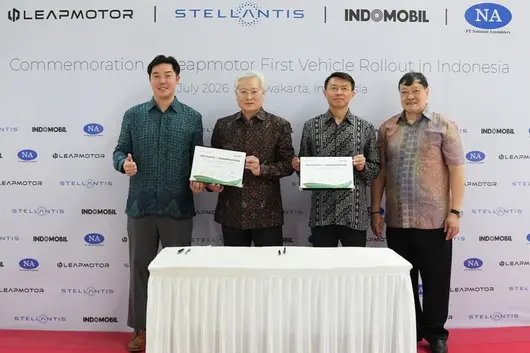
2026 年 7 月,零跑携零跑 B10 及 C10 兩款全球車型,亮相 2026 印尼國際車展(GIIAS 2026),並正式宣佈登陸印尼市場。同日,零跑與印尼 Indomobil 集團共同宣佈,正式在印尼啟動本地化 KD 組裝生產,透過與 Indomobil 集團旗下 PT National Assemblers 深度合作,為印尼消費者帶來卓越的智能出行體驗。
雙車首發,B10 與 C10 亮相印尼

此次在 2026 印尼國際車展展出的兩款全球戰略車型——零跑 B10 和 C10,均體現了零跑「全域自研」的核心優勢——零跑自主研發超過整車成本 65% 的車輛核心部件,包括電驅、電池系統、智能座艙和電子電氣架構。這種高度的垂直整合能力,使零跑能夠從設計到生產持續優化成本,並快速推動技術創新。
伴隨印尼市場日益增長的家庭用車需求,零跑 B10 和 C10 將憑藉豐富的智能化配置和出色的空間表現,為當地消費者帶來高品質電動出行體驗。
本地化製造落地,KD 工廠正式投產

零跑與 Indomobil 集團旗下 PT National Assemblers 合作,目前已在印尼啟動本地化 KD 組裝生產。印尼 KD 工廠已於 2026 年 4 月正式投入營運,首批下線的零跑 B10 和 C10 車型預計從 8 月起開始交付。

隨著印尼 KD 工廠的正式投產,零跑形成馬來西亞 - 印尼本地化製造格局,成為東南亞少數擁有雙 KD 生產基地的新能源汽車品牌,為下一步輻射整個東盟市場奠定了堅實的製造基礎。零跑汽車在印尼的本地化佈局,不僅能夠快速響應市場需求,也將為當地創造技術型就業崗位,推動供應鏈本地化發展。
Stellantis 與 Indomobil 雙重助力,構建完整銷售服務體系

零跑將印尼視為東南亞區域製造與增長的重要基地。憑藉 Stellantis 品牌之家(Stellantis Brand House)模式,零跑將與 Jeep、Citroën 等品牌同店銷售,為消費者提供一站式銷售與售後服務體驗。得益於 Indomobil 集團覆蓋全國的分銷網絡和零售體系,零跑當地的銷售與網絡發展將由 PT Indomobil National Distributor 負責,並計劃到 2026 年底在印尼建成 50 家銷售與服務網點。
零跑進入印尼市場,是與 Stellantis 全球戰略合作的又一重要成果。目前,零跑業務已拓展至全球超過 40 個國家,擁有超過 2000 家銷售網點,全球累計交付量已突破 150 萬輛。隨著本地化 KD 生產的逐步推進和產品線的不斷豐富,零跑計劃每年推出一款新車型,持續為印尼及周边市場帶來更多搭載前沿技術的電動車型。
零跑堅持核心技術全域自研。未來,零跑將繼續深化與 Stellantis 及本地合作夥伴的戰略協同,以印尼為支點,加速構建覆蓋東南亞的電動出行生態,讓更多消費者享受到科技普惠帶來的綠色智能出行新生活。