


首頁語言

搜尋歷史
熱門搜尋
經銷商登入 / 註冊

“Bring In” and “Go Out”, China’s Auto Industry Starts Reaping Benefits from Both Ends
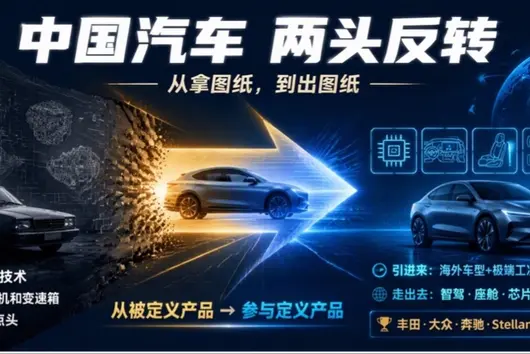
40 years ago, China’s auto industry traded market access for technology; joint venture factories installed foreign engines and transmissions; model updates and pricing required external approval. Now, this trend is reversing at both ends.
China’s auto industry begins “Bring In” and “Go Out”.
The “Bring In” dimension involves taking models released and verified overseas back to sell domestically, moving extreme working conditions, design talent, and certification standards back together.
The “Go Out” dimension involves selling smart driving, cockpits, chips, chassis, and the entire industry chain; Toyota, Volkswagen, Mercedes-Benz, and Stellantis have all started buying Chinese solutions.
The position of China’s auto industry in the global division of labor has adjusted, shifting from the party receiving blueprints to the party providing them, from products defined by others to participating in product definition.

However, the profit structure of domestic brands has not been effectively improved with adjustments in production, sales, and supply chains. Data from the China Association of Automobile Manufacturers (Jan-Sept not yet released) shows exports from Jan to Aug were 7.153 million units, a YoY increase of 66.7%, exceeding last year’s full-year 7.098 million units; but the industry profit margin in the first half was about 3.8%, with the vehicle manufacturing segment at only 1.5%, a new low for the past decade.
Scale and technology are two different things, money is the third thing; the more sold in exports, the more profit isn’t necessarily higher.
"Overseas Returns" have become a popular strategy
When the Chery Fengyun T7 launched, Chery presented not a spec sheet but a verification list: 81 dedicated durability test cars ran 1.45 million km of special durability tests; overall vehicle comprehensive road tests reached 6 million km; temperature range from minus 40°C to 55°C. This car launched domestically only on August 26, while its homologous model Lepas L6 had already been sold in South Africa and Thailand earlier, entering Indonesia, the EU, and the UK from August. The conditions in the list are also overseas data: high-speed bumps in Brazil, high-curvature bends at 180 km/h on German Autobahns, 40°C scorching sun in the Middle East. For detailed content, read our special feature article "Chery Fengyun T7 Returns from Global Trial, Exclusive Swap Price from 94,900 Yuan for Official Launch".
BYD Denza Z launched at the Goodwood Festival of Speed in the UK on July 9, with pre-sales opening domestically only on July 13. Overseas price ranges from 142,900 to 172,900 GBP, roughly triple the domestic price. The Fang Cheng Bao Shark earlier premiered globally as the BYD SHARK 6 at the Mexico launch in May 2024, later entering Australia, Brazil, and the Middle East, only appearing in MIIT declarations and being incorporated into Fang Cheng Bao this July. The domestic version max speed reaches 180 km/h, one level higher than the overseas version’s 160 km/h; what is brought back is the strengthened version, not a downgraded one. Geely’s Lynk & Co Z20 followed the same path, making its global debut in Milan in October 2024 and announcing its European launch, priced at 35,495 Euros, brought back to the domestic market within a year.
Why bring things back? Chery’s own sales volume speaks most plainly. In the first three quarters of 2026, Chery Group exported about 1.55 million units, a 65.6% YoY increase; September single-month exports reached 208,000 units, a new record for single-month exports by Chinese automakers, with exports accounting for over 70% of total sales; domestic sales calculated as total sales minus exports were about 656,000 units, a drop of about 40% YoY. First-half revenue from the Chinese market dropped from 76.055 billion yuan to 44.312 billion yuan; overseas revenue was 98.968 billion yuan, accounting for 69.1% of total revenue. Domestic is dropping, overseas is rising; bringing back brands and products established overseas has become the most hassle-free path. OMODA and JAECOO, which focus on overseas markets, are also planning to return; selling products that have been fully verified and achieved success overseas in the domestic market is also highly topical in marketing.
Previously, export-turned-domestic sales were for clearing inventory; now, what was honed overseas has become a selling point domestically; R&D sequence has changed; Chinese automakers can finally treat global standards as a starting point rather than an endpoint.
It’s not just vehicle models that are being brought in
Hainan established China’s first export vehicle type approval and humid-warm road test base on July 9. 40% steep slopes and bumpy roads simulating Mexican road conditions were brought in; equivalent testing can be done without leaving the country; testing costs dropped by nearly half, effectively moving the entire overseas humid-warm working condition segment back domestically.
BYD’s foreign design iron triangle is equally clever. Former Audi Design Director Ettinger, former Mercedes-Benz Interior Design Director Paganetti, former Ferrari Exterior Design Director Lopez; Ettinger output the Dragon Face design language within less than half a year of joining. What Chinese brands paid for wasn’t just a few renderings, but the qualification to participate in defining global aesthetics.
Results from overseas R&D centers are also turning back; Chery set up the Raunheim R&D Center near Frankfurt. Yin Tongyue’s view is he hopes cars from Chery there are more German than German cars. What Lynk & Co brought back from the track is equally hardcore; starting WTCR in 2019, accumulating 9 championships in 7 years by 2025; released the world’s first mass-produced TCR racing car of a Chinese brand, Lynk & Co 03+ TCR, in December 2025, priced at 1.4 million yuan, started the Nürburgring 24 Hours in 2026. Data and driver feedback from the races and teams were systematically fed back to the R&D department.
Easier to understand when applied to products; BYD made a K-Car RACCO for the Japanese market with integrated tray tables in the seat back.
Whether global stories can be directly converted into sales figures is currently hard to say. CACSI 2025 data from the China Association for Quality shows the weight of high brand awareness in purchase consideration factors has dropped for three consecutive years, declining 6 percentage points in 2025 compared to 2023. The driving effect of perceived quality on satisfaction exceeded brand image for the first time since 2017. Awareness can be raised through storytelling; satisfaction must rely on perceived quality.
Chinese Parts Installed in Joint Venture Factories
Laying out the parts list for GAC Toyota Bozhi 3X reveals it is hard to say which country this car is from. There are 106 Chinese brand suppliers, accounting for 65%. Among all 1,009 parts, imported parts account for only 1%. Voice is iFlytek Spark, LiDAR is Hesai ATX, Smart driving algorithm is Momenta, Domain controller is Desay SV.
The proportion of Chinese parts in this car, according to the Nikkei Asian Review quoting analysts, is speculated to be close to 90%, but Toyota denies it. The situation with the bZ7 is even more complex; according to Nikkei, its Japanese parts account for 30%, an increase rather than a decrease compared to the previous generation, but looking at intelligent configurations, it is indeed more aggressive, using Huawei Harmony Cockpit, Huawei Motors, and Xiaomi Human-Car-Home ecosystem. On September 16, Honda China Executive Vice President Hiroshi Ito said that the localization procurement rate for models launched in China in 2028 is planned to rise to over 99%; strategic cooperation agreements have already been signed with Momenta and Huawei respectively, to be introduced starting with 2027 models. Hiroshi Ito added a limitation to this statement himself; 99% is just a target, Honda is not fixed on the number itself, local suppliers are not limited to Chinese companies; as long as they can provide cost competitiveness locally in China, they are within scope. GM’s localization rate in China’s supply chain has already exceeded 95%; Volkswagen’s localization parts rate exceeds 90%. Lexus Shanghai factory started construction in June, production starts autumn 2027; total investment about 14.6 billion yuan. This is Toyota’s first overseas 100% wholly-owned integrated base for pure electric vehicles and batteries; target local parts usage rate is over 95%.
In terms of intelligence, it is even more thorough; cars sold by foreign brands in China are beginning to replace smart driving and large models with Chinese ones. Audi splits into two lines here; four-ring branded Q6L e-tron, A5L, and Q5L are equipped with Huawei Qiankun; A5L Sportback is the world’s first fuel vehicle equipped with Huawei Qiankun; alphabetic branded AUDI E5 Sportback and E7X are entrusted to Momenta; cockpits access ByteDance’s Doubao large model. Mercedes-Benz’s approach is similar; the MB.OS of the all-new pure electric GLC SUV deeply integrates Doubao AI large model; smart driving uses Momenta’s solution. When the two parties signed a upgrade cooperation memorandum in Beijing in February 2026, German Chancellor Merz test-rode the new S-Class, leaving a comment: “Glad to see the tight integration between German manufacturers and Chinese technology.” Mercedes-Benz’s performance in the domestic market is elaborated in detail in “Lost and Self-Salvage, Mercedes-Benz at the Crossroads of the Chinese Market”.
These parts are not only used in China; Toyota promoted Chinese interior material supplier Wuhu Yuefei in Thailand; the two enterprises had already set up a joint venture company in Thailand in January 2025. Toyota plans to start purchasing Chinese parts on new electric vehicles in Thailand from 2028, and also recommends Japanese suppliers adopt products from Zhejiang Kaihua Mold and Kingfa Science & Technology. Chinese supply chains are going overseas with the foreign enterprise’s global map, which is much bigger than grabbing Japanese orders in China.
Whether reverse adoption can continue, analyst Tadashi Nakanishi of China-West Automotive Industry Research gave another explanation; Japanese vehicle factories increasing Chinese parts intends to awaken Japanese parts manufacturers, allowing them to be exercised. If true, this is just phased pressure, not a permanent shift. Although there are examples of Japanese companies taking Chinese orders in reverse, Toyota has already received airbag orders from IM Motors. Nissan N7 is another reminder; GLOCAL mode, China team led development, Momenta smart driving, Qualcomm 8295P cockpit, orders in 1 hour after launch 10,138 units, but monthly sales dropped from 10,148 units in August 2025 to 928 units in August 2026; changing the supply chain alone cannot save product strength.
If parts can enter foreign factories, the next step is whether the technology itself can be sold.
Japanese Brands Installed with Chinese Chips
On February 20, Nikkei disclosed that Toyota and Suzuki have confirmed adopting Horizon Robotics’ Journey 6B in global markets outside China; replaced are Renesas R-CAR and Mobileye EyeQ. Suzuki implemented first in India, Toyota plans scaled promotion from 2028 to 2029. This path relies on Tier 1 endorsement; Bosch changed the main control chip of the next-generation multi-function camera from Renesas to Horizon Robotics; Horizon Robotics and Denso jointly adapt to the Toyota system. This is the first time Chinese smart driving chips enter Toyota and Suzuki’s overseas supply chains; Japanese brands using Chinese chips in the Chinese market has long happened.
Harder evidence than Japanese media is in Horizon Robotics’ semi-annual report. Journey 6B achieved global premiere production on GAC Toyota models; lifecycle fixed points broke through 20 million units; already obtained fixed points from over 25 mainstream global automakers; forward-looking integrated machine based on Journey 6B secured a global platform fixed point from a certain major German automotive group, sold to Australia, New Zealand, and India. Getting an order for one model and being written into the other party’s platform architecture have completely different gold content; the latter means this Chinese supplier walks with the other party’s global models together.
Volkswagen goes deeper than Japanese brands. Co-engineering program established in November 2023; CARIAD and Horizon Robotics hold 60% and 40% stakes respectively. July 22 deepened to white-box authorization; Volkswagen obtained Horizon Robotics AI base large model underlying architecture permissions for self-developed L3 and L4. Hesai supplying Mercedes-Benz has been officially announced; Q1 report on May 19 confirmed becoming Mercedes-Benz LiDAR strategic partner, supplying its L3 autonomous driving vehicles, covering Europe and China; capacity provided by Thailand Galileo Manufacturing Center. Horizon Robotics indeed has more ideas “After 15 Million Chips, Horizon Robotics Wants to Sell More Than Just Chips”, this article details the cooperation details between Horizon Robotics and Volkswagen and Horizon Robotics’ thoughts.
Regarding cockpits, Ecarx obtained Volkswagen Group fixed point in March 2025, supplying global models for Volkswagen and Skoda; first batch landed in Brazil and India. iFlytek secured Honda’s overseas interaction project in Thailand in May; this is the first time overseas Japanese car companies are provided with smart cockpit solutions by Chinese AI enterprises.
On September 30, JAC Motors released an announcement on abnormal stock price fluctuation; after verification, the company and Huawei, Stellantis indeed have cooperation intentions, but cooperation content, form, etc., are not yet confirmed, nor any binding formal agreements signed; future promotion exists with great uncertainty. Rumors circulated for nearly a month; this is the first official document from the parties involved. According to Reuters and Italian media, the discussed solution is to install Huawei Harmony Smart Cockpit platform into Maserati; JAC relies on Hefei’s Zunjie factory to undertake manufacturing; China market挂着 Zunjie, overseas market挂着 Trident; target to launch the first joint-development mass-produced vehicle by end of 2027. Stellantis APAC Communications Vice President Wang Chao stated twice to the outside world that they do not comment on market rumors; Maserati’s complete strategy will be announced only on December Modena Investor Day.
An Italian ultra-luxury brand wants to turn around by borrowing China’s smart driving platform and manufacturing platform; from selling a single chip to selling a whole car platform; what separates them is not just technology.
How to Collect Money from Selling Technology
XPeng holds the most complete financial sample currently; service and other revenue rose from 5.037 billion yuan in 2024 to 8.341 billion yuan in 2025; Q2 2026 single quarter 2.7 billion yuan; gross margin 75.1%; service business gross profit in the quarter was about 2.03 billion yuan, already close to the same period’s car selling gross profit of 2.06 billion yuan. In March 2026, He Xiaopeng announced Volkswagen became the first customer for XPeng’s second-generation VLA; a detail he mentioned is more interesting than numbers; before investing in XPeng, Volkswagen bought an XPeng car, drove about 500,000 km, then dismantled it, watched thoroughly, then came back to talk.
CATL is taking another path; LRS model invests no money, holds no equity, only outputs technology licenses, engineering training, and manufacturing process support; collects patent licensing fees and technical service fees. After Ford’s European electric vehicle project adopted this model, battery costs dropped 22% compared to self-developed solutions. Zeng Yuqun’s statement is: “We will sell Chinese products to the whole world, and we will also promote technology and standards to the whole world.” Panshi Chassis cooperation with Turkey’s Togg opened a new dimension; signed April 29; jointly developed 3 B-class cars; first mass-produced in 2027; CATL’s own qualitative definition is the first project in China’s auto industry to supply integrated intelligent chassis hardware overseas.
Leapmotor and Stellantis have used the joint venture model from 40 years ago in reverse. In October 2023, Stellantis acquired about 21% of Leapmotor for 1.5 billion euros, established LPMI held 51% by Stellantis, enjoying exclusive sales and manufacturing rights outside Greater China; deepened further in May this year; Zaragoza factory added production line to produce Opel C-class pure electric SUV based on Leapmotor architecture; development cycle less than two years; Leapmotor International has achieved profitability. Zhu Jiangming spoke more plainly; 40 years ago China developed auto industry hoping foreign automakers would joint venture operate; now we go out, also adopt this model. SAIC-GM’s contract extension signed until 2047, signed August 5, 2026; cooperation focus shifted from technology introduction, scale manufacturing to local decision making, capability co-building, from meeting China market to serving global market; landing point is Buick Zhijing E7 officially exported overseas in October 2026.
Audi simply moved the R&D center here; Innovation Technology Center AITC established September 3, 2026; about 300 people; this is Audi’s first overseas intelligent electric technology center; results are reversely supplied to Audi global model R&D system.
Technology service fees are not affected by price wars, not constrained by production capacity, nor limited by tariff barriers; for the first time, money of this nature appears in the revenue structure of Chinese automakers.
Making Money Going Overseas is Not Easy
First half of 2026 China auto industry overall profit margin about 3.8%; vehicle manufacturing segment low to 1.5%, new low for nearly ten years, while 2017 profit margin was still 8%.
Domeestic market is getting more competitive; going overseas is an inevitable choice; can boost sales volume, and also rely on healthier overseas competition environment to bring better profit margins.

However tariffs and technology barriers are rising simultaneously; Brazil in August raised electric and hybrid vehicle import tariffs to 35% cap; EU countervailing final ruling rates: SAIC 45.3%, Geely 28.8%, BYD 27%; January 2026 China-EU reached consensus on price commitment; July plans to expand scope from pure electric to plug-in hybrid; US BIS connected car rules software from 2027 model, hardware from 2030 model comprehensive prohibition. MIT calculated that if completely divest Chinese supply chain, single vehicle comprehensive cost rises 30% to 50%.
Cultural shock is hidden in finer places; in University of Leeds 2026 survey of eight countries, 93% of Chinese respondents held positive attitudes towards autonomous driving, skeptics only 1%; UK and US each had 40% and 41% people holding skeptical attitudes.
If one enterprise has problems, the impact may not be on a single enterprise, but on the entire China auto industry brand.
Sharp Perspective: The Second Half of Going Overseas is Reaping Benefits from Both Ends
Cars and technology are simultaneously moving back and out; the market-for-technology from 40 years ago is being rewritten in reverse; Toyota is using Chinese chips; Volkswagen is using Chinese architectures.
What Chinese auto enterprises can offer now is different from ten years ago; on development cycle, McKinsey’s data says Chinese automakers 20 to 24 months, Western automakers 40 to 50 months; on cost, material and capital expenditure are both about 30% lower; behind stands the world’s largest verification field. Volkswagen’s R&D cycle in China shortened 30%; platform development cost reduced 50%; this is admitted by Oliver Blume himself.
Scale has arrived, system has not yet; after-sales, cross-cultural marketing, high-end brand accumulation are the three weaknesses of Chinese brands overseas.
Volkswagen’s Oliver Blume says China is like a gym for the auto industry; nowhere else can see such fast technology iteration and demand changes. Whether things trained in this gym can be sold to the whole world depends on whether in the next three to five years we can turn selling products into building systems.

In the Malaysia SUV market, many buyers often compare Toyota Corolla Cross and Kia Sportage when choosing a car. Both cars are quite close in price and positioning. Today we will make a detailed comparison from multiple aspects to help you save time on research.
The OTR price of Toyota Corolla Cross in Malaysia is RM 133,800 - 148,800. There are 3 versions in total, including 2026 HEV 1.8L GR Sport (RM 148,800), 2026 HEV 1.8L Standard (RM 140,800), 2026 1.8L Standard (RM 133,800), etc.
The OTR price of Kia Sportage in Malaysia is RM 129,639 - 179,320. There are 4 versions in total, including 2025 1.6T DCT 4WD High (RM 179,320), 2025 1.6T DCT 2WD High (RM 159,320), 2025 2.0L AT 2WD High (RM 139,639), etc.
From a price perspective, the starting price of Kia Sportage is RM 4,161 cheaper than Toyota Corolla Cross. Honestly, in this price range, the difference of a few thousand is actually not significant; the key is still looking at overall value for money and long-term usage costs.

Toyota Corolla Cross body length is 4400 mm, trunk is 400 L.
Kia Sportage body length is 4400 mm, trunk is 400 L.
The dimensions of both cars are almost the same, with little difference in interior space. For cars in this class, daily use is completely sufficient.

Toyota Corolla Cross uses FWD drive system.
Kia Sportage uses FWD drive system.
Both cars have the same drive system, both are FWD, so there won't be a big difference in daily driving feel.

Toyota Corolla Cross and Kia Sportage are both mainstream choices in the Malaysian market, suitable for family use and daily commuting. If you value brand reputation and resale price more, you can prioritize the one with better reputation; if you care more about value and features, then choose the one with richer configurations. In the end, it is still recommended to test drive both cars, as hands-on experience is the most important.

In general, Toyota Corolla Cross and Kia Sportage are both quite good models in the Malaysian market. Which one to choose depends mainly on your personal needs and budget. We suggest doing your research well, comparing quotes from several dealerships, and then going for a test drive to make the final decision. Buying a car is a big matter, spending some time on research will never be wrong.


In Malaysia's SUV market, many buyers compare Toyota Corolla Cross and GWM Haval H6 when choosing a vehicle. These two models are quite close in price and positioning. Today, we will make a detailed comparison from multiple aspects to help you save time on research.
Toyota Corolla Cross's OTR price in Malaysia is RM 133,800 - 148,800, with a total of 3 versions, including 2026 HEV 1.8L GR Sport (RM 148,800), 2026 HEV 1.8L Standard (RM 140,800), 2026 1.8L Standard (RM 133,800), etc.
GWM Haval H6's OTR price in Malaysia is RM 139,750 - 139,750, with a total of 2 versions, including 1.5L Turbo Standard (RM 140,000), 1.5L Turbo Premium (RM 155,000), etc.
In terms of price, Toyota Corolla Cross's starting price is indeed RM 5,950 cheaper than GWM Haval H6. If your budget is limited, Toyota's entry-level version can already meet daily needs. However, be aware, the savings of a few thousand might involve trade-offs in features, depending on your specific requirements.
Toyota Corolla Cross body length is 4400 mm, trunk 400 L.
GWM Haval H6 body length is 4400 mm, trunk 400 L.
The dimensions of both cars are almost identical, interior space differences are minimal. Cars of this level are fully sufficient for daily use.
Toyota Corolla Cross adopts FWD drive mode.
GWM Haval H6 adopts FWD drive mode.
Both cars use the same drive mode, FWD, so the daily driving experience will not differ much.
Both Toyota Corolla Cross and GWM Haval H6 are mainstream choices in the Malaysian market, suitable for family use and daily commuting. If you value brand reputation and resale value more, you can prioritize the one with a better reputation; if you care more about value for money and features, then choose the one with richer configurations. Ultimately, it is recommended to test drive both models; personal experience is the most important.
Overall, Toyota Corolla Cross and GWM Haval H6 are both excellent models in the Malaysian market. Which one to choose depends mainly on your personal needs and budget. It is recommended to do your research, compare quotes from several dealers, and then test drive to make a final decision. Buying a car is a major matter, spending time on research will definitely not be wrong.

In Malaysia's SUV market, many buyers compare the Toyota Yaris Cross and Chery Tiggo 7 Pro when choosing a car. These two models are quite close in price and positioning. Today, we will make a detailed comparison from multiple aspects to help you save time on research.
The OTR price of Toyota Yaris Cross in Malaysia is RM 99,900 - 109,900, with a total of 2 versions, including 2026 1.5L Standard (RM 99,900), 2026 HEV 1.5L Standard (RM 109,900), etc.
The OTR price of Chery Tiggo 7 Pro in Malaysia is RM 123,750 - 123,750, with a total of 2 versions, including 1.6L Turbo Standard (RM 125,000), 1.6L Turbo Premium (RM 140,000), etc.
Looking at the price, the starting price of Toyota Yaris Cross is indeed RM 23,850 cheaper than Chery Tiggo 7 Pro. If your budget is limited, Toyota's entry-level version can already meet daily needs. However, note that the few thousand ringgit difference might involve trade-offs in features, depending on your specific needs.

Toyota Yaris Cross body length is 4400 mm, trunk 400 L.
Chery Tiggo 7 Pro body length is 4400 mm, trunk 400 L.
The dimensions of both cars are almost identical, and the interior space difference is not significant. Cars in this class are completely sufficient for daily use.

Toyota Yaris Cross warranty 5 years/unlimited mileage, maintenance interval every 10,000km or 6 months.
Chery Tiggo 7 Pro warranty 3 years/100,000km, maintenance interval every 10,000km or 6 months.

Both Toyota Yaris Cross and Chery Tiggo 7 Pro are mainstream choices in the Malaysian market, suitable for family use and daily commuting. If you value brand reputation and resale value more, you can prioritize the one with better reputation; if you care more about value for money and features, choose the one with richer configuration. Ultimately, it is recommended to test drive both models, as personal experience is the most important.
Overall, both Toyota Yaris Cross and Chery Tiggo 7 Pro are very good models in the Malaysian market. Which one to choose depends mainly on your personal needs and budget. It is recommended that everyone do their research, compare quotes from several dealerships, and then test drive to make a final decision. Buying a car is a major decision, spending time on research will definitely not be wrong.


喺馬來西亞嘅 SUV 市場,好多買家喺揀車嘅時候都會拿本田 CR-V 同福特 Everest 做比較。這兩款車喺價錢同定位上都啱啱好,而家我哋就從多個方面做一個詳細嘅對比,幫你節省做功課嘅時間。
本田 CR-V 喺馬來西亞嘅 OTR 售價係 RM 178,200 - 195,900,合共有 4 個版本,包括 2026 e:HEV 2.0L 2WD RS(RM 195,900)、2026 1.5T 4WD V(RM 181,900)、2026 e:HEV 2.0L 2WD E(RM 178,200) 等。
福特 Everest 喺馬來西亞嘅 OTR 售價係 RM 266,338 - 430,838,合共有 6 個版本,包括 2026 3.0T 4WD Platinum(RM 430,838)、2026 2.0T 4WD Platinum(RM 348,838)、2026 2.0T 4WD Sport(RM 316,838) 等。
從價錢來看,本田 CR-V 嘅起步價確實比福特 Everest 平咗 RM 88,138。如果你預算有限,本田嘅入門版已經可以滿足日常需要。但都要注意,嗰幾千塊,可能喺配備上會有取舍,具體睇你嘅需要。

本田 CR-V 裝載 2.0L 4 缸,馬力 170 hp。官方油耗 8.0 L/100km。
福特 Everest 裝載 2.5L 柴油,馬力 187 hp。官方油耗 8.5 L/100km。
動力方面,福特 Everest 嘅 2.5L 柴油比本田 CR-V 嘅 2.0L 4 缸多咗 17 匹馬力。不過日常喺市區行,兩款車嘅動力都夠用,唔會覺得唔夠力。

本田 CR-V 嘅安全評級係 5★ (ASEAN NCAP),主動安全系統包括本田 SENSING (ACC, CMBS, LKAS, RDM)。
福特 Everest 嘅安全評級係 5★ (ASEAN NCAP),主動安全系統包括 Co-Pilot360。
兩款車嘅安全評級一樣,喺呢個級別入面安全配備都算畀好齊全咗。而家嘅新車安全性都唔差,唔使太擔心這一點。

本田 CR-V 採用 FWD 驅動方式。
福特 Everest 採用 FWD 驅動方式。
兩款車嘅驅動方式一樣,都係 FWD,日常駕駛感受唔會有太大分別。

總體嚟講,本田 CR-V 同福特 Everest 都係馬來西亞市場好唔錯嘅車型。揀邊一辆,關鍵始終係睇你嘅個人需求同預算。建議大家做足功課,多比較幾間車行嘅報價,再去試駕先做最終決定。買車係件大事,花少少時間做功課絕對無錯。


In the Malaysian SUV market, many buyers compare the Honda CR-V and Chery Tiggo 7 Pro when selecting a car. These two cars are quite close in price and positioning. Today we will do a detailed comparison from multiple aspects to help you save time on research.
The OTR price of Honda CR-V in Malaysia is RM 178,200 - 195,900, with a total of 4 versions, including 2026 e:HEV 2.0L 2WD RS (RM 195,900), 2026 1.5T 4WD V (RM 181,900), 2026 e:HEV 2.0L 2WD E (RM 178,200), etc.
The OTR price of Chery Tiggo 7 Pro in Malaysia is RM 123,750 - 123,750, with a total of 2 versions, including 1.6L Turbo Standard (RM 125,000), 1.6L Turbo Premium (RM 140,000), etc.
From a price perspective, the starting price of Chery Tiggo 7 Pro is RM 54,450 cheaper than Honda CR-V. To be honest, at this price segment, a difference of a few thousand is actually not that big; the key still lies in the overall cost-performance ratio and long-term usage costs.
Honda CR-V is equipped with a 2.0L 4-cyl, 170 hp. Official fuel consumption 8.0 L/100km.
Chery Tiggo 7 Pro is equipped with a 1.5L Turbo, 140 hp. Official fuel consumption 7.0 L/100km.
In terms of power, the 2.0L 4-cyl of Honda CR-V has 30 more horsepower than the 1.5L Turbo of Chery Tiggo 7 Pro, providing more confidence in mid-range acceleration, especially when overtaking on highways. However, the fuel consumption of Chery Tiggo 7 Pro may be more user-friendly, and the difference in daily city commuting will not be too significant.
The safety rating of Honda CR-V is 5★ (ASEAN NCAP), and active safety systems include Honda SENSING (ACC, CMBS, LKAS, RDM).
The safety rating of Chery Tiggo 7 Pro is TBD, and active safety systems include Basic.
Regarding safety features, both cars have received good ratings. However, the Honda SENSING (ACC, CMBS, LKAS, RDM) of Honda CR-V and the Basic of Chery Tiggo 7 Pro have some differences in functions. If you value active safety more, you can compare the function lists of both carefully.
Honda CR-V body length is 4500 mm, trunk 450 L.
Chery Tiggo 7 Pro body length is 4400 mm, trunk 400 L.
Regarding space, the body of Honda CR-V is 100 mm longer than Chery Tiggo 7 Pro, the interior seating space will be slightly more spacious, especially rear legroom. If you frequently carry family members or need to put in a stroller, a slightly larger body is indeed more practical.
Honda CR-V and Chery Tiggo 7 Pro are both mainstream choices in the Malaysian market, suitable for family use and daily commuting. If you value brand reputation and resale value more, you can prioritize the one with better reputation; if you care more about cost-performance and features, choose the one with richer configuration. In the end, it is suggested to test drive both; personal experience is the most important.
Overall, Honda CR-V and Chery Tiggo 7 Pro are both very good models in the Malaysian market. Which one to choose, the key still depends on your personal needs and budget. It is recommended to do research, compare quotes from several car dealers, and then go for a test drive to make the final decision. Buying a car is a major event, spending some time on research will definitely not be wrong.


