首頁怒江

搜尋歷史
熱門搜尋
經銷商登入 / 註冊
In the Malaysian SUV market, many buyers compare the Honda WR-V and Mazda CX-30 when choosing a car. These two cars are quite close in price and positioning, so today we will do a detailed comparison from multiple aspects to help you save time on research.
The OTR price of the Honda WR-V in Malaysia is RM 89,900 - 107,900, with a total of 4 versions, including 2023 1.5L V (RM 99,900), 2023 1.5L E (RM 95,900), 2023 1.5L S (RM 89,900), etc.
The OTR price of the Mazda CX-30 in Malaysia is RM 122,409 - 146,409, with a total of 4 versions, including 2025 2.0L High+ Premium (RM 146,409), 2025 2.0L High+ (RM 138,409), 2025 2.0L High (RM 130,409), etc.
In terms of price, the Honda WR-V is indeed RM 32,509 cheaper to start than the Mazda CX-30. If your budget is limited, the Honda entry-level version is already sufficient for daily needs. But keep in mind, that saving a few thousand ringgit might mean compromises in features, depending on your specific needs.

The Honda WR-V has a safety rating of 5★ (ASEAN NCAP), and the active safety system includes Honda SENSING.
The Mazda CX-30 has a safety rating of 5★ (ASEAN NCAP), and the active safety system includes i-Activsense.
Both cars have the same safety rating, and safety features in this class are quite comprehensive. Safety in new cars nowadays is generally not bad, so there is no need to worry too much about this point.

The Honda WR-V uses FWD drive method.
The Mazda CX-30 uses FWD drive method.
Both cars have the same drive method, both are FWD, so the driving experience in daily use should not differ much.

Both the Honda WR-V and Mazda CX-30 are mainstream choices in the Malaysian market, suitable for family use and daily commuting. If you value brand reputation and resale value more, you can prioritize the one with better reputation; if you care more about cost-performance ratio and features, choose the one with richer specifications. Ultimately, it is recommended to test drive both, as personal experience is the most important.

Overall, both the Honda WR-V and Mazda CX-30 are excellent models in the Malaysian market. Which one to choose depends mainly on your personal needs and budget. It is recommended to do your homework, compare quotes from several dealerships, and then test drive to make the final decision. Buying a car is a big matter, spending time doing research will never be wrong.


Have you noticed a strange phenomenon?
Nowadays, when browsing car news, the screen is full of "Heavyweight", "Shocking Launch", "Disruptive Breakthrough". Press conferences from various brands feel like rushing through appointments; one leaves the stage as another takes it. New car iterations are faster than smartphones; it seems anyone who lags half a beat will be eliminated.
But take a close look: From project initiation to delivery, a car takes only one or two years. In between, design, tooling, road testing, tuning, supply chain integration... can it really be refined thoroughly?
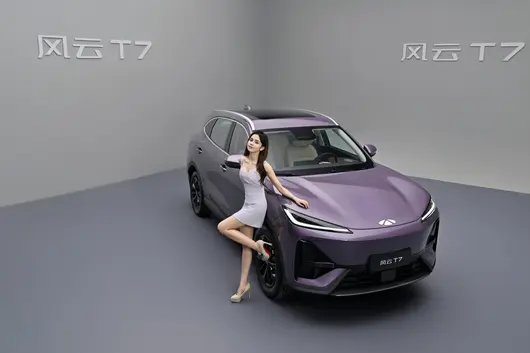
The industry is running, some are flying. But on August 12, the pre-sale launch of Chery Fengyun T7 had the theme — "Slow work makes a good car, sorry for the wait".
These six words, in this shortcut era, are like a bucket of cold water poured on boiling impetuousness.


I wasn't moved solely by its configuration. The entire lineup has a 600 km range, pre-sale price starting at 109,900 RMB, 80% high-strength steel, 9 airbags, 8775 Chip... These numbers are indeed impressive, but what moved me more was the unconventional path behind it.
The platform-sibling models of Fengyun T7 went to Milan Design Week first. Over 5,000 overseas users participated in co-creation, letting international aesthetics give a "stamp of approval" first, then returning to serve Chinese families. This logic is completely opposite to most brands who "sell explosively domestically first before considering going overseas".
Going in reverse is because it has something to fall back on — 23 years of Chery's global technical accumulation, 81 dedicated durability units undergoing simultaneous road testing, and cumulative whole-vehicle testing exceeding 6 million kilometers. Conducting extreme condition verification for Southeast Asian rainy seasons, Middle East high temperatures, and Indonesian high humidity, then bringing products that have undergone global "beatings" back home.


What do you call this? This is "Reverse Going Overseas".
I have seen too many brands treat "Global Car" as a marketing buzzword, but Fengyun T7 makes me feel it truly uses "Global" as a ruler to measure itself.
The second point that moved me is its precise grasp of the "dignity anxiety" of new middle-class families.
People buying cars today are no longer those from ten years ago who just wanted "any car", nor those from five years ago who just wanted "large enough screens". What they want is — dignity without worrying about breakdowns.
This dignity is: In winter in the north at -30°C, the heat pump AC still heats normally, no need to wrap in a down jacket to drive. On wet season flooded roads, IP68 waterproofing (96 times the national standard) lets you confidently drive through, without worrying about battery water ingress and stalling. After driving for a few years, interior leather hasn't hardened or faded, still looking new and durable. When the rear seats fold down to become a 1.9-meter flat bed, the composure to leave anytime on weekends.
These are not "fast variables" that can be flashed on a launch PPT, but "slow work" that requires time to settle.
What made me more emotional is its "laying out the ugly terms upfront" —
Power battery damaged due to thermal runaway caused by its own reasons? Compensate with a new car of the same model. Smart driving assistance causes an accident? Compensate up to 5 million RMB. Whole vehicle lifetime warranty includes the battery, motor, and electronic control systems, 666 RMB to buy lifetime basic maintenance.
Throwing out this combination of punches is not playing marketing gimmicks, but telling users: I am responsible for every single screw I build.


To be honest, in this era where "Software-Defined Vehicles" and "Monthly OTA Upgrades" become the main theme, I once doubted whether the "basic car-building skills" of traditional automakers were undervalued. Fengyun T7 showed me that the "old-fashioned hard work" of obsessing over chassis tuning, body stiffness, battery safety, and durability testing is still an unavoidable ruler for measuring the quality of a car.
Electrification is the first half, Intelligence is the second half. But no matter which half, safety, reliability, and durability are the eternal bottom line. This is not conservatism; it is respect for users' lives and time.
Of course, we welcome innovation and disruption. But when everyone chases trends, someone willing to bend down to lay the foundation, refine details, and write promises into contracts — this in itself is a scarce value.
Fengyun T7 made me rethink a question:
In this era pursuing "fast", "slow" instead became the greatest sincerity.


Pre-sale price starting at 109,900 RMB, it might not be the one with the flashiest specs, but it could very well be the one that makes you feel secure driving, comfortable sitting, and feeling "this money was well spent" even years later.
Sorry for the wait. But good food is never afraid of being late.
This car, I genuinely recommend to ordinary people who don't chase trends, don't join the crowd, just want to give their family a stable peace of mind. Because they know, the most expensive thing in life has never been the car, but peace of mind.

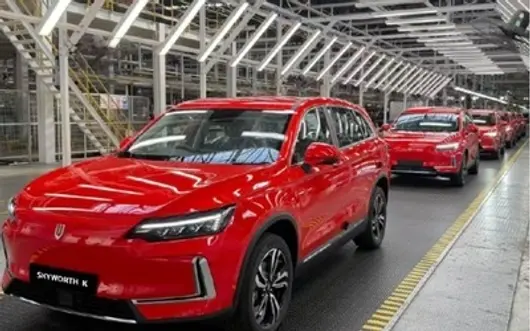
【CNMO科技消息】7月21日,创维汽车官方宣布,旗下SKYWORTH K车型正式下线,首批车辆将作为香港出租车投入运营,并计划于7月30日正式与公众见面。

创维汽车SKYWORTH K
从官方发布的信息来看,此次下线的SKYWORTH K将率先交付香港出租车运营市场。官方配文“满电集结,驰骋香江”表明,新车已经完成生产准备,即将开启交付流程。与此同时,创维汽车还公布了工厂下线现场照片,多辆新车整装待发,现场还打出“驰骋香江 创维汽车批量交付香港出租车”的横幅,标志着首批车辆已经进入交付阶段。

据CNMO科技了解,香港新能源汽车市场发展速度持续加快,政府也在积极推动公共交通电动化。出租车作为城市公共交通的重要组成部分,逐步向新能源车型转型已成为行业发展趋势。相比传统燃油出租车,纯电动车型在运营成本、能源消耗以及日常维护方面具备一定优势,同时也有助于降低城市碳排放,改善道路交通环境。
创维汽车K系列是创维汽车(Skyworth Auto)旗下的中型纯电动SUV车型。作为创维集团进军汽车产业的重要成果,该车系通过整合创维在家电与智能家居领域的生态优势,致力于打造“移动的第三空间”。
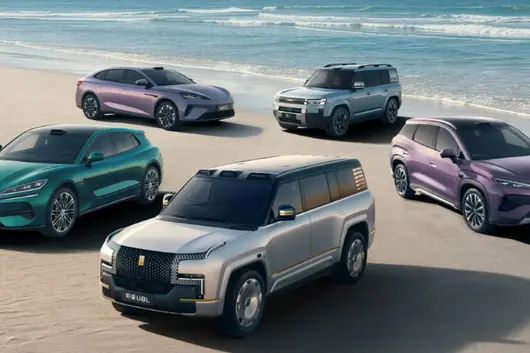
BYD officially released the May 2026 production and sales flash report, with new energy vehicles from all brands reaching a monthly sales volume of 383,453 vehicles, a slight increase of 0.26% year-on-year, achieving year-on-year positive growth in monthly sales after ten months; among them, passenger car deliveries reached 376,990 units, surging 19.4% month-on-month, wiping out the pain of previous model iterations, presenting a new pattern where the domestic base is stable, overseas sales are soaring, and high-end brands are scaling up across the board. Amidst the market environment of intensified competition in the domestic new energy sector, Tesla FSD entering China, and an intense launch of independent new products, it has forged a unique structural growth path.

The Dynasty and Ocean main brands combined sold 330,215 vehicles in May, accounting for over 80% of the group's total sales, remaining the stabilizer for BYD's sales volume. The full series had 8 models exceeding 20,000 units in monthly sales, covering products from 50,000 entry-level commuter to 200,000 home SUV.

Inside the Dynasty Network, the Yuan family sold 56,691 units, and the Song family 51,370 units. Both crossed the 50,000 threshold, becoming two major sales pillars for the brand, catering to home commuter and urban-rural travel needs; the Qin family followed closely with a stable performance of 28,360 units. The Han and Tang series maintained a volume in the six-thousand range, deeply cultivating the mid-to-large home sedan and SUV niche markets; the brand new model Xia is in the market cultivation phase, delivering 1,810 units monthly, with potential for steady volume growth as channels expand.
The Ocean Network's growth momentum is even more rapid, with 5 models entering the 20,000 club across the series: Sealion 42,615 units, Seal 34,117 units, Seagull 39,919 units, Dolphin 22,260 units, and Song PLUS 27,755 units. Among them, Seagull remains the best-selling entry-level commuter model thanks to its affordable pricing of 60,000-80,000. Sealion, as a new volume model, stands firm at the 40,000 level upon launch, filling the mid-size SUV product gap in the Ocean Network and perfecting the Ocean product tier layout. From commuter small cars to compact SUVs, the two main brands rely on DM-i hybrid and pure electric dual-line technologies to牢牢锁住 the mainstream home market share within 150,000 domestically.
Fang Cheng Bao Year-on-Year Surges 139.7%, Brand Upward Positioning Takes EffectThe high-end matrix of Denza, Fang Cheng Bao, and Yangwang sold a combined 46,489 vehicles in May, officially breaking away from the niche positioning to become a new pivot for BYD's brand premium and profit growth, breaking the industry curse of difficulty in high-end breakthrough for domestic brands.

The off-road brand Fang Cheng Bao sold 30,186 units monthly, surging 139.7% year-on-year, creating a new high in monthly sales since the brand launched. Its Titanium 7 model sold 18,280 units monthly, while Leopard 5 and Leopard 8 output remained stable, continuously squeezing the survival space for joint venture and imported models in the 250,000-400,000 hardcore off-road niche market.

Denza delivered 16,303 units in May, with the MPV benchmark D9 selling 6,721 units, and the Z9 series close to 6,000 units. MPV and mid-to-large sedan dual-line efforts helped them stand firm in the luxury new energy track; the million-level ultra-luxury brand Yangwang continued its steady climb, delivering 286 units that month, a year-on-year increase of 105.8%, completing market verification of the domestic brand ceiling product and forming a full price range product layout from 100,000+ home, 300,000-400,000 off-road, 500,000 luxury MPV to million-level flagship.

In May, BYD's overseas sales of passenger cars and pickup trucks reached 160,177 units, surging 80.7% year-on-year. Exports accounted for over 42% of the full series total sales, setting a new historical high for brand export and becoming the core driving force to stabilize May overall sales and achieve year-on-year positive growth.
Southeast Asia, Europe, and Latin America became the main incremental markets. Seagull, Song PLUS, and Yuan series continued to top new energy best-seller lists in multiple countries; the SHARK pickup truck exceeded 4,000 units in monthly exports for two consecutive months. Relying on the completion of localization production in Thailand, Brazil, Hungary, and Uzbekistan with four overseas vehicle factories, localized production continues to land, avoiding tariffs while rapidly penetrating terminal channels. Against the background of stock market competition in the domestic auto industry and normalized price wars, the rapidly expanding overseas market effectively counteracts sales volatility brought by domestic model iterations, officially upgrading from a supplementary market to BYD's core growth engine. As of now, BYD's global cumulative new energy vehicle sales have exceeded 16.5 million units, with the globalization map continuously broadening.
Intelligent Driving Empowers Product Iteration, H2 New Products Prepare to Surge VolumeMay marked a key node in BYD's intelligent driving landing, with the God's Eye intelligent driving system becoming a core bonus point for models: the number of vehicles with advanced intelligent driving across all brands exceeded 3.15 million, with daily road test data exceeding 200 million kilometers; that month, BYD implemented City Pilot and Smart Parking dual safety backup services, becoming the world's first auto manufacturer to achieve dual intelligent driving backups. Three days after policy implementation, the activation rate of models equipped with the God's Eye system in cities surged 50%. Intelligent driving experience upgrades directly drove in-store order conversion, solidifying product competitiveness for subsequent models to continue volume sales, and facing the intelligent driving market shock brought by FSD entering China.
From data details, BYD's cumulative sales from January to May 2026 were 1,405,039 units, down 20.32% year-on-year. The core reason is that the full series of main models were concentratedly iterated, and the capacity ramp-up of the 2nd Gen Fast Charge Blade Battery was restricted. The new Flash Charge Battery upgraded fast charging and low-temperature performance. Full series iteration models prioritized installing new batteries, but production line retrofitting dragged down capacity release. Order backlogs on popular models and delayed deliveries compressed the May delivery volume to a certain extent.
As the end of the second quarter approaches and the 2nd Gen Blade Battery capacity continues to release, coupled with new models such as Denza N8L, Fang Cheng Bao Titanium 7 Pure Electric Version, Sealion 05, and Xia L landing the market, the industry generally predicts that BYD's full brand sales in June are expected to exceed 400,000 vehicles. Relying on the four-dimension development logic of low-end volume locking share, high-end raising profit, overseas pushing volume, and intelligence improving product power, amidst the intensified new energy elimination round in the domestic market, BYD's full category layout advantage continues to amplify, securing its status as the domestic new energy leader, accelerating steadily towards global top auto manufacturers.